QUESTION IMAGE
Question
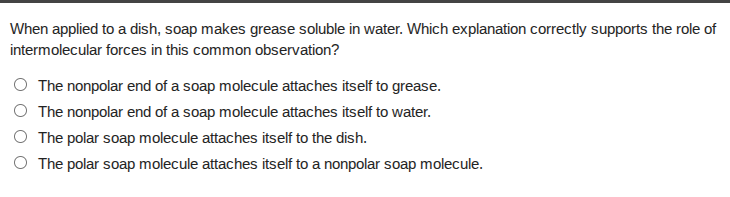
when applied to a dish, soap makes grease soluble in water. which explanation correctly supports the role of intermolecular forces in this common observation?
the nonpolar end of a soap molecule attaches itself to grease.
the nonpolar end of a soap molecule attaches itself to water.
the polar soap molecule attaches itself to the dish.
the polar soap molecule attaches itself to a nonpolar soap molecule.
Soap molecules have a nonpolar hydrocarbon tail and a polar carboxylate head. By the principle "like dissolves like," nonpolar grease interacts with the nonpolar end of the soap, while the polar end interacts with polar water, allowing grease to be dissolved and rinsed away. The other options are incorrect: nonpolar ends do not attach to polar water, soap molecules are amphipathic (not fully polar), and polar and nonpolar ends of soap molecules associate rather than polar-polar self-attachment for grease solubility.

Snap & solve any problem in the app
Get step-by-step solutions on Sovi AI
Photo-based solutions with guided steps
Explore more problems and detailed explanations
A. The nonpolar end of a soap molecule attaches itself to grease.