QUESTION IMAGE
Question
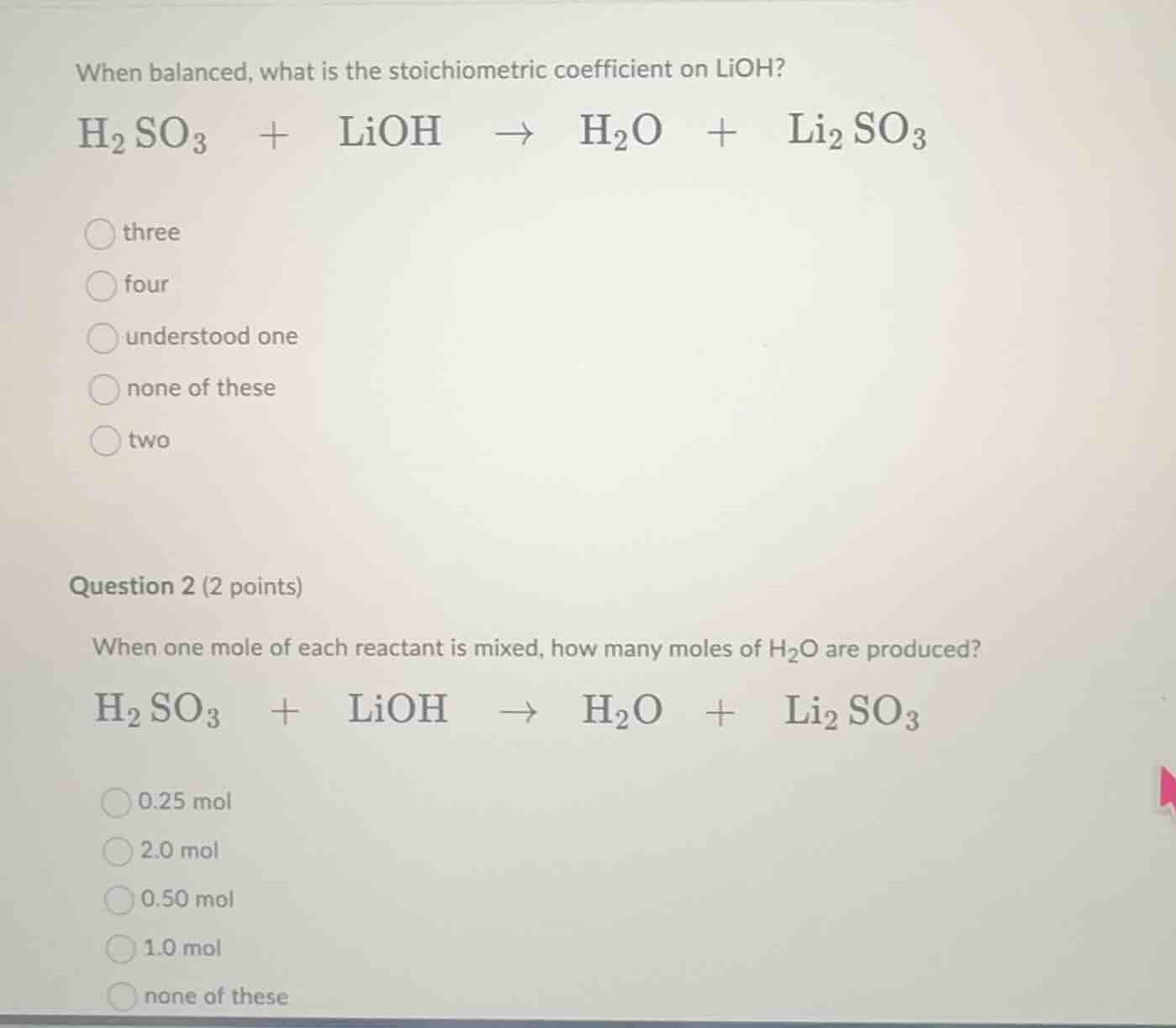
when balanced, what is the stoichiometric coefficient on lioh?\
$\ce{h_{2}so_{3} + lioh -> h_{2}o + li_{2}so_{3}}$\
\bigcirc three\
\bigcirc four\
\bigcirc understood one\
\bigcirc none of these\
\bigcirc two\
\
question 2 (2 points)\
when one mole of each reactant is mixed, how many moles of $\ce{h_{2}o}$ are produced?\
$\ce{h_{2}so_{3} + lioh -> h_{2}o + li_{2}so_{3}}$\
\bigcirc 0.25 mol\
\bigcirc 2.0 mol\
\bigcirc 0.50 mol\
\bigcirc 1.0 mol\
\bigcirc none of these
Question 1:
Step1: Balance the equation
We start with the unbalanced equation: $\ce{H_{2}SO_{3} + LiOH -> H_{2}O + Li_{2}SO_{3}}$.
First, look at the $\ce{Li}$ atoms. On the product side, $\ce{Li_{2}SO_{3}}$ has 2 $\ce{Li}$ atoms. So we need 2 $\ce{LiOH}$ on the reactant side to balance $\ce{Li}$:
$\ce{H_{2}SO_{3} + 2LiOH -> H_{2}O + Li_{2}SO_{3}}$.
Now check $\ce{H}$ and $\ce{O}$. On the reactant side, $\ce{H_{2}SO_{3}}$ has 2 $\ce{H}$, and $2\ce{LiOH}$ has 2 $\ce{H}$, so total $\ce{H}$ is 4. On the product side, $\ce{H_{2}O}$ has 2 $\ce{H}$ per molecule. To balance $\ce{H}$, we need 2 $\ce{H_{2}O}$ (since $2\times2 = 4$ $\ce{H}$). Let's check:
$\ce{H_{2}SO_{3} + 2LiOH -> 2H_{2}O + Li_{2}SO_{3}}$.
Now check $\ce{S}$: 1 on each side. $\ce{O}$: $\ce{H_{2}SO_{3}}$ has 3, $2\ce{LiOH}$ has 2, total 5. $\ce{2H_{2}O}$ has 2, $\ce{Li_{2}SO_{3}}$ has 3, total 5. So the balanced equation is $\ce{H_{2}SO_{3} + 2LiOH -> 2H_{2}O + Li_{2}SO_{3}}$. The coefficient for $\ce{LiOH}$ is 2.
Step1: Use the balanced equation
From the balanced equation $\ce{H_{2}SO_{3} + 2LiOH -> 2H_{2}O + Li_{2}SO_{3}}$, the mole ratio of $\ce{H_{2}SO_{3}}$ to $\ce{LiOH}$ is $1:2$.
Step2: Determine the limiting reactant
We have 1 mole of $\ce{H_{2}SO_{3}}$ and 1 mole of $\ce{LiOH}$. According to the ratio, 1 mole of $\ce{H_{2}SO_{3}}$ would require $2$ moles of $\ce{LiOH}$, but we only have 1 mole of $\ce{LiOH}$. So $\ce{LiOH}$ is the limiting reactant.
Step3: Calculate moles of $\ce{H_{2}O}$
The mole ratio of $\ce{LiOH}$ to $\ce{H_{2}O}$ is $2:2$ (or $1:1$). So 1 mole of $\ce{LiOH}$ will produce 1 mole of $\ce{H_{2}O}$? Wait, no. Wait the balanced equation is $\ce{H_{2}SO_{3} + 2LiOH -> 2H_{2}O + Li_{2}SO_{3}}$. So 2 moles of $\ce{LiOH}$ produce 2 moles of $\ce{H_{2}O}$ (ratio $2:2 = 1:1$). So 1 mole of $\ce{LiOH}$ (limiting) will produce 1 mole of $\ce{H_{2}O}$? Wait, no, wait: 2 moles $\ce{LiOH}$ → 2 moles $\ce{H_{2}O}$, so 1 mole $\ce{LiOH}$ → 1 mole $\ce{H_{2}O}$? Wait, no, let's check again. Wait the balanced equation: coefficients are 1, 2, 2, 1. So mole ratio $\ce{LiOH : H_{2}O} = 2:2 = 1:1$. So 1 mole $\ce{LiOH}$ → 1 mole $\ce{H_{2}O}$? Wait, but wait, the options include 1.0 mol? Wait no, wait the options are 0.25, 2.0, 0.50, 1.0, none. Wait maybe I made a mistake. Wait no, let's re-express:
Wait the balanced equation is $\ce{H_{2}SO_{3} + 2LiOH -> 2H_{2}O + Li_{2}SO_{3}}$. So moles of $\ce{LiOH}$ needed for 1 mole $\ce{H_{2}SO_{3}}$: 2. We have 1 mole $\ce{H_{2}SO_{3}}$ and 1 mole $\ce{LiOH}$. So $\ce{LiOH}$ is limiting (1 mole). The ratio of $\ce{LiOH}$ to $\ce{H_{2}O}$ is 2:2, so 1 mole $\ce{LiOH}$ produces 1 mole $\ce{H_{2}O}$? Wait but the options have 1.0 mol. Wait, but let's check again. Wait, no: 2 moles $\ce{LiOH}$ produce 2 moles $\ce{H_{2}O}$, so 1 mole $\ce{LiOH}$ produces 1 mole $\ce{H_{2}O}$. So the answer is 1.0 mol? Wait but the options include 1.0 mol. Wait, but maybe I messed up the balanced equation. Wait no, let's rebalance:
Original equation: $\ce{H_{2}SO_{3} + LiOH -> H_{2}O + Li_{2}SO_{3}}$.
Li: 1 on left, 2 on right → put 2 in front of LiOH: $\ce{H_{2}SO_{3} + 2LiOH -> H_{2}O + Li_{2}SO_{3}}$.
H: $\ce{H_{2}SO_{3}}$ has 2, 2LiOH has 2 → total 4. $\ce{H_{2}O}$ has 2 per molecule → need 2 $\ce{H_{2}O}$: $\ce{H_{2}SO_{3} + 2LiOH -> 2H_{2}O + Li_{2}SO_{3}}$.
Yes, that's correct. So mole ratio LiOH : H₂O is 2:2 = 1:1. So 1 mole LiOH (limiting) produces 1 mole H₂O. Wait but the options have 1.0 mol. Wait, but the options are 0.25, 2.0, 0.50, 1.0, none. So 1.0 mol is an option. Wait, but maybe I made a mistake. Wait, no: if we have 1 mole H₂SO₃ and 1 mole LiOH, LiOH is limiting (since 1 mole H₂SO₃ needs 2 moles LiOH). So moles of LiOH = 1, so moles of H₂O = (2 moles H₂O / 2 moles LiOH) × 1 mole LiOH = 1 mole. So the answer is 1.0 mol.

Snap & solve any problem in the app
Get step-by-step solutions on Sovi AI
Photo-based solutions with guided steps
Explore more problems and detailed explanations
two