QUESTION IMAGE
Question
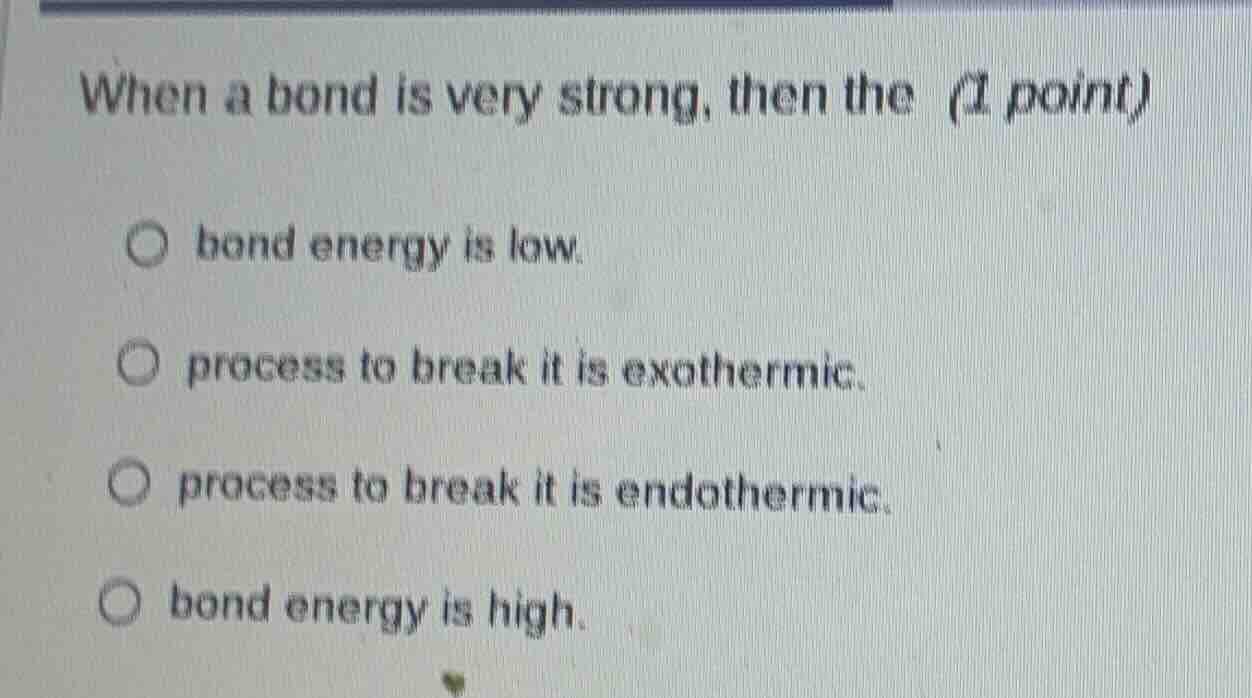
when a bond is very strong, then the (1 point)
bond energy is low.
process to break it is exothermic.
process to break it is endothermic.
bond energy is high.
- Option 1 (bond energy is low): Bond energy is the energy required to break a bond. A strong bond should require more energy to break, so its bond energy should be high, not low. Eliminate this.
- Option 2 (process to break it is exothermic): Breaking a bond requires energy input (endothermic), while forming a bond releases energy (exothermic). So breaking a strong bond is endothermic, not exothermic. Eliminate this.
- Option 3 (process to break it is endothermic): While breaking any bond is endothermic, the question is about the relationship between bond strength and bond energy (or the other options). The key here is the bond energy - a strong bond has high bond energy. This option is about the type of reaction (endothermic) which is true for bond breaking, but the more direct relationship with bond strength is bond energy. However, let's check option 4.
- Option 4 (bond energy is high): Bond energy is the energy needed to break a bond. A very strong bond means it takes a lot of energy to break it, so its bond energy is high. This directly relates bond strength to bond energy. Also, breaking a strong bond (high bond energy) is endothermic (option 3), but the question's options - the most direct consequence of a strong bond is high bond energy. Wait, but let's re - evaluate:
Wait, let's correct the earlier thought. The question is "When a bond is very strong, then the...". Let's recall:
- Bond energy: The amount of energy required to break a bond. A stronger bond requires more energy to break, so bond energy is high. So option 4 is correct.
- For bond breaking: Breaking a bond always requires energy, so it's endothermic (option 3 is also correct in terms of the process type, but the question's options - let's check the options again.
Wait, the options are:
- bond energy is low. (False)
- process to break it is exothermic. (False, bond breaking is endothermic)
- process to break it is endothermic. (True, because breaking a bond requires energy)
- bond energy is high. (True, because a strong bond needs more energy to break, so bond energy is high)
Wait, now there's a confusion. But let's check the definitions again.
Bond energy: The energy required to break one mole of bonds in the gas phase. A strong bond has a high bond energy because you need more energy to break it.
Bond breaking: Any bond breaking is endothermic (ΔH positive) because energy is absorbed to break the bond.
So both option 3 and option 4 seem related. But let's check the question again. The question is "When a bond is very strong, then the...".
Let's analyze each option:
- Option 1: Wrong, as strong bond → high bond energy.
- Option 2: Wrong, bond breaking is endothermic.
- Option 3: Breaking a bond is endothermic, regardless of strength? Wait, no - the strength affects how much energy is needed (bond energy), but the process of breaking a bond is always endothermic. But the question is about the consequence of a strong bond.
- Option 4: A strong bond means it's hard to break, so the energy required (bond energy) is high. So this is a direct relationship.
Wait, but let's check standard chemistry concepts. The strength of a bond is related to its bond energy: stronger bonds have higher bond energies. So when a bond is very strong, its bond energy is high (option 4 is correct). Also, breaking a bond (any bond) is endothermic (option 3 is correct). But let's check the options again.
Wait, maybe the question is designed such that the most direct answer is option 4 (bond energy is high) and option 3 (process to break it is endotherm…

Snap & solve any problem in the app
Get step-by-step solutions on Sovi AI
Photo-based solutions with guided steps
Explore more problems and detailed explanations
D. bond energy is high, C. process to break it is endothermic
Wait, no - the options are:
- bond energy is low.
- process to break it is exothermic.
- process to break it is endothermic.
- bond energy is high.
So the correct options are C and D? But that's not possible in a single - answer question. Wait, maybe I made a mistake. Let's check an example.
Take H - H bond (strong bond) and I - I bond (weaker bond). The bond energy of H - H is higher than I - I. Breaking H - H is endothermic (requires energy), breaking I - I is also endothermic, but H - H requires more energy (higher bond energy) because it's stronger.
So for a very strong bond:
- Bond energy is high (option 4 is correct).
- Process to break it is endothermic (option 3 is correct).
But since it's a single - choice question, maybe the intended answer is option 4 (bond energy is high) as the most direct consequence of a strong bond, while option 3 is a general property of bond breaking.
So the correct answer is D. bond energy is high.