QUESTION IMAGE
Question
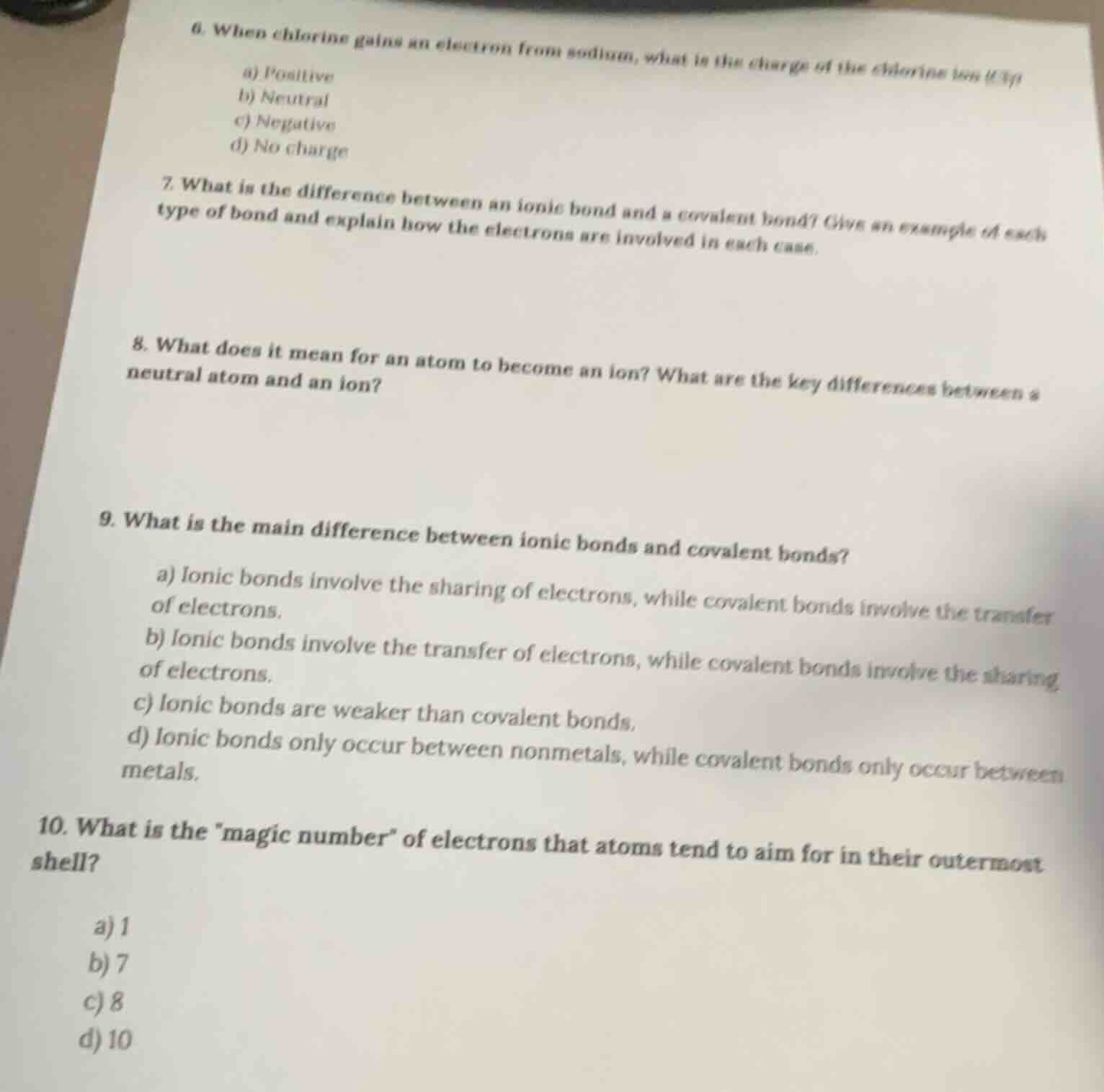
- when chlorine gains an electron from sodium, what is the charge of the chlorine ion (cl⁻)?
a) positive
b) neutral
c) negative
d) no charge
- what is the difference between an ionic bond and a covalent bond? give an example of each type of bond and explain how the electrons are involved in each case.
- what does it mean for an atom to become an ion? what are the key differences between a neutral atom and an ion?
- what is the main difference between ionic bonds and covalent bonds?
a) ionic bonds involve the sharing of electrons, while covalent bonds involve the transfer of electrons.
b) ionic bonds involve the transfer of electrons, while covalent bonds involve the sharing of electrons.
c) ionic bonds are weaker than covalent bonds.
d) ionic bonds only occur between nonmetals, while covalent bonds only occur between metals.
- what is the \magic number\ of electrons that atoms tend to aim for in their outermost shell?
a) 1
b) 7
c) 8
d) 10
Question 6
A neutral atom has equal protons (positive charge) and electrons (negative charge). When chlorine gains an electron, it has more electrons (negative charges) than protons (positive charges), so the ion has a negative charge.
- Ionic Bond: Involves electron transfer between a metal and non - metal. For example, in \( \text{NaCl} \), sodium (\( \text{Na} \)) donates its valence electron to chlorine (\( \text{Cl} \)). \( \text{Na} \) becomes \( \text{Na}^+ \) (loses electron), \( \text{Cl} \) becomes \( \text{Cl}^- \) (gains electron), and the opposite charges attract.
- Covalent Bond: Involves electron sharing between non - metals. For example, in \( \text{H}_2\text{O} \), oxygen and hydrogen atoms share electrons. Oxygen needs 2 more electrons, and each hydrogen needs 1 more. They share electrons to achieve stable electron configurations.
- Atom to Ion: An atom becomes an ion when it gains or loses electrons. This changes its electron - proton balance, giving it a net charge.
- Neutral Atom vs Ion:
- Charge: Neutral atoms have equal protons and electrons (net charge = 0). Ions have a net charge (positive if lost electrons, negative if gained electrons).
- Electron Configuration: Neutral atoms have a stable or unstable electron configuration. Ions have a stable electron configuration (like a noble gas) after gaining/losing electrons.
- Size: Positive ions (cations) are smaller than their neutral atoms (lost electrons, less electron - electron repulsion). Negative ions (anions) are larger than their neutral atoms (gained electrons, more electron - electron repulsion).

Snap & solve any problem in the app
Get step-by-step solutions on Sovi AI
Photo-based solutions with guided steps
Explore more problems and detailed explanations
c) Negative