QUESTION IMAGE
Question
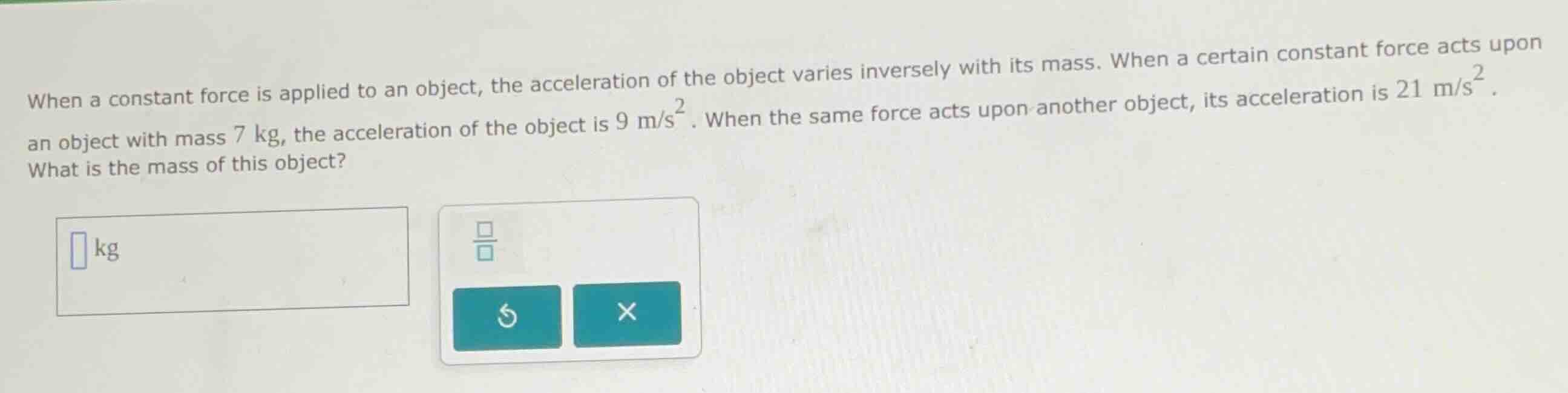
when a constant force is applied to an object, the acceleration of the object varies inversely with its mass. when a certain constant force acts upon an object with mass 7 kg, the acceleration of the object is 9 m/s². when the same force acts upon another object, its acceleration is 21 m/s². what is the mass of this object?
Step1: Recall the inverse variation formula
For inverse variation, if \( a \) (acceleration) varies inversely with \( m \) (mass), we have \( a=\frac{k}{m} \) (or \( F = ma \), since \( F \) is constant, \( m_1a_1=m_2a_2 \)). Here, \( F \) (force) is constant, so \( m_1a_1 = m_2a_2 \). Let \( m_1 = 7\space kg \), \( a_1=9\space m/s^2 \), \( a_2 = 21\space m/s^2 \), and we need to find \( m_2 \).
Step2: Substitute values into the formula
Substitute into \( m_1a_1=m_2a_2 \): \( 7\times9=m_2\times21 \).
Step3: Solve for \( m_2 \)
First, calculate \( 7\times9 = 63 \). Then, \( m_2=\frac{63}{21} \). Simplify \( \frac{63}{21}=3 \).

Snap & solve any problem in the app
Get step-by-step solutions on Sovi AI
Photo-based solutions with guided steps
Explore more problems and detailed explanations
3