QUESTION IMAGE
Question
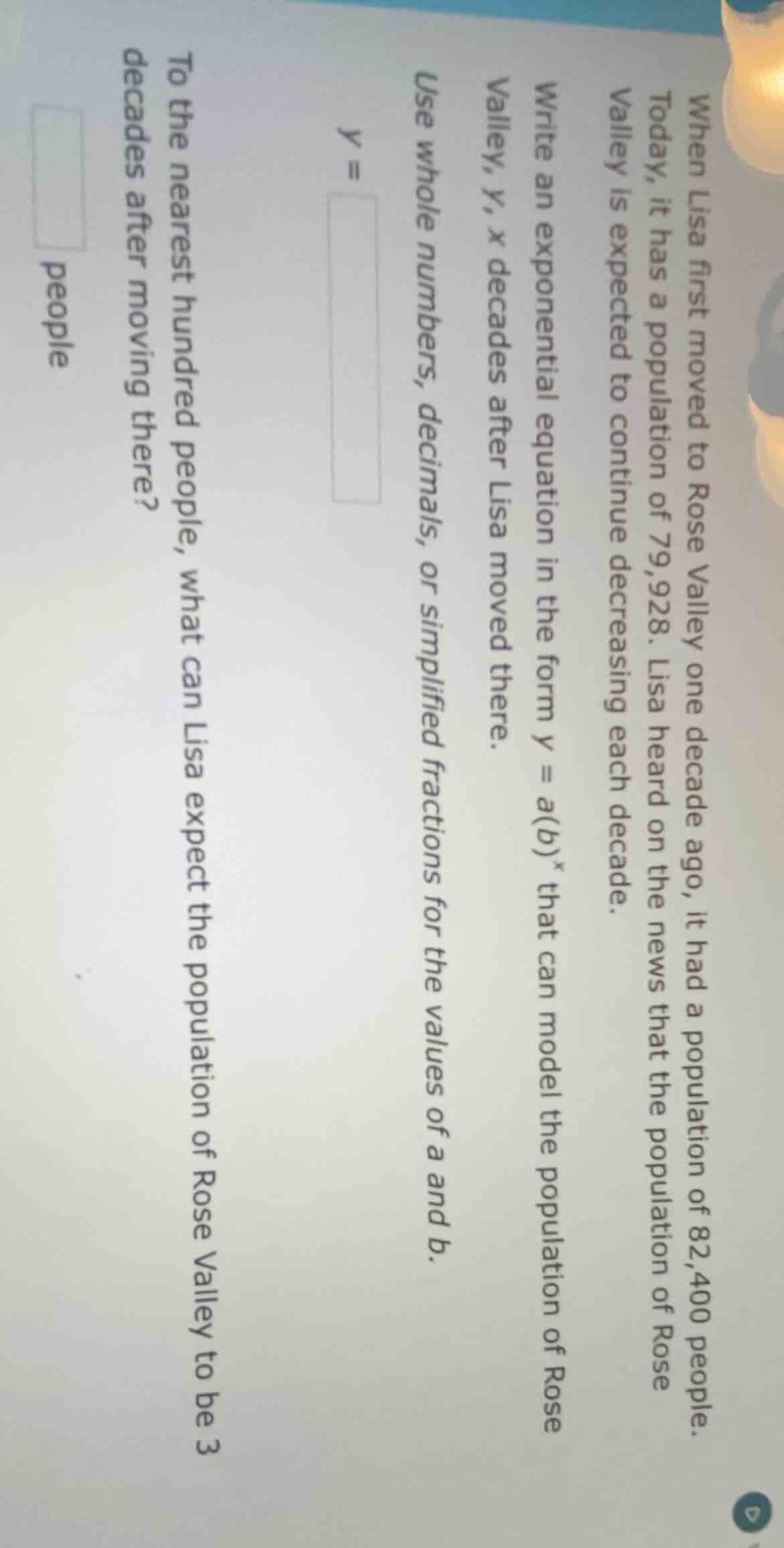
when lisa first moved to rose valley one decade ago, it had a population of 82,400 people. today, it has a population of 79,928. lisa heard on the news that the population of rose valley is expected to continue decreasing each decade. write an exponential equation in the form ( y = a(b)^x ) that can model the population of rose valley, ( y ), ( x ) decades after lisa moved there. use whole numbers, decimals, or simplified fractions for the values of ( a ) and ( b ).( y = square )to the nearest hundred people, what can lisa expect the population of rose valley to be 3 decades after moving there?(square) people
Step1: Identify initial a value
When \(x=0\) (Lisa moved there), the population was 82,400, so \(a = 82400\).
Step2: Solve for decay factor b
After 1 decade (\(x=1\)), \(y=79928\). Substitute into \(y=a(b)^x\):
$$79928 = 82400(b)^1$$
$$b = \frac{79928}{82400} = 0.97$$
Step3: Write the exponential equation
Substitute \(a=82400\) and \(b=0.97\) into the form:
$$y = 82400(0.97)^x$$
Step4: Calculate population at x=3
Substitute \(x=3\) into the equation:
$$y = 82400(0.97)^3$$
First calculate \(0.97^3 = 0.97\times0.97\times0.97 = 0.912673\)
Then \(y = 82400\times0.912673 \approx 75204.2552\)
Round to nearest hundred: \(75200\)

Snap & solve any problem in the app
Get step-by-step solutions on Sovi AI
Photo-based solutions with guided steps
Explore more problems and detailed explanations
Equation:
\(y = 82400(0.97)^x\)
Population after 3 decades:
75200 people