QUESTION IMAGE
Question
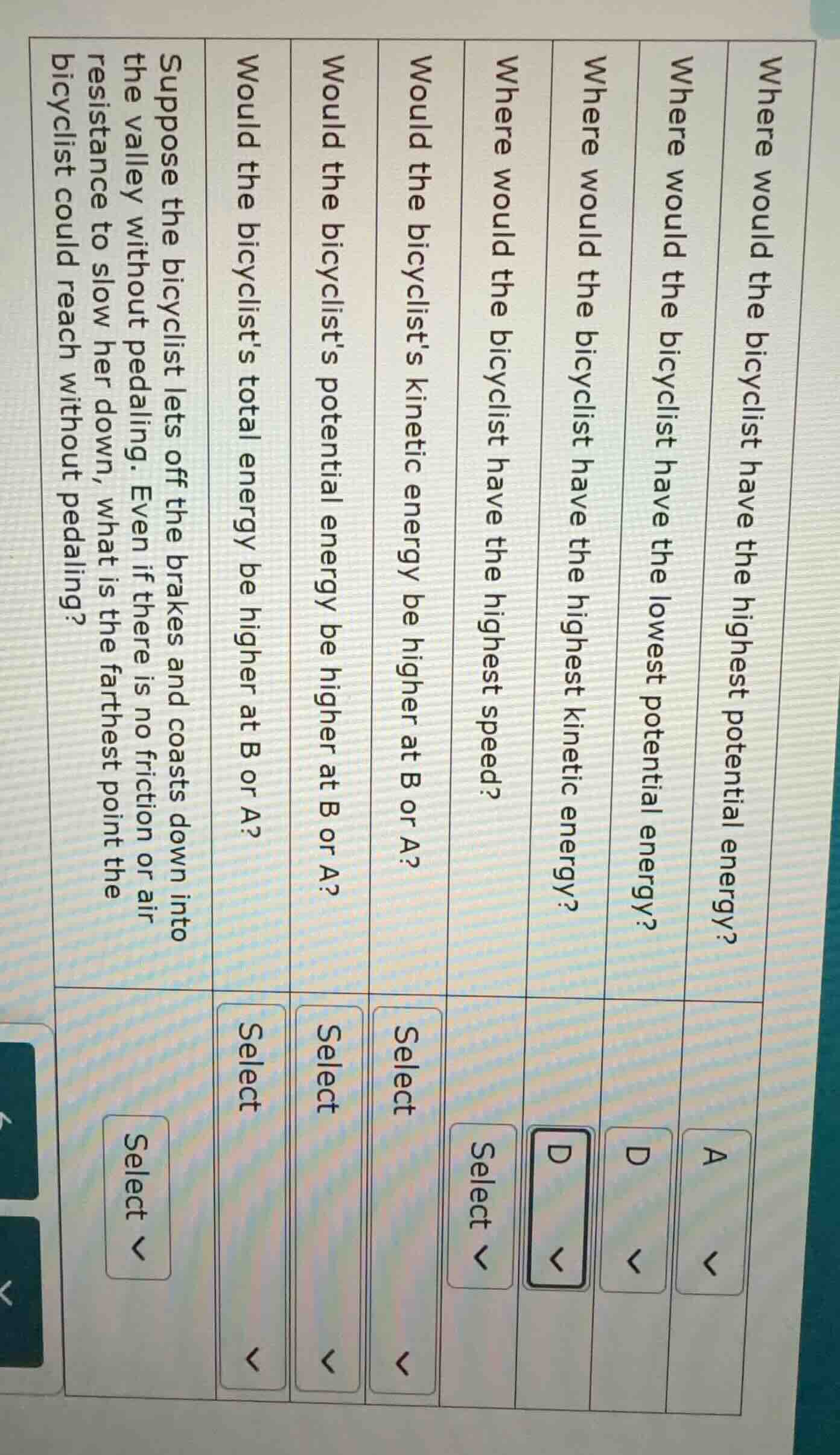
where would the bicyclist have the highest potential energy? a
where would the bicyclist have the lowest potential energy? d
where would the bicyclist have the highest kinetic energy? d
where would the bicyclist have the highest speed? select
would the bicyclist’s kinetic energy be higher at b or a? select
would the bicyclist’s potential energy be higher at b or a? select
would the bicyclist’s total energy be higher at b or a? select
suppose the bicyclist lets off the brakes and coasts down into the valley without pedaling. even if there is no friction or air resistance to slow her down, what is the farthest point the bicyclist could reach without pedaling? select
To solve these questions, we use the principle of conservation of mechanical energy (potential energy + kinetic energy) and the relationship between height, speed, potential energy, and kinetic energy. Assume point A is a higher point (e.g., the top of a hill) and point B is a lower point (e.g., the bottom of a valley), and point D is another point (likely the lowest point for kinetic energy and the highest speed, and the lowest point for potential energy).
1. Where would the bicyclist have the highest potential energy?
Potential energy (PE) is given by \( PE = mgh \), where \( m \) is mass, \( g \) is acceleration due to gravity, and \( h \) is height. Higher height means higher potential energy. If A is the highest point, the bicyclist has the highest potential energy at A.

Snap & solve any problem in the app
Get step-by-step solutions on Sovi AI
Photo-based solutions with guided steps
Explore more problems and detailed explanations
A
2. Where would the bicyclist have the lowest potential energy?
Using \( PE = mgh \), lower height means lower potential energy. If D is the lowest point (e.g., the bottom of the valley), the bicyclist has the lowest potential energy at D.