QUESTION IMAGE
Question
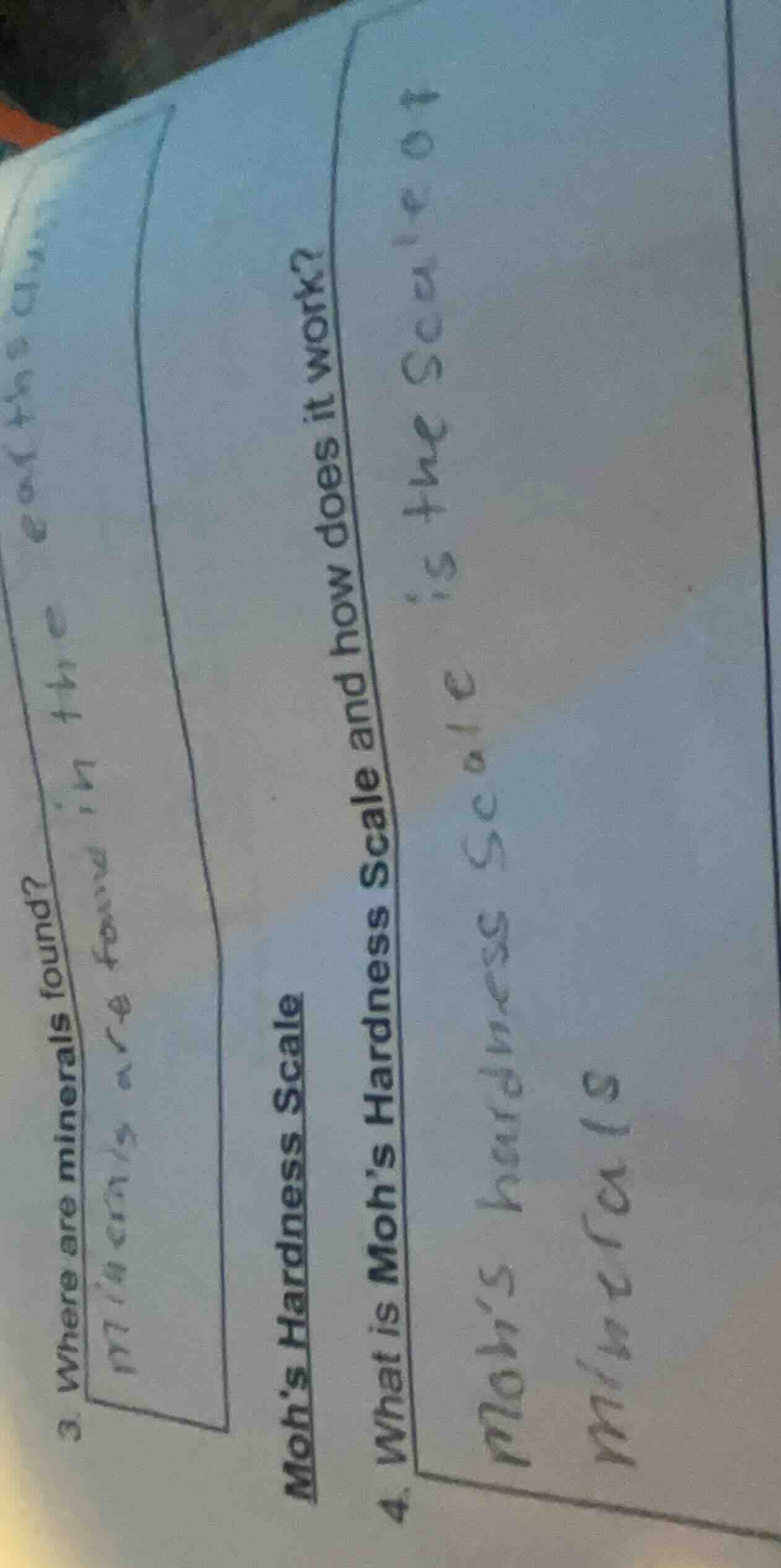
- where are minerals found?
minerals are found in the earths crust
mohs hardness scale
- what is mohs hardness scale and how does it work?
mohs hardness scale is the scale of minerals
For question 3:
Minerals are found in various geological environments. They form in igneous rocks (from cooling magma/lava), sedimentary rocks (from sediment accumulation and cementation), metamorphic rocks (from rock alteration under heat/pressure), and also in hydrothermal veins, evaporite deposits, and as components of soil, ocean floors, and even in living organisms (like some biominerals).
Moh’s Hardness Scale is a qualitative ordinal scale (from 1 to 10) that measures the scratch resistance of minerals. A mineral with a higher number on the scale can scratch a mineral with a lower number. It works by testing which mineral can scratch another: for example, talc (hardness 1) is very soft and can be scratched by gypsum (hardness 2), and diamond (hardness 10) is the hardest, scratching all others on the scale. The scale includes minerals: 1 - Talc, 2 - Gypsum, 3 - Calcite, 4 - Fluorite, 5 - Apatite, 6 - Orthoclase, 7 - Quartz, 8 - Topaz, 9 - Corundum, 10 - Diamond.

Snap & solve any problem in the app
Get step-by-step solutions on Sovi AI
Photo-based solutions with guided steps
Explore more problems and detailed explanations
Minerals are found in igneous rocks (from cooling magma/lava), sedimentary rocks (from sediment accumulation/cementation), metamorphic rocks (from rock alteration under heat/pressure), hydrothermal veins, evaporite deposits, soil, ocean floors, and some biominerals in living organisms.