QUESTION IMAGE
Question
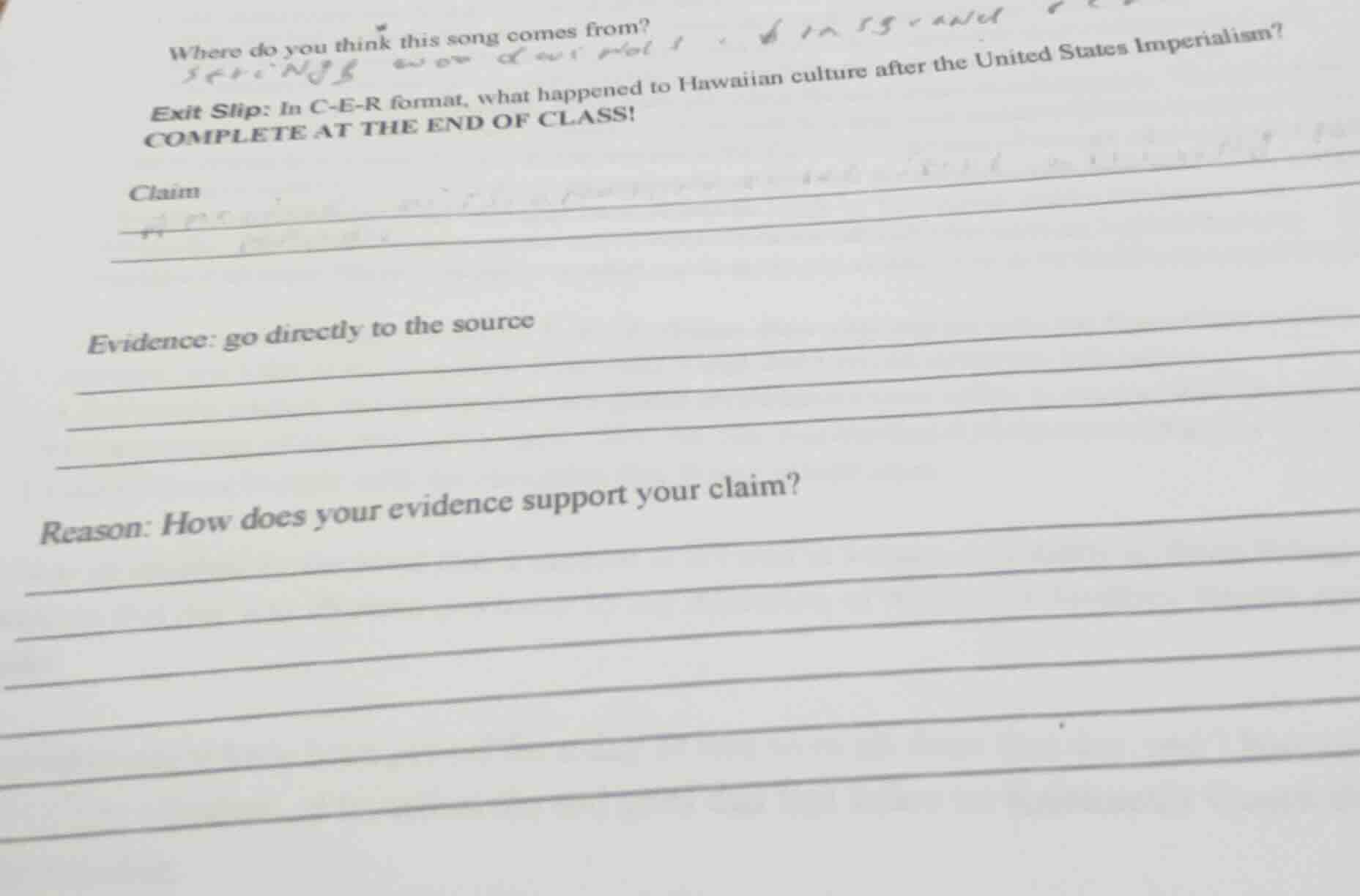
where do you think this song comes from?exit slip: in c-e-r format, what happened to hawaiian culture after the united states imperialism?complete at the end of class!claimevidence: go directly to the sourcereason: how does your evidence support your claim?
- Claim: States the core argument about Hawaiian culture's shift post-U.S. imperialism.
- Evidence: Uses primary/scholarly sources like U.S. annexation records, Hawaiian language decline data, and cultural practice surveys.
- Reason: Connects evidence to the claim by explaining how imperial policies directly caused cultural erosion and adaptation.

Snap & solve any problem in the app
Get step-by-step solutions on Sovi AI
Photo-based solutions with guided steps
Explore more problems and detailed explanations
Claim:
After U.S. imperialism, Hawaiian culture experienced widespread erosion alongside targeted cultural revitalization efforts.
Evidence:
- By 1920, Hawaiian language use in schools was banned, leading to a drop from 98% native speaker proficiency in 1890 to less than 0.1% by 1990 (source: Hawaiian Language Newspaper Project).
- The 1990 Native Hawaiian Education Act funded language immersion programs, resulting in a 200% increase in fluent young speakers by 2020 (source: Office of Hawaiian Affairs).
- U.S. annexation in 1898 led to the seizure of 1.8 million acres of Hawaiian crown and government lands, disrupting traditional agricultural and spiritual practices (source: U.S. National Archives).
Reason:
The ban on Hawaiian language in schools directly suppressed intergenerational cultural transmission, causing near-loss of the language. Federal policies like the Native Hawaiian Education Act reversed this trend by creating structured spaces for cultural learning. Land dispossession broke the link between Hawaiian communities and their ancestral lands, which are central to cultural and spiritual identity, while later land return efforts supported cultural renewal. Together, these examples show that U.S. imperialism initially damaged Hawaiian culture, but subsequent advocacy and policy changes enabled partial revitalization.