QUESTION IMAGE
Question
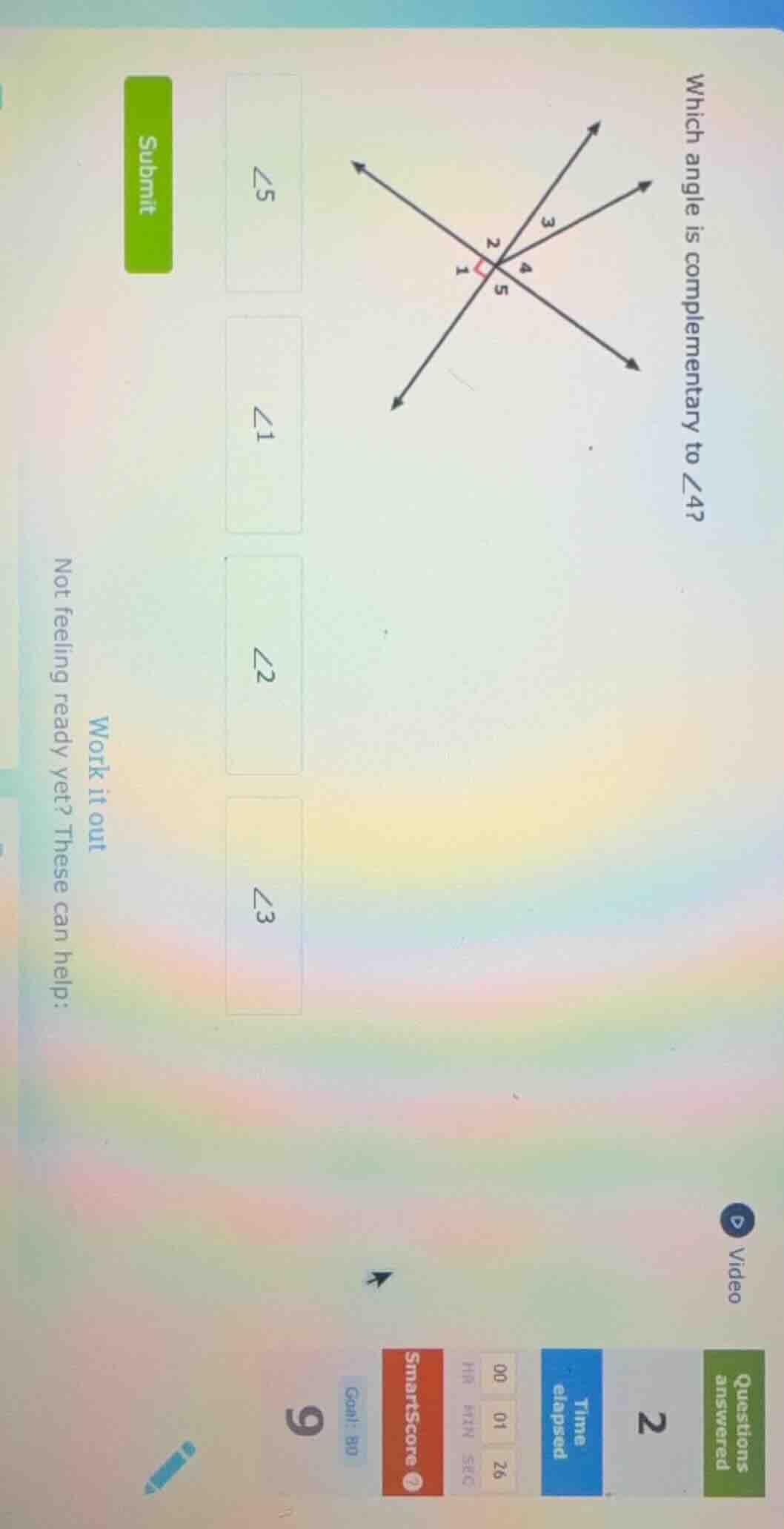
which angle is complementary to ∠4? ∠5 ∠1 ∠2 ∠3
Step1: Recall complementary angle definition
Complementary angles sum to \(90^\circ\). From the diagram, \(\angle 2\) is a right angle (\(90^\circ\)), so \(\angle 3 + \angle 4 = 90^\circ\) (since \(\angle 2=\angle 3 + \angle 4\) as they form \(\angle 2\)). Wait, no, looking at the diagram, \(\angle 2\) is right, so \(\angle 4 + \angle 3\)? Wait, no, the right angle is between \(\angle 2\) and \(\angle 5\)? Wait, no, the diagram has a right angle (red square) at \(\angle 2\) and \(\angle 5\)? Wait, no, the right angle is between the two lines, so \(\angle 2 + \angle 5 + \angle 4\)? No, better: complementary angles add to \(90^\circ\). Let's see the angles around the intersection. The right angle (red) means \(\angle 2 = 90^\circ\)? Wait, no, the red square is at \(\angle 2\) and \(\angle 5\)? Wait, the diagram shows \(\angle 2\) and \(\angle 5\) with a right angle, so \(\angle 2 + \angle 5 + \angle 4\)? No, maybe \(\angle 2\) is \(90^\circ\), so \(\angle 3 + \angle 4 = 90^\circ\)? Wait, no, the question is which angle is complementary to \(\angle 4\). So we need an angle that when added to \(\angle 4\) gives \(90^\circ\). Looking at the diagram, \(\angle 3\) and \(\angle 4\) are adjacent to the right angle (\(\angle 2\) or the right angle), so \(\angle 3 + \angle 4 = 90^\circ\)? Wait, no, maybe \(\angle 3\) is complementary to \(\angle 4\) because \(\angle 3 + \angle 4 = \angle 2\) (the right angle, \(90^\circ\)). Wait, let's re-express: if \(\angle 2\) is \(90^\circ\), and \(\angle 2 = \angle 3 + \angle 4\), then \(\angle 3 + \angle 4 = 90^\circ\), so \(\angle 3\) is complementary to \(\angle 4\). Wait, but the options are \(\angle 5\), \(\angle 1\), \(\angle 2\), \(\angle 3\). Wait, maybe I misread. Wait, the right angle is between \(\angle 2\) and \(\angle 5\)? No, the red square is at \(\angle 2\) and \(\angle 5\), so \(\angle 2 + \angle 5 = 90^\circ\)? No, right angle is \(90^\circ\), so if \(\angle 2\) is right, then \(\angle 4 + \angle 3 = 90^\circ\)? Wait, no, let's check the options. The options are \(\angle 5\), \(\angle 1\), \(\angle 2\), \(\angle 3\). Wait, \(\angle 1\) is vertical to some angle, \(\angle 5\) is adjacent. Wait, maybe the right angle is \(\angle 2 + \angle 4 + \angle 3\)? No, the diagram: two intersecting lines, with a right angle (red) at \(\angle 2\) and \(\angle 5\), so \(\angle 2 = 90^\circ\), and \(\angle 4 + \angle 3 = \angle 2\), so \(\angle 3 + \angle 4 = 90^\circ\), so \(\angle 3\) is complementary to \(\angle 4\).
Step2: Verify each option
- \(\angle 5\): \(\angle 4 + \angle 5\) – are they complementary? If \(\angle 5\) is part of a straight line? No, \(\angle 5\) and \(\angle 4\) – maybe \(\angle 5\) is equal to \(\angle 1\) (vertical angles), but \(\angle 1\) is supplementary to some angle.
- \(\angle 1\): \(\angle 1\) and \(\angle 4\) – \(\angle 1\) is vertical to \(\angle 4 + \angle 3 + \angle 2\)? No, vertical angles are equal, \(\angle 1\) is equal to \(\angle 4 + \angle 3 + \angle 2\)? No, intersecting lines: vertical angles are equal, so \(\angle 1\) is equal to \(\angle 4 + \angle 3 + \angle 2\)? No, maybe \(\angle 1\) is supplementary to \(\angle 2 + \angle 3 + \angle 4\).
- \(\angle 2\): \(\angle 2\) is \(90^\circ\), so \(\angle 4 + \angle 2 = 90^\circ + \angle 4 > 90^\circ\), not complementary.
- \(\angle 3\): \(\angle 3 + \angle 4 = 90^\circ\) (since they form the right angle \(\angle 2\)), so \(\angle 3\) is complementary to \(\angle 4\).

Snap & solve any problem in the app
Get step-by-step solutions on Sovi AI
Photo-based solutions with guided steps
Explore more problems and detailed explanations
\(\angle 3\)