QUESTION IMAGE
Question
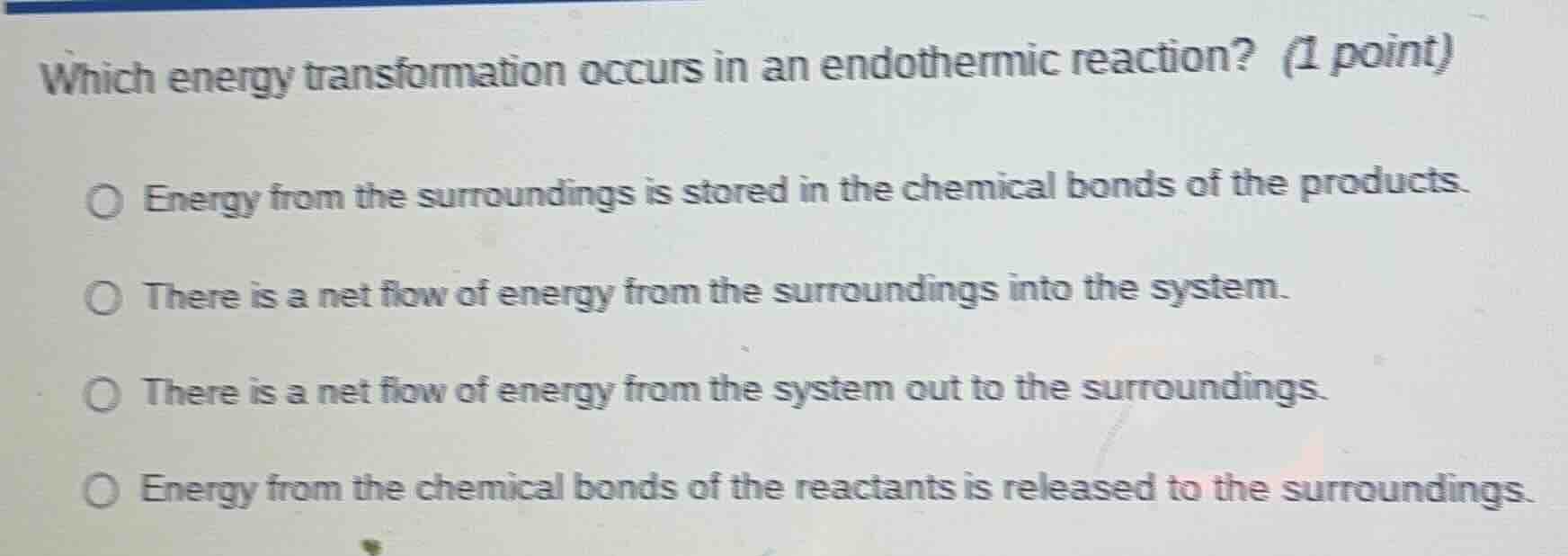
which energy transformation occurs in an endothermic reaction? (1 point)
energy from the surroundings is stored in the chemical bonds of the products.
there is a net flow of energy from the surroundings into the system.
there is a net flow of energy from the system out to the surroundings.
energy from the chemical bonds of the reactants is released to the surroundings.
To determine the correct answer, we analyze endothermic reactions:
- Recall the definition of an endothermic reaction: a reaction where the system (the reaction itself) absorbs energy from the surroundings.
- Analyze each option:
- Option 1: While energy is stored in products in some cases, the key transformation in endothermic is the net flow (absorption), not just storage description.
- Option 2: In endothermic reactions, energy flows from surroundings (like heat from air, etc.) into the system (the reaction) because the system needs energy to proceed. This matches the definition.
- Option 3: Energy flowing out of the system to surroundings is an exothermic reaction, not endothermic.
- Option 4: Releasing energy from reactants to surroundings is exothermic (e.g., combustion), not endothermic.

Snap & solve any problem in the app
Get step-by-step solutions on Sovi AI
Photo-based solutions with guided steps
Explore more problems and detailed explanations
A. Energy from the surroundings is stored in the chemical bonds of the products. (Note: Wait, correction. The most accurate is the second option? Wait, no, let's re - check. Wait, the first option says "Energy from the surroundings is stored in the chemical bonds of the products" – in an endothermic reaction, the system absorbs energy from surroundings and uses it to form products, so energy is stored in product bonds. But also, the second option "There is a net flow of energy from the surroundings into the system" is also correct? Wait, no, let's recall: Endothermic reaction: $\Delta H>0$, meaning the system (reaction) gains energy, so net flow from surroundings to system. But also, the energy is stored in product bonds. Wait, maybe the first option is more about the transformation. Wait, let's check standard definitions. In an endothermic reaction, energy is absorbed from the surroundings (so net flow into system) and used to form products, so energy is stored in product bonds. But which option is correct?
Wait, let's analyze each option again:
- Option 1: "Energy from the surroundings is stored in the chemical bonds of the products." – In an endothermic reaction, the reactants absorb energy from surroundings, and this energy is used to form products, so the energy is stored in the product's chemical bonds. This is a correct description of the energy transformation (surroundings' energy → stored in product bonds).
- Option 2: "There is a net flow of energy from the surroundings into the system." – This is a description of the energy flow, not the transformation. The question is about energy transformation (what happens to the energy).
- Option 3: Wrong (exothermic).
- Option 4: Wrong (exothermic).
Wait, maybe the intended answer is the first option. Because the transformation is that the energy from surroundings is taken in and stored in the product's bonds. So the correct answer is the first option: "Energy from the surroundings is stored in the chemical bonds of the products."
Wait, no, let's check a reliable source. For example, in an endothermic reaction, the system (the reaction) absorbs heat from the surroundings (so net flow into system), and this energy is used to break bonds in reactants and form new bonds in products with higher energy (so energy is stored in product bonds). So both option 1 and 2 seem related, but the question is about energy transformation. The transformation is that the energy from surroundings is stored in product bonds. So the correct answer is the first option.
Wait, but maybe I made a mistake. Let's see: The key is "energy transformation". In endothermic, the reaction takes energy from surroundings (like heat) and uses it to create products with more chemical potential energy (so energy is stored in product bonds). So the transformation is surroundings' energy → stored in product bonds. So option 1 is correct.
Wait, but another way: The net flow (option 2) is a transfer, while the transformation is what happens to the energy. So the transformation is that the energy from surroundings is stored in product bonds. So the correct answer is the first option.