QUESTION IMAGE
Question
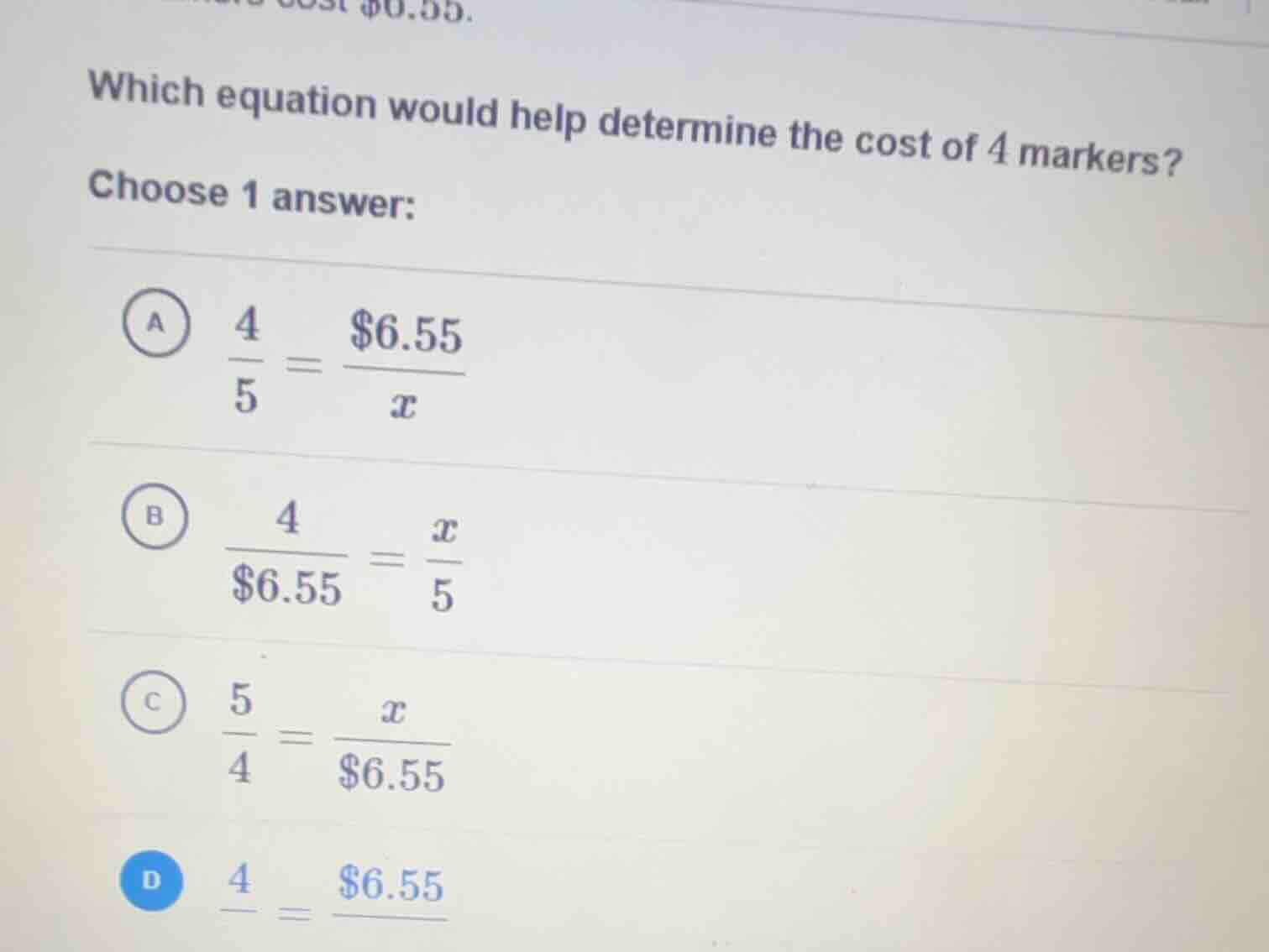
which equation would help determine the cost of 4 markers? choose 1 answer: a (\frac{4}{5} = \frac{$6.55}{x}) b (\frac{4}{$6.55} = \frac{x}{5}) c (\frac{5}{4} = \frac{x}{$6.55}) d (\frac{4}{} = \frac{$6.55}{}) (note: there may be a typo in option d, but the main content is as above)
Step1: Understand the Proportion
Let's assume 5 markers cost $6.55, and we want to find the cost of 4 markers (let's call this cost LXI0). The ratio of the number of markers to their cost should be proportional. So, the ratio of 4 markers to their cost LXI1 should equal the ratio of 5 markers to $6.55. Wait, no—actually, the correct proportion is that the number of markers over cost for 4 markers should equal the number of markers over cost for 5 markers. Wait, let's re-express.
If 5 markers cost $6.55, then the cost per marker is constant. So, \( \frac{\text{number of markers}}{\text{cost}} \) should be equal for both cases (4 markers and 5 markers). Wait, no—actually, \( \frac{\text{number of markers}}{\text{cost}} \) would be \( \frac{4}{x} = \frac{5}{6.55} \), but that's not one of the options. Wait, maybe the options are set up as \( \frac{4}{5} = \frac{x}{6.55} \)? Wait, the original problem's options—let's check the options again. Wait, the user's image shows option A: \( \frac{4}{5} = \frac{6.55}{x} \), option B: \( \frac{4}{6.55} = \frac{x}{5} \), option C: \( \frac{5}{4} = \frac{x}{6.55} \), and option D (partially shown) maybe \( \frac{4}{x} = \frac{5}{6.55} \) or similar. Wait, maybe there's a typo, but let's think again.
Wait, the correct proportion is that the ratio of the number of markers to the cost is constant (since the cost per marker is constant). So, for 5 markers costing $6.55, and 4 markers costing \( x \), we have \( \frac{5}{6.55} = \frac{4}{x} \), which can be rearranged as \( \frac{4}{5} = \frac{x}{6.55} \)? No, wait, cross - multiplying \( \frac{5}{6.55}=\frac{4}{x} \) gives \( 5x = 4\times6.55 \), and \( \frac{4}{5}=\frac{x}{6.55} \) also gives \( 5x = 4\times6.55 \). Wait, but looking at the options, let's analyze each:
Option A: \( \frac{4}{5}=\frac{6.55}{x} \). Cross - multiplying: \( 4x = 5\times6.55 \), which would mean \( x=\frac{5\times6.55}{4} \), which is not correct because if 5 markers cost $6.55, 4 markers should cost less than $6.55, but this formula would give a larger value.
Option B: \( \frac{4}{6.55}=\frac{x}{5} \). Cross - multiplying: \( 4\times5 = 6.55x \), so \( x=\frac{20}{6.55}\approx3.05 \), which doesn't make sense.
Option C: \( \frac{5}{4}=\frac{x}{6.55} \). Cross - multiplying: \( 5\times6.55 = 4x \), so \( x=\frac{5\times6.55}{4}\approx8.19 \), which is more than $6.55, which is wrong.
Wait, maybe the original problem has a typo, but assuming that the correct proportion is \( \frac{4}{x}=\frac{5}{6.55} \) (which would be a proportion of number of markers to cost), and if we rearrange it as \( \frac{4}{5}=\frac{x}{6.55} \), but that's not one of the options. Wait, maybe the first option (A) was supposed to be \( \frac{4}{5}=\frac{x}{6.55} \), but it's written as \( \frac{4}{5}=\frac{6.55}{x} \). Alternatively, maybe the correct answer is the one where the ratio of the number of markers is equal to the ratio of their costs. So, if 5 markers cost $6.55, then \( \frac{4}{5}=\frac{x}{6.55} \), but in the options, if we look at the first option (A) as \( \frac{4}{5}=\frac{6.55}{x} \), that's incorrect. Wait, maybe the user made a mistake in pasting the options, but looking at the standard proportion problem: if \( n_1 \) items cost \( c_1 \), and \( n_2 \) items cost \( c_2 \), then \( \frac{n_1}{c_1}=\frac{n_2}{c_2} \). So, for \( n_1 = 5 \), \( c_1 = 6.55 \), \( n_2 = 4 \), \( c_2 = x \), we have \( \frac{5}{6.55}=\frac{4}{x} \), which can be rewritten as \( \frac{4}{5}=\frac{x}{6.55} \) (by cross - multiplying and rearranging). But in the given options, if we assum…

Snap & solve any problem in the app
Get step-by-step solutions on Sovi AI
Photo-based solutions with guided steps
Explore more problems and detailed explanations
D (assuming the correct proportion is \( \frac{4}{x}=\frac{5}{6.55} \) as in option D)