QUESTION IMAGE
Question
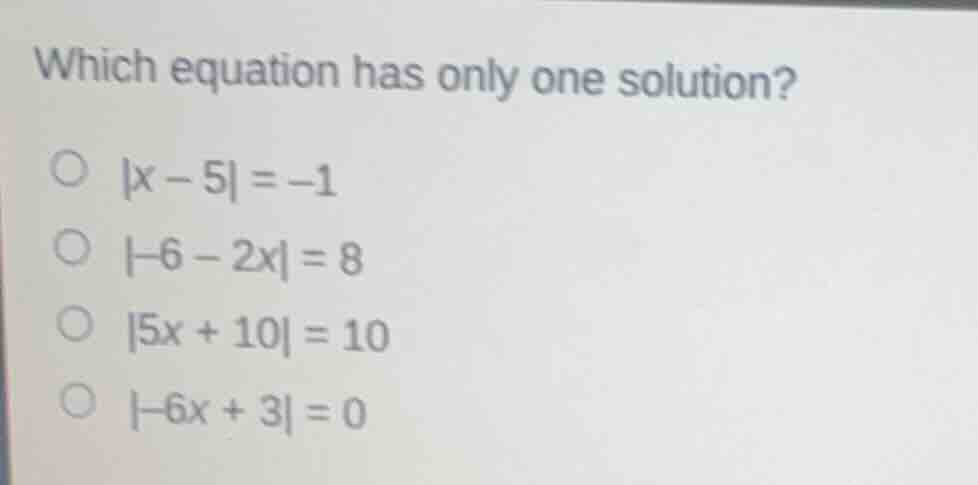
which equation has only one solution?
○ |x - 5| = -1
○ |-6 - 2x| = 8
○ |5x + 10| = 10
○ |-6x + 3| = 0
Step1: Analyze \(|x - 5|=-1\)
The absolute value of a number is always non - negative (i.e., \(|a|\geq0\) for any real number \(a\)). Since the right - hand side of the equation \(|x - 5|=-1\) is \(- 1\) (a negative number), this equation has no solutions.
Step2: Analyze \(|-6 - 2x| = 8\)
By the definition of absolute value, if \(|a|=b\) (\(b>0\)), then \(a = b\) or \(a=-b\).
For \(|-6 - 2x| = 8\), we have two cases:
Case 1: \(-6-2x = 8\)
Add 6 to both sides: \(-2x=8 + 6=14\)
Divide both sides by \(-2\): \(x=-7\)
Case 2: \(-6-2x=-8\)
Add 6 to both sides: \(-2x=-8 + 6=-2\)
Divide both sides by \(-2\): \(x = 1\)
So this equation has two solutions.
Step3: Analyze \(|5x + 10| = 10\)
Using the absolute - value definition (\(|a|=b,b>0\) implies \(a = b\) or \(a=-b\)):
Case 1: \(5x+10 = 10\)
Subtract 10 from both sides: \(5x=10 - 10=0\)
Divide both sides by 5: \(x = 0\)
Case 2: \(5x+10=-10\)
Subtract 10 from both sides: \(5x=-10 - 10=-20\)
Divide both sides by 5: \(x=-4\)
So this equation has two solutions.
Step4: Analyze \(|-6x + 3| = 0\)
By the definition of absolute value, if \(|a| = 0\), then \(a=0\).
So we set \(-6x + 3=0\)
Subtract 3 from both sides: \(-6x=-3\)
Divide both sides by \(-6\): \(x=\frac{-3}{-6}=\frac{1}{2}\)
This equation has only one solution.

Snap & solve any problem in the app
Get step-by-step solutions on Sovi AI
Photo-based solutions with guided steps
Explore more problems and detailed explanations
\(\boldsymbol{|-6x + 3| = 0}\) (the equation \(|-6x + 3| = 0\) has only one solution)