QUESTION IMAGE
Question
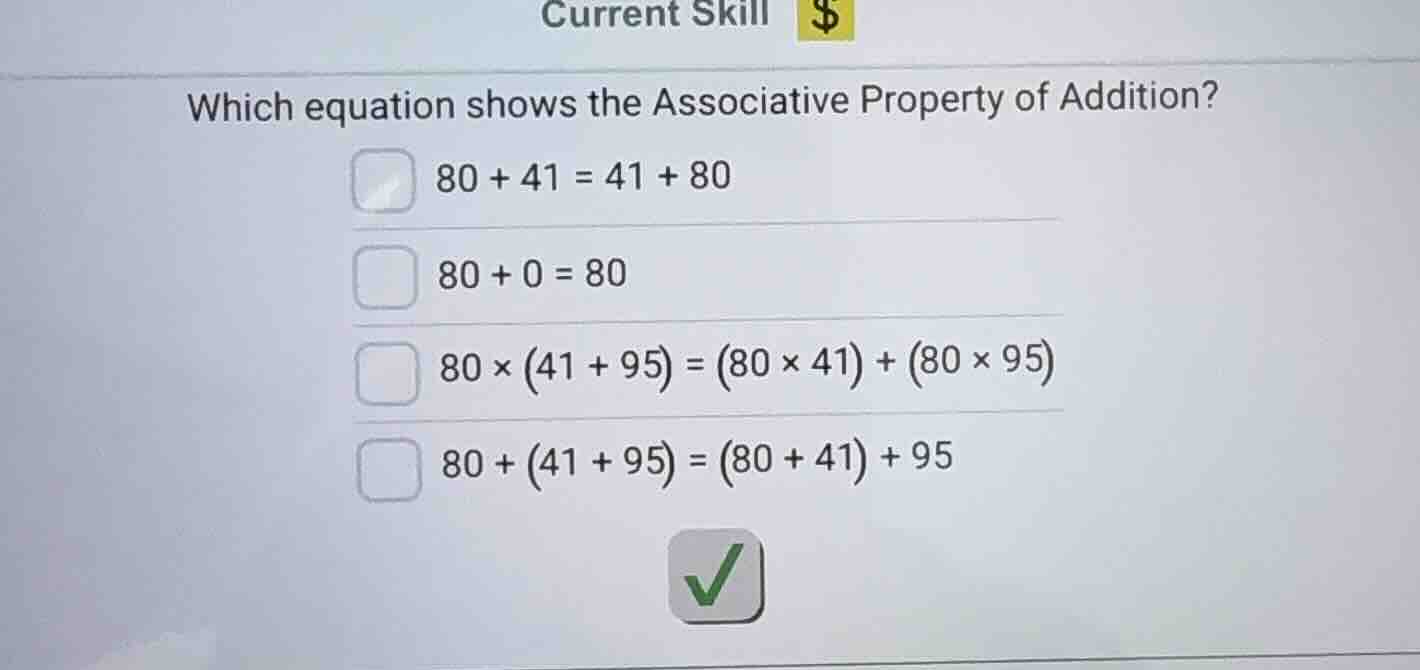
which equation shows the associative property of addition? 80 + 41 = 41 + 80 80 + 0 = 80 80 × (41 + 95) = (80 × 41) + (80 × 95) 80 + (41 + 95) = (80 + 41) + 95
Brief Explanations
- Recall the Associative Property of Addition: For any real numbers \(a\), \(b\), and \(c\), \(a+(b + c)=(a + b)+c\). This property states that the way we group three or more numbers when adding does not change the sum.
- Analyze each option:
- Option 1: \(80 + 41=41 + 80\) shows the Commutative Property of Addition (\(a + b=b + a\)), not the Associative Property.
- Option 2: \(80+0 = 80\) shows the Identity Property of Addition (adding 0 to a number gives the number itself), not the Associative Property.
- Option 3: \(80\times(41 + 95)=(80\times41)+(80\times95)\) shows the Distributive Property of Multiplication over Addition, not related to addition's associative property.
- Option 4: \(80+(41 + 95)=(80 + 41)+95\) follows the form \(a+(b + c)=(a + b)+c\) where \(a = 80\), \(b = 41\), and \(c = 95\), which is the Associative Property of Addition.

Snap & solve any problem in the app
Get step-by-step solutions on Sovi AI
Photo-based solutions with guided steps
Explore more problems and detailed explanations
\(80+(41 + 95)=(80 + 41)+95\) (the fourth option)