QUESTION IMAGE
Question
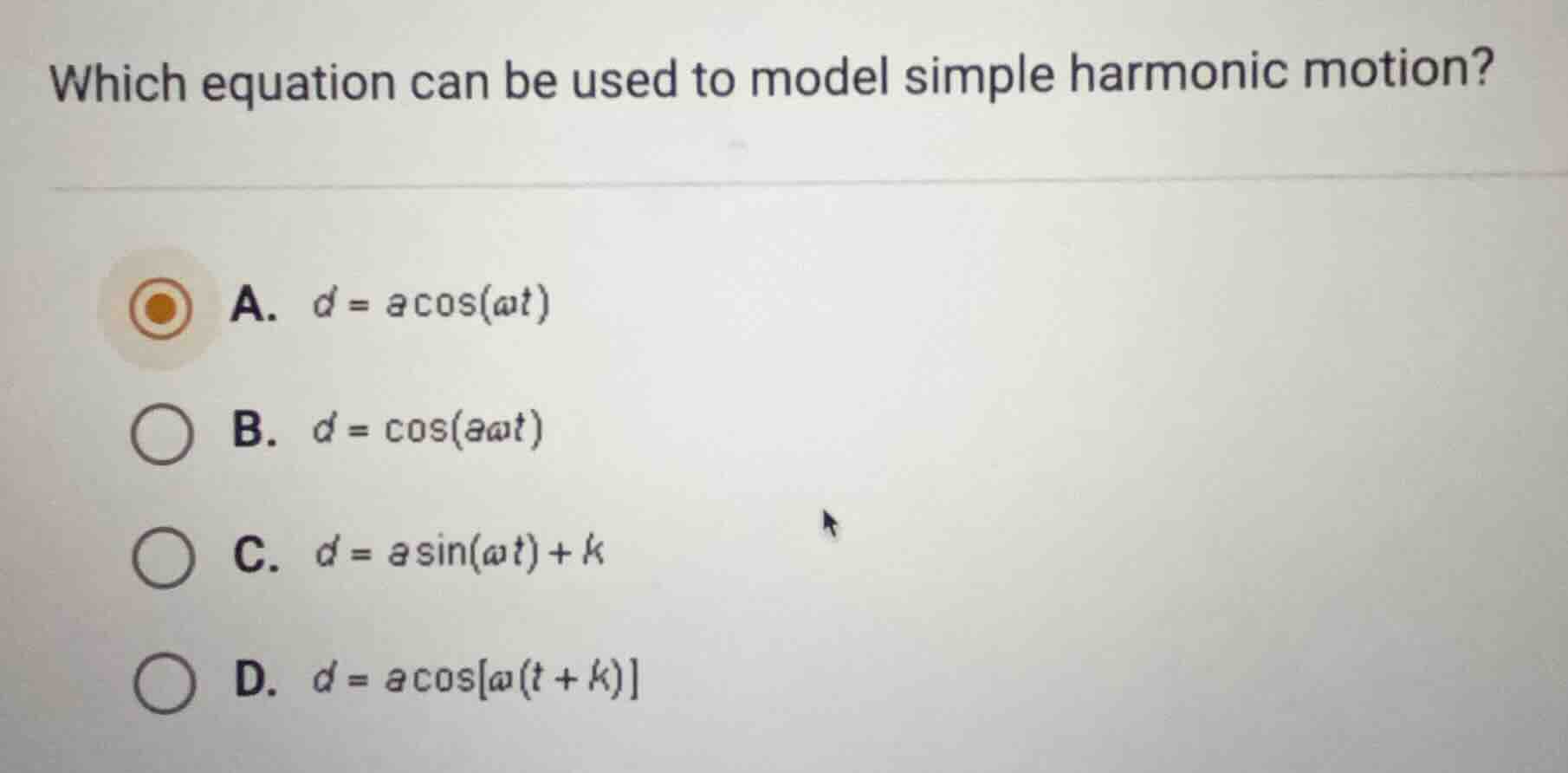
which equation can be used to model simple harmonic motion?
a. $d = a\cos(\omega t)$
b. $d = \cos(a\omega t)$
c. $d = a\sin(\omega t) + k$
d. $d = a\cos\omega(t + k)$
Brief Explanations
Simple harmonic motion is modeled by sinusoidal functions where:
- $a$ = amplitude (scales the oscillation range),
- $\omega$ = angular frequency (controls oscillation rate),
- The base form is either cosine or sine with the argument $\omega t$ (for motion starting at maximum displacement at $t=0$, cosine is used).
- Option B lacks an amplitude scale factor outside the trigonometric function.
- Option C adds a vertical shift $k$, which is for shifted harmonic motion, not the basic model.
- Option D includes a phase shift inside the function, which is a modified form, not the standard base model for simple harmonic motion.

Snap & solve any problem in the app
Get step-by-step solutions on Sovi AI
Photo-based solutions with guided steps
Explore more problems and detailed explanations
A. $d = a\cos(\omega t)$