QUESTION IMAGE
Question
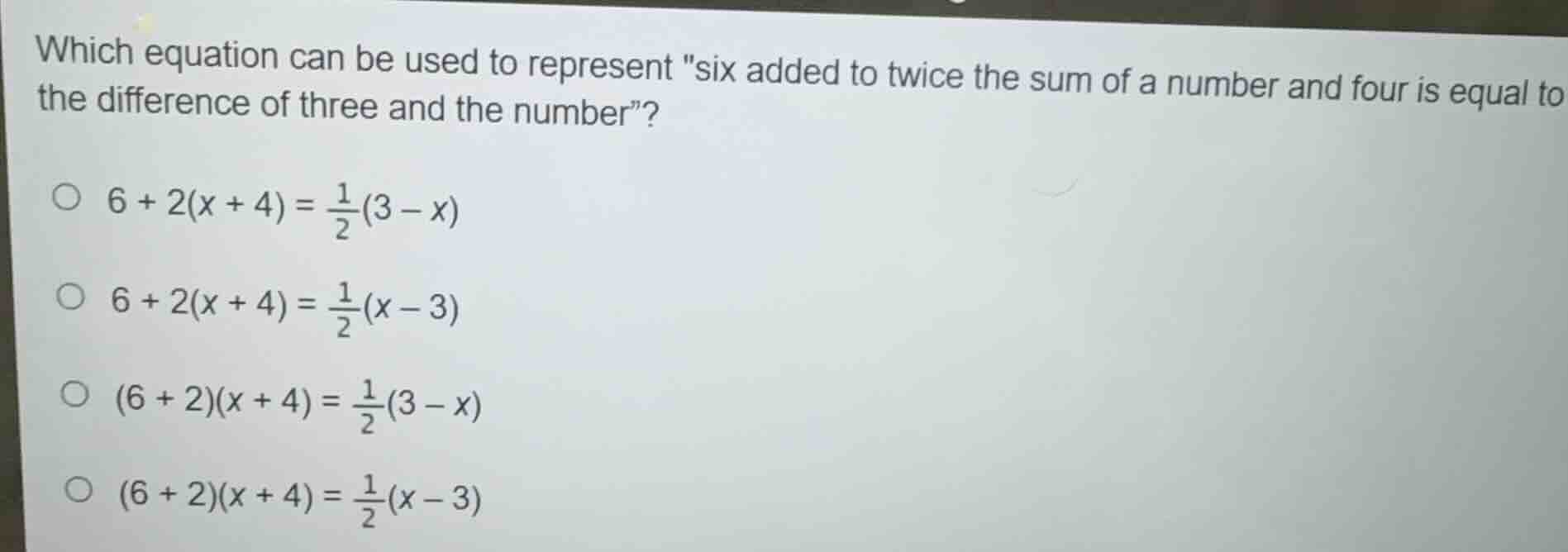
which equation can be used to represent \six added to twice the sum of a number and four is equal to the difference of three and the number\?
6 + 2(x + 4) = \frac{1}{2}(3 - x)
6 + 2(x + 4) = \frac{1}{2}(x - 3)
(6 + 2)(x + 4) = \frac{1}{2}(3 - x)
(6 + 2)(x + 4) = \frac{1}{2}(x - 3)
Step1: Define the variable
Let the number be \( x \).
Step2: Translate "twice the sum of a number and four"
The sum of a number and four is \( x + 4 \), twice that sum is \( 2(x + 4) \).
Step3: Translate "six added to twice the sum..."
Six added to \( 2(x + 4) \) is \( 6 + 2(x + 4) \).
Step4: Translate "the difference of three and the number"
The difference of three and the number is \( 3 - x \), and half of that difference is \( \frac{1}{2}(3 - x) \).
Step5: Form the equation
Putting it together, the equation is \( 6 + 2(x + 4)=\frac{1}{2}(3 - x) \).

Snap & solve any problem in the app
Get step-by-step solutions on Sovi AI
Photo-based solutions with guided steps
Explore more problems and detailed explanations
A. \( 6 + 2(x + 4)=\frac{1}{2}(3 - x) \)