QUESTION IMAGE
Question
which equation can be used to solve for b?
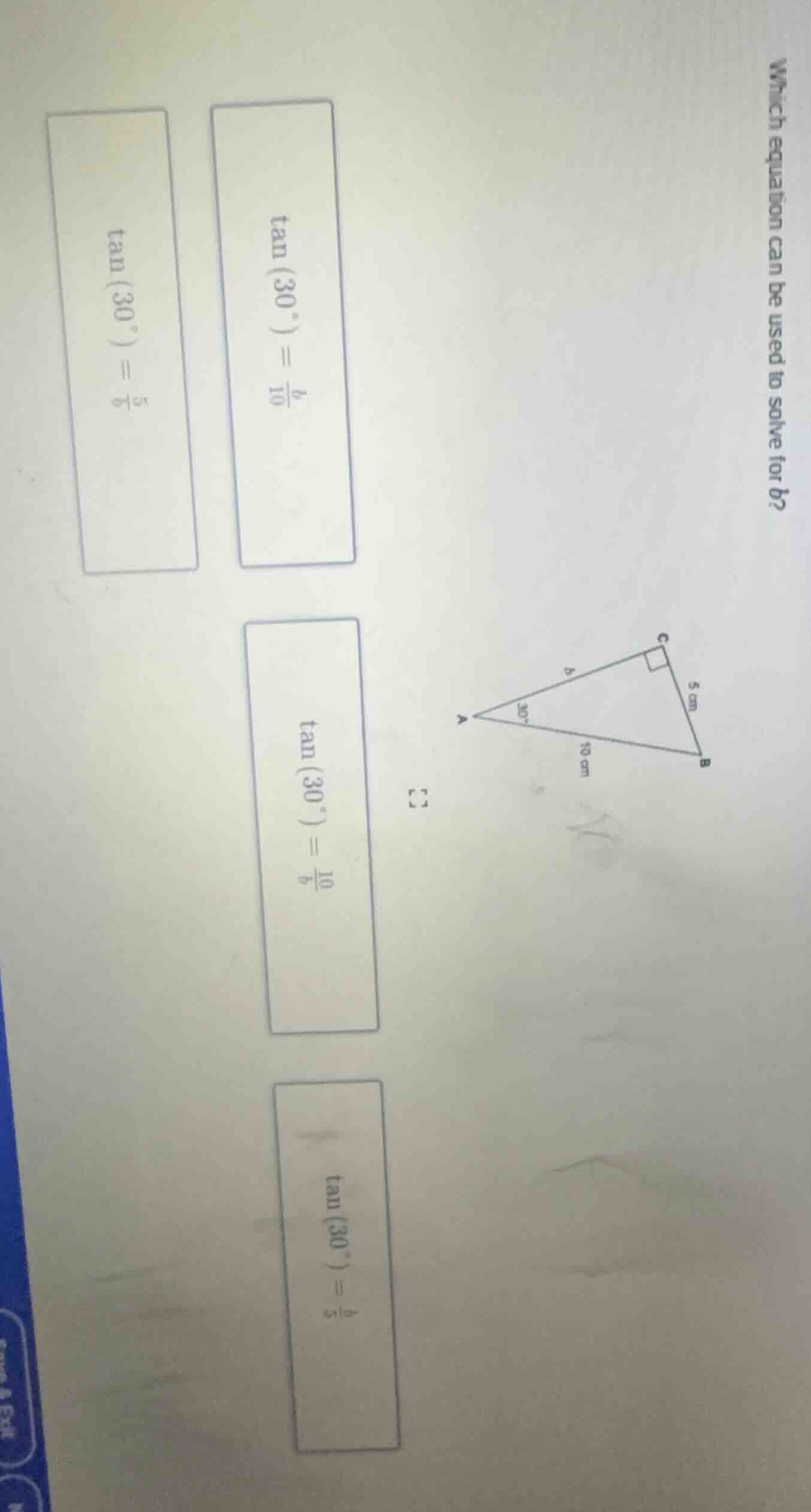
there is a right triangle abc with right angle at c. the length of bc is 5 cm, the length of ab is 10 cm, and angle at a is 30°. the options are:
tan(30°) = \frac{b}{10}
tan(30°) = \frac{10}{b}
tan(30°) = \frac{5}{b}
tan(30°) = \frac{b}{5}
Step1: Recall tangent definition
In a right triangle, $\tan(\theta) = \frac{\text{opposite}}{\text{adjacent}}$ to angle $\theta$.
Step2: Identify sides for $\angle A = 30^\circ$
For $\angle A = 30^\circ$, opposite side is $BC = 5$ cm, adjacent side is $AC = b$. Wait, no, wait: Wait, the triangle has right angle at $C$. So sides: $BC = 5$ (opposite to $A$), $AC = b$ (adjacent to $A$), $AB = 10$? Wait, no, maybe I misread. Wait, the options: Let's check the options. Wait, one of the options is $\tan(30^\circ) = \frac{5}{b}$? Wait, no, the correct approach: In right triangle $ABC$, right-angled at $C$, $\angle A = 30^\circ$. So $\tan(30^\circ) = \frac{BC}{AC} = \frac{5}{b}$? Wait, no, wait the options: Wait, the options are:
- $\tan(30^\circ) = \frac{b}{10}$
- $\tan(30^\circ) = \frac{10}{b}$
- $\tan(30^\circ) = \frac{5}{b}$
- $\tan(30^\circ) = \frac{b}{5}$
Wait, no, the image shows: Let's re-express. The triangle: $C$ is right angle, $A$ is $30^\circ$, $BC = 5$ cm, $AB = 10$ cm, $AC = b$. So for angle $A$ (30°), opposite side is $BC = 5$, adjacent side is $AC = b$. Wait, but $\tan(\theta) = \text{opposite}/\text{adjacent} = 5/b$. Wait, but let's check the options. Wait, maybe I made a mistake. Wait, the options: One of them is $\tan(30^\circ) = \frac{5}{b}$? Wait, the user's image: Let's parse the options. The first option (top left) is $\tan(30^\circ) = \frac{5}{b}$? Wait, the text in the image: The first box (left) is $\tan(30^\circ) = \frac{5}{b}$? Wait, no, the original problem: Let's re-express.
Wait, the correct formula for tangent: in right triangle, $\tan(\theta) = \frac{\text{opposite}}{\text{adjacent}}$. For angle $A = 30^\circ$, opposite side is $BC = 5$ (since $C$ is right angle, $BC$ is opposite $A$), adjacent side is $AC = b$ (adjacent to $A$). So $\tan(30^\circ) = \frac{BC}{AC} = \frac{5}{b}$. Wait, but let's check the options. Wait, the options given:
Wait, the user's image: The options are:
- $\tan(30^\circ) = \frac{b}{10}$
- $\tan(30^\circ) = \frac{10}{b}$
- $\tan(30^\circ) = \frac{5}{b}$
- $\tan(30^\circ) = \frac{b}{5}$
Wait, no, maybe I misread the triangle. Wait, maybe $AB = 10$ is the hypotenuse? Wait, $AB = 10$, $BC = 5$, so in a 30-60-90 triangle, hypotenuse is twice the shorter leg. So $BC = 5$ (shorter leg, opposite 30°), hypotenuse $AB = 10$, so that's correct (10 = 2*5). Then $AC = b$ (longer leg, opposite 60°). So for angle $A = 30°$, opposite side is $BC = 5$, adjacent side is $AC = b$. So $\tan(30°) = \frac{\text{opposite}}{\text{adjacent}} = \frac{5}{b}$. So the equation $\tan(30^\circ) = \frac{5}{b}$ can be used to solve for $b$. Wait, but let's check the options. The left box (first option) is $\tan(30^\circ) = \frac{5}{b}$? So that's the correct one.
Wait, maybe I made a mistake earlier. Let's confirm:
In right triangle $ABC$, $\angle C = 90^\circ$, $\angle A = 30^\circ$, $BC = 5$ (opposite $A$), $AC = b$ (adjacent to $A$), $AB = 10$ (hypotenuse). Then $\tan(\angle A) = \frac{BC}{AC} = \frac{5}{b}$. So the equation is $\tan(30^\circ) = \frac{5}{b}$.

Snap & solve any problem in the app
Get step-by-step solutions on Sovi AI
Photo-based solutions with guided steps
Explore more problems and detailed explanations
The equation $\boldsymbol{\tan(30^\circ) = \frac{5}{b}}$ (assuming the left - most option is $\tan(30^\circ)=\frac{5}{b}$) can be used to solve for $b$.