QUESTION IMAGE
Question
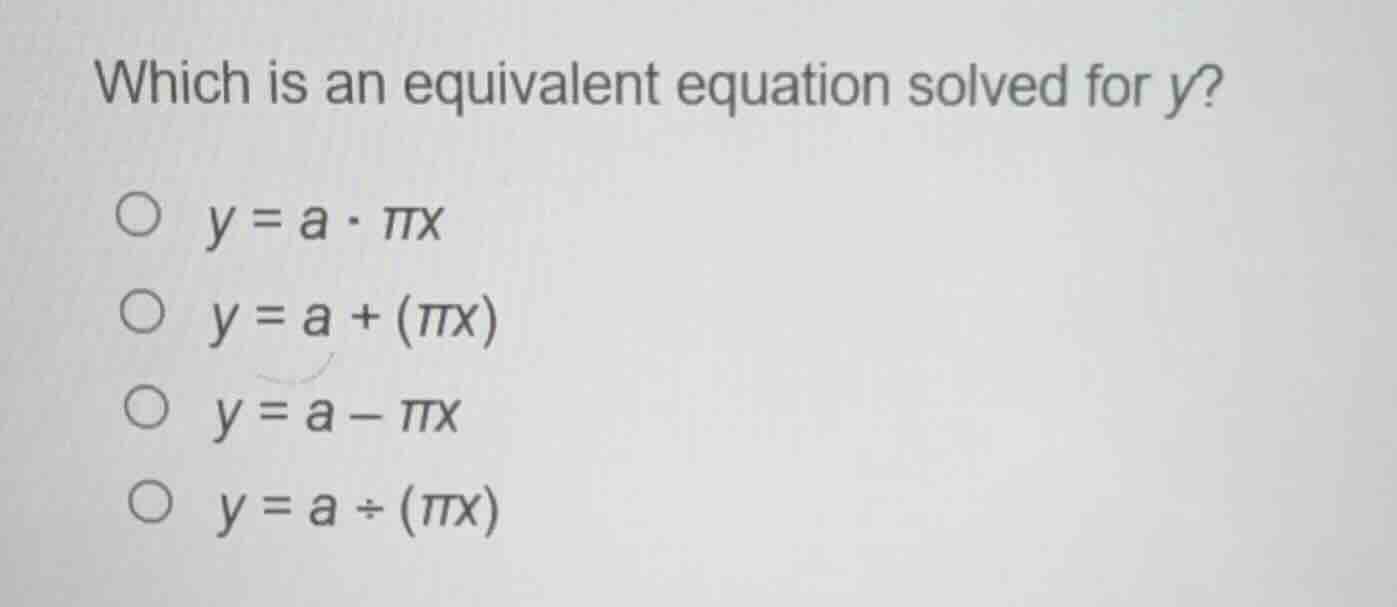
which is an equivalent equation solved for y?
○ $y = a \cdot \pi x$
○ $y = a + (\pi x)$
○ $y = a - \pi x$
○ $y = a \div (\pi x)$
To determine the equivalent equation solved for \( y \), we assume the original equation (not shown here) is likely of the form \( a = y \cdot \pi x \) (a common form where solving for \( y \) involves division). Let's analyze each option:
Step 1: Recall the process of solving for \( y \)
If we start with an equation like \( a = y \cdot \pi x \), we isolate \( y \) by dividing both sides by \( \pi x \):
\[
y = \frac{a}{\pi x}
\]
This is equivalent to \( y = a \div (\pi x) \).
Step 2: Analyze other options
- \( y = a \cdot \pi x \): This would be the result of multiplying \( a \) and \( \pi x \), not solving for \( y \) from a typical equation.
- \( y = a + (\pi x) \): This is addition, not related to isolating \( y \) from a product.
- \( y = a - \pi x \): This is subtraction, also not related to isolating \( y \) from a product.
Thus, the equivalent equation solved for \( y \) is \( y = a \div (\pi x) \).

Snap & solve any problem in the app
Get step-by-step solutions on Sovi AI
Photo-based solutions with guided steps
Explore more problems and detailed explanations
\( y = a \div (\pi x) \) (the fourth option: \( y = a \div (\pi x) \))