QUESTION IMAGE
Question
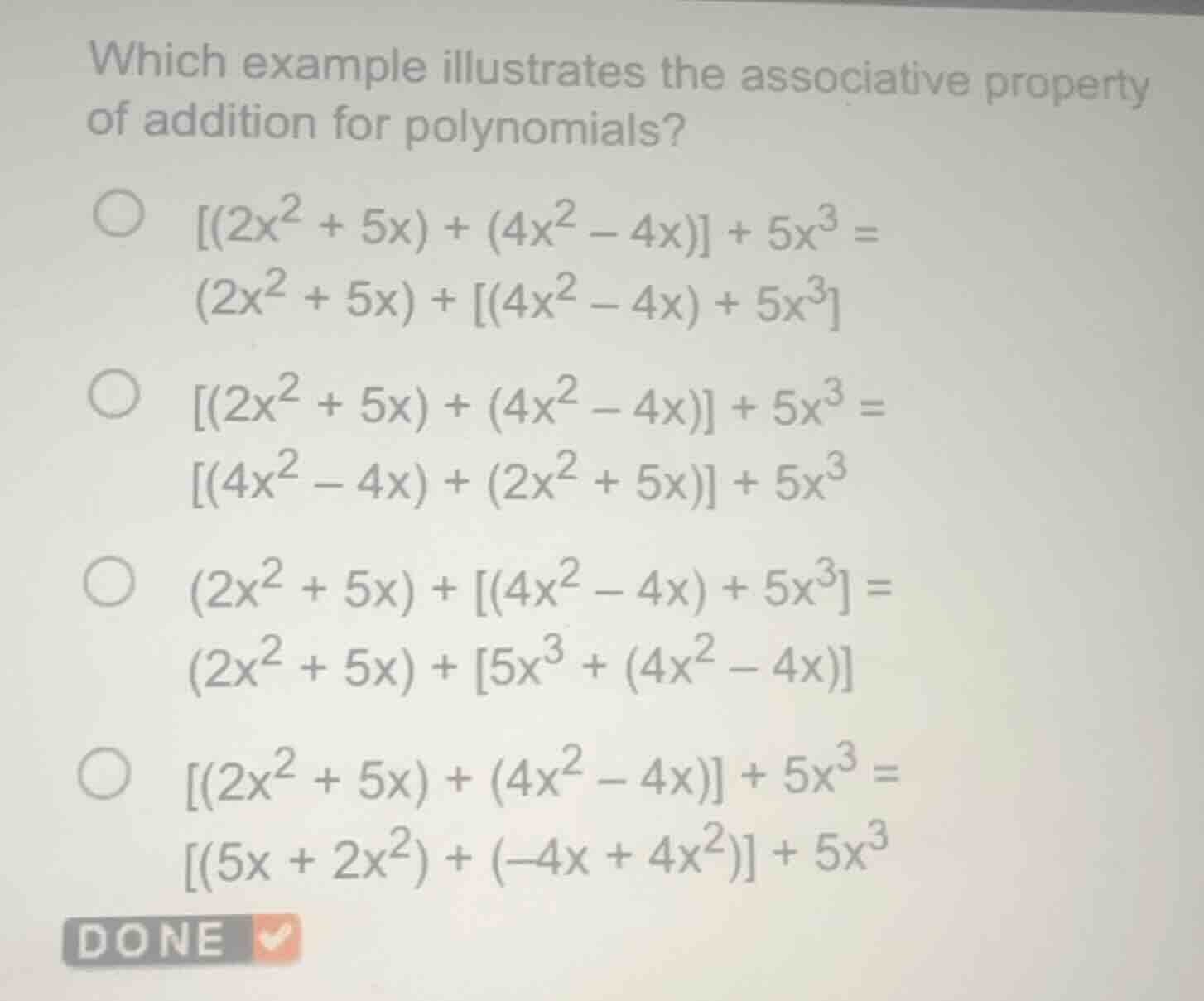
which example illustrates the associative property of addition for polynomials?
$(2x^2 + 5x) + (4x^2 - 4x) + 5x^3 = (2x^2 + 5x) + (4x^2 - 4x) + 5x^3$
$(2x^2 + 5x) + (4x^2 - 4x) + 5x^3 = (4x^2 - 4x) + (2x^2 + 5x) + 5x^3$
$(2x^2 + 5x) + (4x^2 - 4x) + 5x^3 = (2x^2 + 5x) + 5x^3 + (4x^2 - 4x)$
$(2x^2 + 5x) + (4x^2 - 4x) + 5x^3 = (5x + 2x^2) + (-4x + 4x^2) + 5x^3$
done
The associative property of addition states that for any terms \(a\), \(b\), \(c\), the grouping of addends does not change the sum: \((a + b) + c = a + (b + c)\). We identify the option that rearranges only the grouping of polynomial addends, not the order of the terms themselves.
- The second, third, and fourth options rearrange the order of terms (commutative property), not just grouping.
- The first option keeps the order of all polynomials the same, only changing the grouping of the addition.

Snap & solve any problem in the app
Get step-by-step solutions on Sovi AI
Photo-based solutions with guided steps
Explore more problems and detailed explanations
A. \([(2x^{2} + 5x) + (4x^{2} - 4x)] + 5x^{3} = (2x^{2} + 5x) + [(4x^{2} - 4x) + 5x^{3}]\)