QUESTION IMAGE
Question
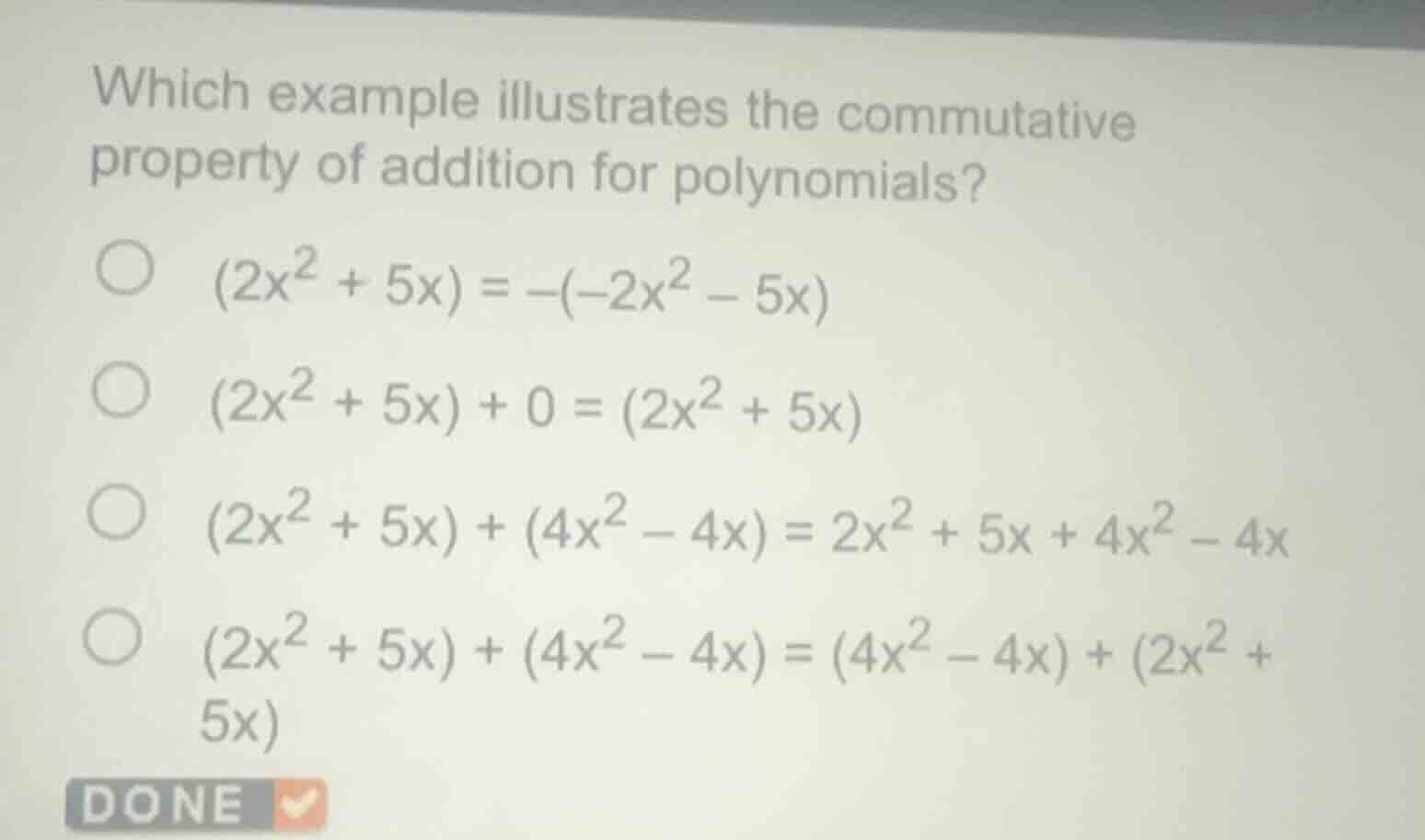
which example illustrates the commutative property of addition for polynomials?
$(2x^2 + 5x) = -(-2x^2 - 5x)$
$(2x^2 + 5x) + 0 = (2x^2 + 5x)$
$(2x^2 + 5x) + (4x^2 - 4x) = 2x^2 + 5x + 4x^2 - 4x$
$(2x^2 + 5x) + (4x^2 - 4x) = (4x^2 - 4x) + (2x^2 + 5x)$
Brief Explanations
The commutative property of addition states that for any two quantities $A$ and $B$, $A + B = B + A$. For polynomials, this means swapping the order of the polynomials being added does not change the sum.
- The first option shows the property of multiplying by $-1$ (distributive property for negatives).
- The second option shows the identity property of addition (adding 0 leaves the polynomial unchanged).
- The third option shows the associative property of addition (removing parentheses for like terms grouping).
- The fourth option swaps the order of the two polynomials being added, matching the commutative property.

Snap & solve any problem in the app
Get step-by-step solutions on Sovi AI
Photo-based solutions with guided steps
Explore more problems and detailed explanations
$\boldsymbol{(2x^2 + 5x) + (4x^2 - 4x) = (4x^2 - 4x) + (2x^2 + 5x)}$