QUESTION IMAGE
Question
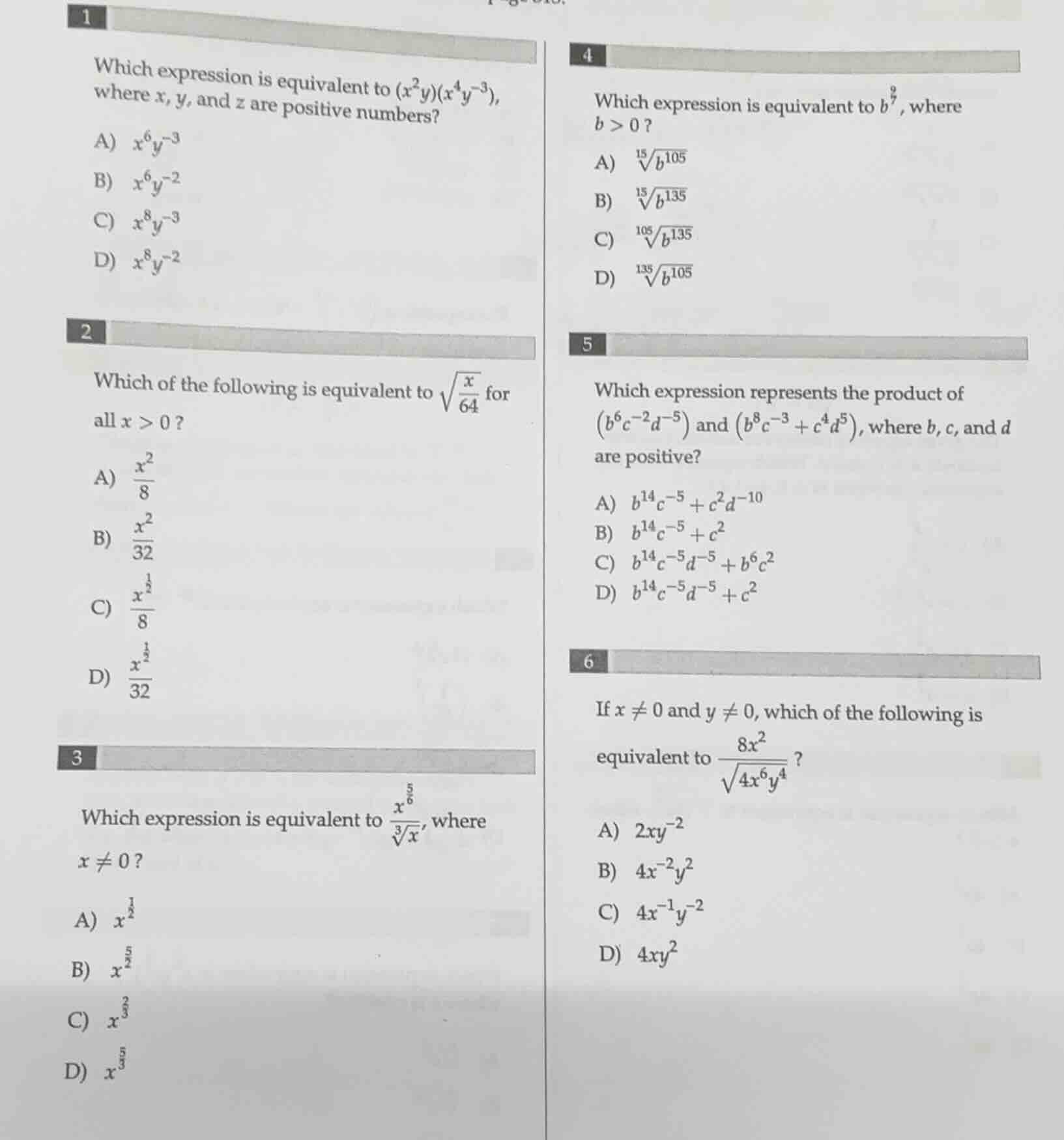
1 which expression is equivalent to ((x^2y)(x^4y^{-3})), where (x), (y), and (z) are positive numbers? a) (x^6y^{-3}) b) (x^6y^{-2}) c) (x^8y^{-3}) d) (x^8y^{-2}) 2 which of the following is equivalent to (sqrt{\frac{x}{64}}) for all (x > 0)? a) (\frac{x^2}{8}) b) (\frac{x^2}{32}) c) (\frac{x^{\frac{1}{2}}}{8}) d) (\frac{x^{\frac{1}{2}}}{32}) 3 which expression is equivalent to (\frac{x^{\frac{5}{6}}}{sqrt3{x}}), where (x
eq 0)? a) (x^{\frac{1}{2}}) b) (x^{\frac{5}{2}}) c) (x^{\frac{2}{3}}) d) (x^{\frac{5}{3}}) 4 which expression is equivalent to (b^{\frac{9}{7}}), where (b > 0)? a) (sqrt15{b^{105}}) b) (sqrt15{b^{135}}) c) (sqrt105{b^{135}}) d) (sqrt135{b^{105}}) 5 which expression represents the product of ((b^6c^{-2}d^{-5})) and ((b^8c^{-3}+c^4d^5)), where (b), (c), and (d) are positive? a) (b^{14}c^{-5}+c^2d^{-10}) b) (b^{14}c^{-5}+c^2) c) (b^{14}c^{-5}d^{-5}+b^6c^2) d) (b^{14}c^{-5}d^{-5}+c^2) 6 if (x
eq 0) and (y
eq 0), which of the following is equivalent to (\frac{8x^2}{sqrt{4x^6y^4}})? a) (2xy^{-2}) b) (4x^{-2}y^2) c) (4x^{-1}y^{-2}) d) (4xy^2)
Step1: Multiply like terms (x)
When multiplying exponents with the same base, add exponents: $x^2 \cdot x^4 = x^{2+4} = x^6$
Step2: Multiply like terms (y)
$y^1 \cdot y^{-3} = y^{1+(-3)} = y^{-2}$
Step1: Split the square root
$\sqrt{\frac{x}{64}} = \frac{\sqrt{x}}{\sqrt{64}}$
Step2: Simplify roots
$\sqrt{x} = x^\frac{1}{2}$, $\sqrt{64}=8$, so $\frac{x^\frac{1}{2}}{8}$
Step1: Rewrite root as exponent
$\sqrt[3]{x} = x^\frac{1}{3}$, so the expression becomes $\frac{x^\frac{5}{6}}{x^\frac{1}{3}}$
Step2: Subtract exponents
When dividing exponents with the same base, subtract exponents: $x^{\frac{5}{6}-\frac{1}{3}} = x^{\frac{5}{6}-\frac{2}{6}} = x^\frac{3}{6} = x^\frac{1}{2}$
Step1: Rewrite exponent as root
$b^\frac{9}{7} = \sqrt[7]{b^9}$. To match the options, find a common index: multiply numerator/denominator of the exponent by 15: $\frac{9}{7}=\frac{135}{105}$
Step2: Rewrite as root
$b^\frac{135}{105} = \sqrt[105]{b^{135}}$

Snap & solve any problem in the app
Get step-by-step solutions on Sovi AI
Photo-based solutions with guided steps
Explore more problems and detailed explanations
B) $x^6y^{-2}$
---