QUESTION IMAGE
Question
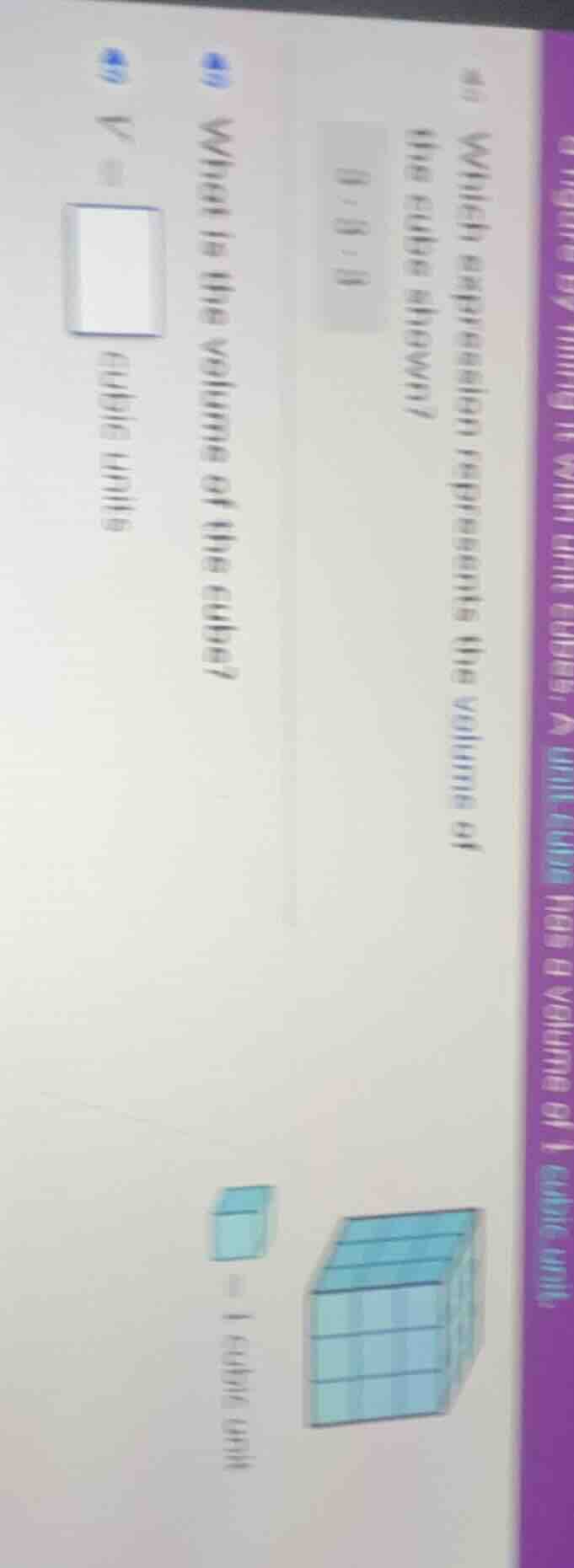
3? which expression represents the volume of the cube shown? 0·3·3 what is the volume of the cube? v = \square cubic units = 1 cubic unit
Step1: Determine side length of cube
From the diagram, the cube is made up of small cubes (1 cubic unit each). Observing the cube, each side (length, width, height) has 4 small cubes? Wait, no, looking at the cube's dimensions: wait, maybe the cube has side length 4? Wait, no, maybe the cube is composed of layers. Wait, the small cube is 1 cubic unit, so its side length is 1 unit. Now, looking at the big cube: let's count the number of small cubes along each edge. From the diagram, if we see that along length, width, and height, there are 4? Wait, no, maybe 4? Wait, no, maybe the cube has side length \( s \), and the volume of a cube is \( V = s^3 \). Wait, maybe the cube has side length 4? Wait, no, let's re-examine. Wait, the small cube is 1 cubic unit, so its edge length is 1 unit. Now, the big cube: let's see the number of small cubes along each edge. If we look at the diagram, the big cube has 4 layers? Wait, no, maybe the cube has side length 4? Wait, no, maybe the cube is 4x4x4? Wait, no, maybe the cube has side length 4? Wait, no, let's check again. Wait, the small cube is 1 cubic unit, so edge length 1. The big cube: if we count the number of small cubes along one edge, say, length: 4, width: 4, height: 4? No, wait, maybe the cube is 4 units on each side? Wait, no, maybe the cube has side length 4? Wait, no, let's think again. Wait, the volume of a cube is \( V = s \times s \times s \), where \( s \) is the side length. If each small cube is 1 cubic unit (so edge length 1), then if the big cube has side length \( s \), the number of small cubes is \( s^3 \), which is the volume. Wait, maybe the big cube has side length 4? Wait, no, maybe the cube has side length 4? Wait, no, let's look at the diagram again. Wait, the big cube: let's see the number of small cubes along each edge. If we see that along the length, there are 4 small cubes, along width 4, and height 4? Then volume would be \( 4 \times 4 \times 4 = 64 \)? Wait, no, maybe the cube has side length 4? Wait, no, maybe I made a mistake. Wait, maybe the cube has side length 4? Wait, no, let's check the diagram again. Wait, the small cube is 1 cubic unit, so edge length 1. The big cube: if we count the number of small cubes along one edge, say, length: 4, width: 4, height: 4. Then volume is \( 4 \times 4 \times 4 = 64 \)? Wait, no, maybe the cube has side length 4? Wait, no, maybe the cube is 4x4x4. Wait, but maybe the cube has side length 4? Wait, let's confirm. The volume of a cube is \( V = s^3 \). If each small cube is 1 cubic unit (edge length 1), then the side length of the big cube is equal to the number of small cubes along one edge. If the big cube has 4 small cubes along each edge, then \( s = 4 \), so \( V = 4^3 = 64 \). Wait, but maybe the cube has side length 4? Wait, no, maybe the cube is 4 units on each side. So volume is \( 4 \times 4 \times 4 = 64 \).
Step2: Calculate volume
Using the formula for the volume of a cube, \( V = s^3 \), where \( s \) is the side length. If the side length \( s = 4 \) (since each small cube is 1 unit, and there are 4 small cubes along each edge), then:
\( V = 4 \times 4 \times 4 \)
\( V = 64 \)

Snap & solve any problem in the app
Get step-by-step solutions on Sovi AI
Photo-based solutions with guided steps
Explore more problems and detailed explanations
64