QUESTION IMAGE
Question
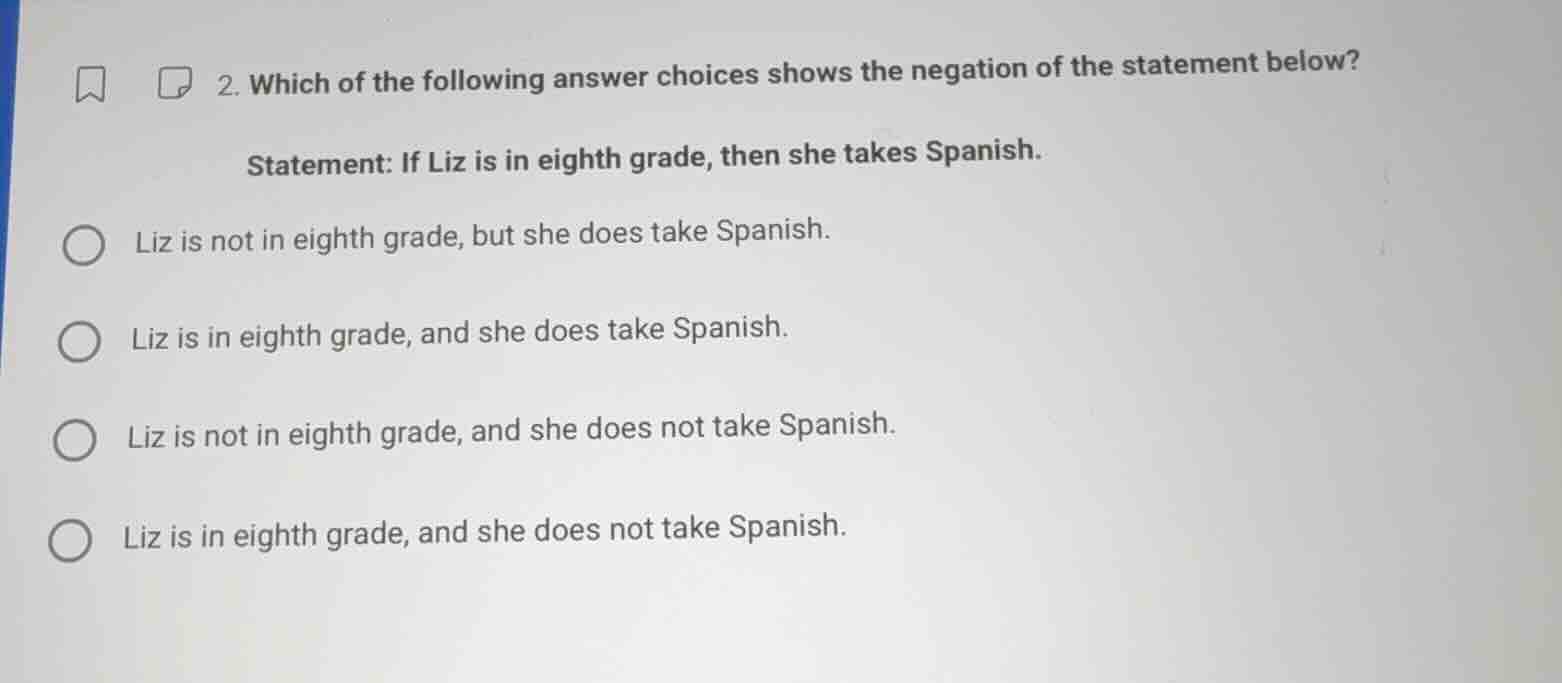
- which of the following answer choices shows the negation of the statement below?
statement: if liz is in eighth grade, then she takes spanish.
- liz is not in eighth grade, but she does take spanish.
- liz is in eighth grade, and she does take spanish.
- liz is not in eighth grade, and she does not take spanish.
- liz is in eighth grade, and she does not take spanish.
To find the negation of a conditional statement \( p \to q \) (where \( p \) is "Liz is in eighth grade" and \( q \) is "she takes Spanish"), we use the logical rule that the negation of \( p \to q \) is \( p \land
eg q \). This means we need the case where the antecedent (\( p \)) is true and the consequent (\( q \)) is false. So we check each option:
- First option: \(
eg p \land q \) – not the negation.
- Second option: \( p \land q \) – this is the statement itself, not the negation.
- Third option: \(
eg p \land
eg q \) – not the negation.
- Fourth option: \( p \land
eg q \) (Liz is in eighth grade (\( p \)) and she does not take Spanish (\(
eg q \))) – this matches the negation of \( p \to q \).

Snap & solve any problem in the app
Get step-by-step solutions on Sovi AI
Photo-based solutions with guided steps
Explore more problems and detailed explanations
D. Liz is in eighth grade, and she does not take Spanish. (assuming the last option is D; if the options are labeled differently, adjust the label but keep the text. Since the original options are unlabeled here but the last one is the correct negation, we identify it as the correct choice with its text.)