QUESTION IMAGE
Question
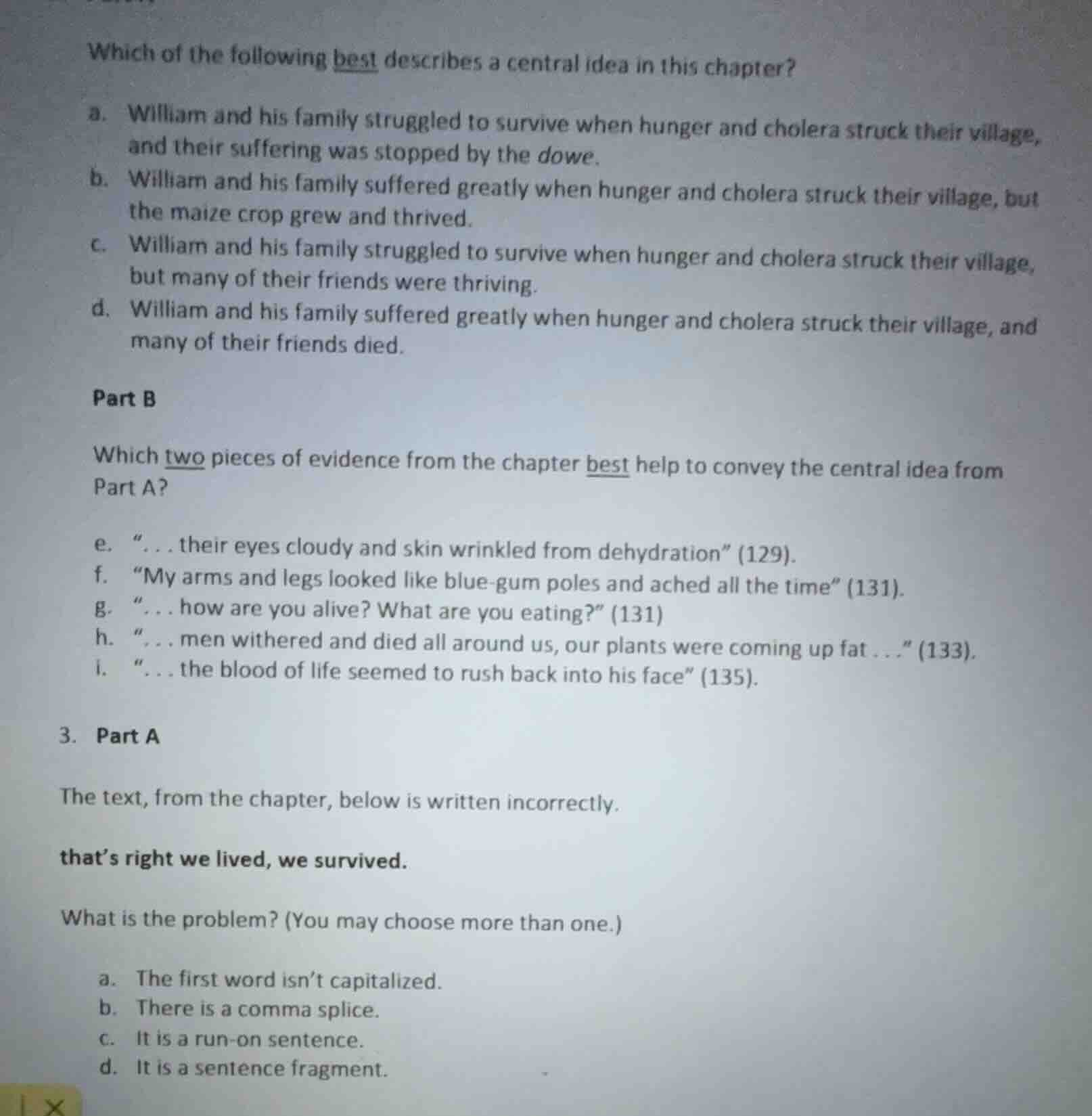
which of the following best describes a central idea in this chapter?
a. william and his family struggled to survive when hunger and cholera struck their village, and their suffering was stopped by the dowe.
b. william and his family suffered greatly when hunger and cholera struck their village, but the maize crop grew and thrived.
c. william and his family struggled to survive when hunger and cholera struck their village, but many of their friends were thriving.
d. william and his family suffered greatly when hunger and cholera struck their village, and many of their friends died.
part b
which two pieces of evidence from the chapter best help to convey the central idea from part a?
e. “... their eyes cloudy and skin wrinkled from dehydration” (129).
f. “my arms and legs looked like blue - gum poles and ached all the time” (131).
g. “... how are you alive? what are you eating?” (131)
h. “... men withered and died all around us, our plants were coming up fat...” (133).
i. “... the blood of life seemed to rush back into his face” (135).
- part a
the text, from the chapter, below is written incorrectly.
that’s right we lived, we survived.
what is the problem? (you may choose more than one.)
a. the first word isn’t capitalized.
b. there is a comma splice.
c. it is a run - on sentence.
d. it is a sentence fragment.
Part A (First Question)
- Option a: "dowe" is unclear and not a typical solution to hunger/cholera, so incorrect.
- Option b: If the maize crop grew while they suffered, it doesn't match typical central ideas of struggle.
- Option c: If friends were thriving, it contradicts the family's struggle, so incorrect.
- Option d: Suffering with friends dying aligns with the impact of hunger and cholera on the village.
- To support Part A's central idea (suffering and friends dying), we need evidence of suffering and death.
- Option e: Shows dehydration (suffering), relevant.
- Option f: Shows William's physical suffering, relevant.
- Option g: Asking about survival/eating doesn't show suffering/death.
- Option h: Men died and plants grew (contrast, shows suffering and death), relevant.
- Option i: Recovery, not suffering/death.
- So the two best are e, f, h? Wait, no, need to match Part A's idea (suffering and friends died). So h shows men died, e and f show suffering. Let's check: Part A's answer is d (suffered greatly, friends died). So evidence should be of suffering and death. So h ("men withered and died...") and either e or f (suffering). Let's pick h and e or f. Let's see: e is about others' dehydration, f is William's suffering, h is men dying. So two pieces: h and, say, f? Or e? Let's confirm. The central idea is suffering and friends died. So h (men died) and f (William's suffering) or e (others' suffering). Let's go with h and f? Wait, the options: e, f, h. Let's check each:
- e: "their eyes cloudy and skin wrinkled from dehydration" – shows suffering (dehydration from cholera/hunger).
- f: "My arms and legs...ached all the time" – William's suffering.
- h: "men withered and died all around us..." – friends dying.
So the two best are h (death) and either e or f (suffering). Let's pick h and f, or h and e. Let's see the options: e, f, h. So the two pieces are h and, say, f? Or e? Let's go with h and f? Wait, the problem says "two pieces". Let's check the options again. The correct evidence should support "suffered greatly" and "many of their friends died". So h is about men dying (friends died), and e or f is about suffering. So e: others' dehydration (suffering), f: William's suffering, h: men dying. So the two are h and, for example, f (William's suffering) or e (others' suffering). Let's pick h and f? Or h and e? Let's see the answer. The correct evidence should be h (death) and one of e/f (suffering). So the two pieces are h and, say, f. So the answer is f and h? Or e and h? Let's check the quotes:
- e: "their eyes cloudy and skin wrinkled from dehydration" (129) – shows suffering.
- f: "My arms and legs looked like blue - gum poles and ached all the time" (131) – shows William's suffering.
- h: "men withered and died all around us, our plants were coming up fat..." (133) – shows men died (friends died).
So the two best are h and, for example, f (William's suffering) or e (others' suffering). Let's go with h and f. Wait, but the options are e, f, g, h, i. So the two correct are h and f? Or h and e? Let's confirm with the central idea (suffered greatly, friends died). So h (friends died) and f (suffered greatly). So the two pieces are f and h.
- The sentence: "that’s right we lived, we survived."
- Option a: The first word "that" should be capitalized (That), so a is correct.
- Option b: Comma splice – two independent clauses ("that’s right we lived" and "we survived") joined by a comma. So b is correct.
- Option c: Run - on sentence – multiple independent clauses without proper punctuation, but here it's a comma splice (a type of run - on), but comma splice is more specific. Wait, a comma splice is a run - on with a comma. So if b is correct, c is also? Wait, no: a comma splice is a specific type of run - on (using a comma to join two independent clauses). So the sentence has "that’s right we lived, we survived" – two independent clauses ("that’s right we lived" and "we survived") joined by a comma – so comma splice (b) and also, the first word isn't capitalized (a). Is it a run - on? A run - on can be comma splice or fused sentence. So b (comma splice) is correct, a (first word not capitalized) is correct. Is it a run - on (c)? Yes, because it's a comma splice (a type of run - on). But let's check the options:
- a: First word not capitalized – correct.
- b: Comma splice – correct (two independent clauses with comma).
- c: Run - on sentence – since it's a comma splice, it is a run - on, so c is also correct? Wait, no, comma splice is a type of run - on. So a, b, c? But the options are a, b, c, d. d: sentence fragment – no, it's two independent clauses, not a fragment. So the problems are a (first word not capitalized) and b (comma splice) and c (run - on)? Wait, but the question says "you may choose more than one". Let's analyze:
- "that’s right we lived, we survived" – first word "that" should be "That" (a is correct).
- It has two independent clauses ("that’s right we lived" and "we survived") joined by a comma – comma splice (b is correct).
- A run - on sentence is two or more independent clauses joined without proper punctuation, so comma splice is a run - on, so c is also correct? But usually, comma splice is a type of run - on. So a, b, c? But let's check the options again. The sentence: "that’s right we lived, we survived."
- a: First word not capitalized – correct.
- b: Comma splice – correct (two independent clauses, comma between them).
- c: Run - on sentence – yes, because it's a comma splice (a type of run - on).
- d: Sentence fragment – no, it's two independent clauses, not a fragment.
So the correct options are a, b, c? Wait, but maybe the answer is a and b? Let's check standard grammar. A comma splice is a run - on, so if b is correct, c is also correct. But maybe the question considers comma splice (b) and first word (a) as the problems. Let's see: the sentence starts with "that’s" (should be "That’s"), so a is correct. Then, "we lived, we survived" – two independent clauses with a comma, so comma splice (b) and also a run - on (c). But maybe the answer is a and b. Let's confirm.

Snap & solve any problem in the app
Get step-by-step solutions on Sovi AI
Photo-based solutions with guided steps
Explore more problems and detailed explanations
d. William and his family suffered greatly when hunger and cholera struck their village, and many of their friends died.