QUESTION IMAGE
Question
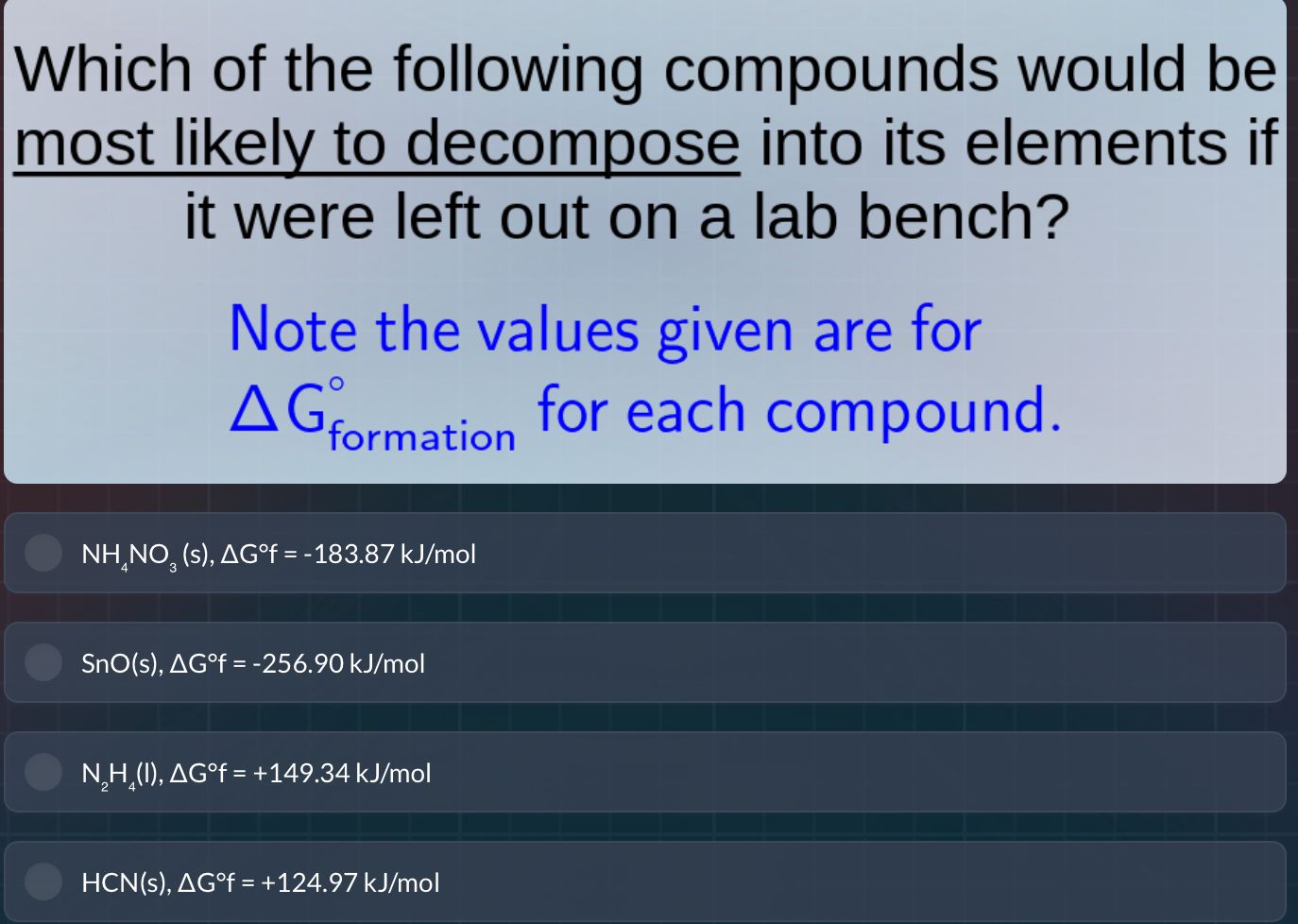
which of the following compounds would be most likely to decompose into its elements if it were left out on a lab bench? note the values given are for δg°_formation for each compound. nh₄no₃ (s), δg°f = -183.87 kj/mol sno(s), δg°f = -256.90 kj/mol n₂h₄(l), δg°f = +149.34 kj/mol hcn(s), δg°f = +124.97 kj/mol
Step1: Recall $\Delta G^\circ$ for decomposition
The decomposition of a compound into its elements is the reverse of its formation reaction. For a reaction, the Gibbs free energy change of the reverse reaction ($\Delta G^\circ_{\text{decomp}}$) is the negative of the Gibbs free energy of formation ($\Delta G^\circ_{\text{f}}$) of the compound: $\Delta G^\circ_{\text{decomp}} = -\Delta G^\circ_{\text{f}}$. A reaction is spontaneous (favorable) when $\Delta G^\circ < 0$. So, for decomposition to be spontaneous, $\Delta G^\circ_{\text{decomp}} < 0 \implies -\Delta G^\circ_{\text{f}} < 0 \implies \Delta G^\circ_{\text{f}} > 0$ (because multiplying both sides by -1 reverses the inequality).
Step2: Analyze each compound's $\Delta G^\circ_{\text{f}}$
- For $\ce{NH4NO3(s)}$, $\Delta G^\circ_{\text{f}} = -183.87\ \text{kJ/mol}$ (negative, so decomposition would have $\Delta G^\circ_{\text{decomp}} = 183.87\ \text{kJ/mol} > 0$, non - spontaneous).
- For $\ce{SnO(s)}$, $\Delta G^\circ_{\text{f}} = -256.90\ \text{kJ/mol}$ (negative, decomposition $\Delta G^\circ_{\text{decomp}} = 256.90\ \text{kJ/mol} > 0$, non - spontaneous).
- For $\ce{N2H4(l)}$, $\Delta G^\circ_{\text{f}} = +149.34\ \text{kJ/mol}$ (positive, decomposition $\Delta G^\circ_{\text{decomp}}=- 149.34\ \text{kJ/mol}<0$, spontaneous).
- For $\ce{HCN(s)}$, $\Delta G^\circ_{\text{f}} = +124.97\ \text{kJ/mol}$ (positive, decomposition $\Delta G^\circ_{\text{decomp}}=-124.97\ \text{kJ/mol}<0$, spontaneous).
Step3: Compare the magnitudes of $\Delta G^\circ_{\text{decomp}}$ for spontaneous cases
We need to find which compound is most likely to decompose. The more negative $\Delta G^\circ_{\text{decomp}}$ is, the more spontaneous the reaction. For $\ce{N2H4(l)}$, $\Delta G^\circ_{\text{decomp}}=- 149.34\ \text{kJ/mol}$; for $\ce{HCN(s)}$, $\Delta G^\circ_{\text{decomp}}=-124.97\ \text{kJ/mol}$. Since $- 149.34<-124.97$, the decomposition of $\ce{N2H4(l)}$ is more spontaneous.

Snap & solve any problem in the app
Get step-by-step solutions on Sovi AI
Photo-based solutions with guided steps
Explore more problems and detailed explanations
$\ce{N2H4(l)}$, $\Delta G^\circ\text{f}= + 149.34\ \text{kJ/mol}$