QUESTION IMAGE
Question
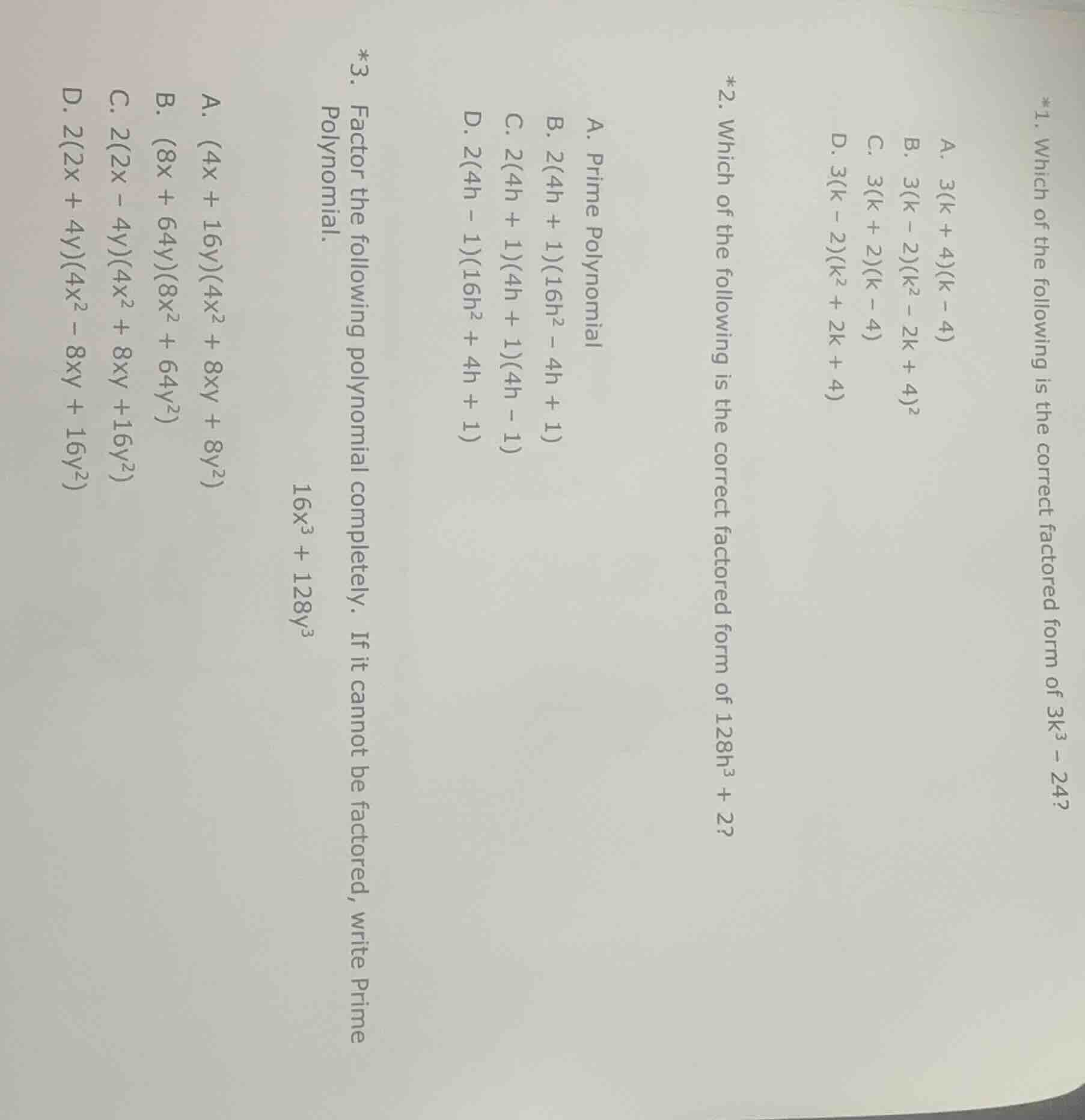
*1. which of the following is the correct factored form of $3k^3 - 24$?
a. $3(k + 4)(k - 4)$
b. $3(k - 2)(k^2 - 2k + 4)$
c. $3(k + 2)(k - 4)$
d. $3(k - 2)(k^2 + 2k + 4)$
*2. which of the following is the correct factored form of $128h^3 + 2$?
a. prime polynomial
b. $2(4h + 1)(16h^2 - 4h + 1)$
c. $2(4h + 1)(4h + 1)(4h - 1)$
d. $2(4h - 1)(16h^2 + 4h + 1)$
*3. factor the following polynomial completely. if it cannot be factored, write prime polynomial.
$16x^3 + 128y^3$
a. $(4x + 16y)(4x^2 + 8xy + 8y^2)$
b. $(8x + 64y)(8x^2 + 64y^2)$
c. $2(2x - 4y)(4x^2 + 8xy + 16y^2)$
d. $2(2x + 4y)(4x^2 - 8xy + 16y^2)$
Problem 1
Step1: Factor out 3 from \(3k^3 - 24\)
\(3k^3 - 24 = 3(k^3 - 8)\)
Step2: Recognize \(k^3 - 8\) as a difference of cubes (\(a^3 - b^3=(a - b)(a^2 + ab + b^2)\)) where \(a = k\), \(b = 2\)
\(k^3 - 8=(k - 2)(k^2 + 2k + 4)\)
Step3: Substitute back the factored form of \(k^3 - 8\)
\(3(k^3 - 8)=3(k - 2)(k^2 + 2k + 4)\)
Step1: Factor out 2 from \(128h^3+2\)
\(128h^3 + 2=2(64h^3 + 1)\)
Step2: Recognize \(64h^3 + 1\) as a sum of cubes (\(a^3 + b^3=(a + b)(a^2 - ab + b^2)\)) where \(a = 4h\), \(b = 1\)
\(64h^3+1=(4h + 1)(16h^2 - 4h + 1)\)
Step3: Substitute back the factored form of \(64h^3 + 1\)
\(2(64h^3 + 1)=2(4h + 1)(16h^2 - 4h + 1)\)
Step1: Factor out 16 from \(16x^3 + 128y^3\)
\(16x^3 + 128y^3=16(x^3 + 8y^3)\)
Step2: Recognize \(x^3 + 8y^3\) as a sum of cubes (\(a^3 + b^3=(a + b)(a^2 - ab + b^2)\)) where \(a = x\), \(b = 2y\)
\(x^3 + 8y^3=(x + 2y)(x^2 - 2xy + 4y^2)\)
Step3: Substitute back and simplify the factored form
\(16(x^3 + 8y^3)=16(x + 2y)(x^2 - 2xy + 4y^2)=2\times8(x + 2y)(x^2 - 2xy + 4y^2)=2(4x + 8y)(x^2 - 2xy + 4y^2)\) (Wait, let's re - check the options. Wait, the original polynomial is \(16x^3+128y^3\), factor out 16 first: \(16(x^3 + 8y^3)\), and \(x^3 + 8y^3=(x + 2y)(x^2-2xy + 4y^2)\), so \(16(x^3 + 8y^3)=16(x + 2y)(x^2 - 2xy + 4y^2)=2\times8(x + 2y)(x^2 - 2xy + 4y^2)\). But looking at the options, let's factor in another way. Wait, \(16x^3+128y^3 = 16(x^3 + 8y^3)=16(x + 2y)(x^2-2xy + 4y^2)\). But the options are in terms of \(2x\) and \(4y\) etc. Wait, maybe we made a mistake. Wait, \(16x^3+128y^3=16(x^3 + 8y^3)=16(x + 2y)(x^2 - 2xy + 4y^2)\). Let's check option C: \(2(2x - 4y)(4x^2 + 8xy + 16y^2)\) is incorrect. Wait, option A: \((4x + 16y)(4x^2+8xy + 8y^2)\) is wrong. Option B: \((8x + 64y)(8x^2 + 64y^2)\) is wrong. Wait, let's factor out 16: \(16(x^3 + 8y^3)=16(x + 2y)(x^2-2xy + 4y^2)\). If we factor 8 from the first factor: \(16(x + 2y)(x^2-2xy + 4y^2)=2\times8(x + 2y)(x^2-2xy + 4y^2)=2(8x + 16y)(x^2-2xy + 4y^2)\) which is not in the options. Wait, maybe there is a typo in the options or our approach is wrong. Wait, another way: \(16x^3+128y^3 = 16(x^3 + 8y^3)=16(x + 2y)(x^2-2xy + 4y^2)\). Let's check option C: \(2(2x - 4y)(4x^2 + 8xy + 16y^2)\). \(2(2x - 4y)=4(x - 2y)\), \((4x^2 + 8xy + 16y^2)=4(x^2 + 2xy + 4y^2)\), so \(2(2x - 4y)(4x^2 + 8xy + 16y^2)=8(x - 2y)(x^2 + 2xy + 4y^2)\) which is not equal to \(16x^3 + 128y^3\). Option D: \(2(2x + 4y)(4x^2 - 8xy + 16y^2)\). \(2(2x + 4y)=4(x + 2y)\), \((4x^2 - 8xy + 16y^2)=4(x^2 - 2xy + 4y^2)\), so \(2(2x + 4y)(4x^2 - 8xy + 16y^2)=16(x + 2y)(x^2 - 2xy + 4y^2)=16x^3+128y^3\). Oh! We made a mistake in the sign of the middle term. The correct factoring of \(x^3 + 8y^3=(x + 2y)(x^2-2xy + 4y^2)\), and in option D, \((4x^2 - 8xy + 16y^2)=4(x^2 - 2xy + 4y^2)\) and \(2(2x + 4y)=4(x + 2y)\), so \(4(x + 2y)\times4(x^2 - 2xy + 4y^2)=16(x + 2y)(x^2 - 2xy + 4y^2)=16x^3+128y^3\). So the correct factoring is \(2(2x + 4y)(4x^2 - 8xy + 16y^2)\)

Snap & solve any problem in the app
Get step-by-step solutions on Sovi AI
Photo-based solutions with guided steps
Explore more problems and detailed explanations
D. \(3(k - 2)(k^2 + 2k + 4)\)