QUESTION IMAGE
Question
which of the following explains the relationship between angles a and b?
To determine the relationship between angles \( A \) (let's assume angle \( a \)) and \( B \) (let's assume angle \( b \)):
Step 1: Identify the lines and intersection
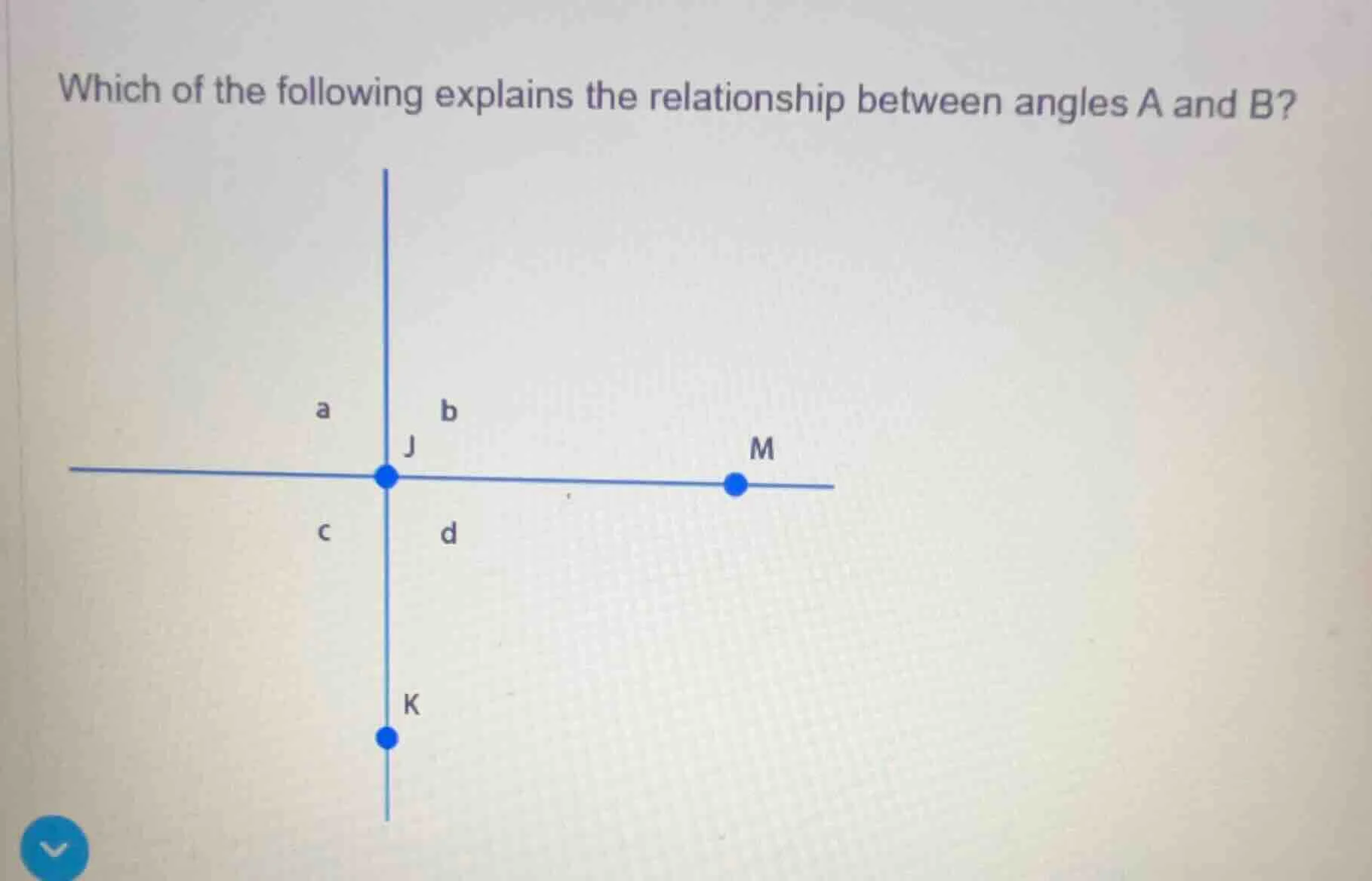
The diagram shows two perpendicular lines (a vertical and a horizontal line) intersecting at point \( J \). Perpendicular lines form right angles (\( 90^\circ \)) at their intersection.
Step 2: Analyze the angles
Angles \( a \) and \( b \) are adjacent angles formed by the intersection of the two perpendicular lines. Since the lines are perpendicular, the sum of angles \( a \) and \( b \) is \( 90^\circ \) (they are complementary angles) or, more precisely, they are adjacent angles that form a right angle (each is \( 90^\circ \) if we consider the standard perpendicular intersection, but typically, adjacent angles formed by perpendicular lines are complementary and each is \( 90^\circ \) only if they are vertical angles, but here \( a \) and \( b \) are adjacent and form a right angle). Wait, actually, when two lines are perpendicular, all four angles formed are right angles (\( 90^\circ \)). So angles \( a \) and \( b \) are both \( 90^\circ \) (they are congruent right angles) or adjacent angles that sum to \( 90^\circ \) (complementary). But more accurately, since the lines are perpendicular, the angle between them is \( 90^\circ \), so \( a + b = 90^\circ \) (complementary) or they are both \( 90^\circ \) (congruent).
Step 3: Conclusion
The relationship is that angles \( A \) and \( B \) are complementary (sum to \( 90^\circ \)) or congruent right angles (each \( 90^\circ \)) because they are formed by the intersection of two perpendicular lines.
(Note: If the options include "They are complementary angles (sum to \( 90^\circ \))" or "They are right angles (each \( 90^\circ \))", that would be the correct explanation. Since the diagram shows perpendicular lines, the angles formed are right angles, so \( A \) and \( B \) are adjacent angles that form a right angle, meaning they are complementary or each is \( 90^\circ \).)

Snap & solve any problem in the app
Get step-by-step solutions on Sovi AI
Photo-based solutions with guided steps
Explore more problems and detailed explanations
To determine the relationship between angles \( A \) (let's assume angle \( a \)) and \( B \) (let's assume angle \( b \)):
Step 1: Identify the lines and intersection
The diagram shows two perpendicular lines (a vertical and a horizontal line) intersecting at point \( J \). Perpendicular lines form right angles (\( 90^\circ \)) at their intersection.
Step 2: Analyze the angles
Angles \( a \) and \( b \) are adjacent angles formed by the intersection of the two perpendicular lines. Since the lines are perpendicular, the sum of angles \( a \) and \( b \) is \( 90^\circ \) (they are complementary angles) or, more precisely, they are adjacent angles that form a right angle (each is \( 90^\circ \) if we consider the standard perpendicular intersection, but typically, adjacent angles formed by perpendicular lines are complementary and each is \( 90^\circ \) only if they are vertical angles, but here \( a \) and \( b \) are adjacent and form a right angle). Wait, actually, when two lines are perpendicular, all four angles formed are right angles (\( 90^\circ \)). So angles \( a \) and \( b \) are both \( 90^\circ \) (they are congruent right angles) or adjacent angles that sum to \( 90^\circ \) (complementary). But more accurately, since the lines are perpendicular, the angle between them is \( 90^\circ \), so \( a + b = 90^\circ \) (complementary) or they are both \( 90^\circ \) (congruent).
Step 3: Conclusion
The relationship is that angles \( A \) and \( B \) are complementary (sum to \( 90^\circ \)) or congruent right angles (each \( 90^\circ \)) because they are formed by the intersection of two perpendicular lines.
(Note: If the options include "They are complementary angles (sum to \( 90^\circ \))" or "They are right angles (each \( 90^\circ \))", that would be the correct explanation. Since the diagram shows perpendicular lines, the angles formed are right angles, so \( A \) and \( B \) are adjacent angles that form a right angle, meaning they are complementary or each is \( 90^\circ \).)