QUESTION IMAGE
Question
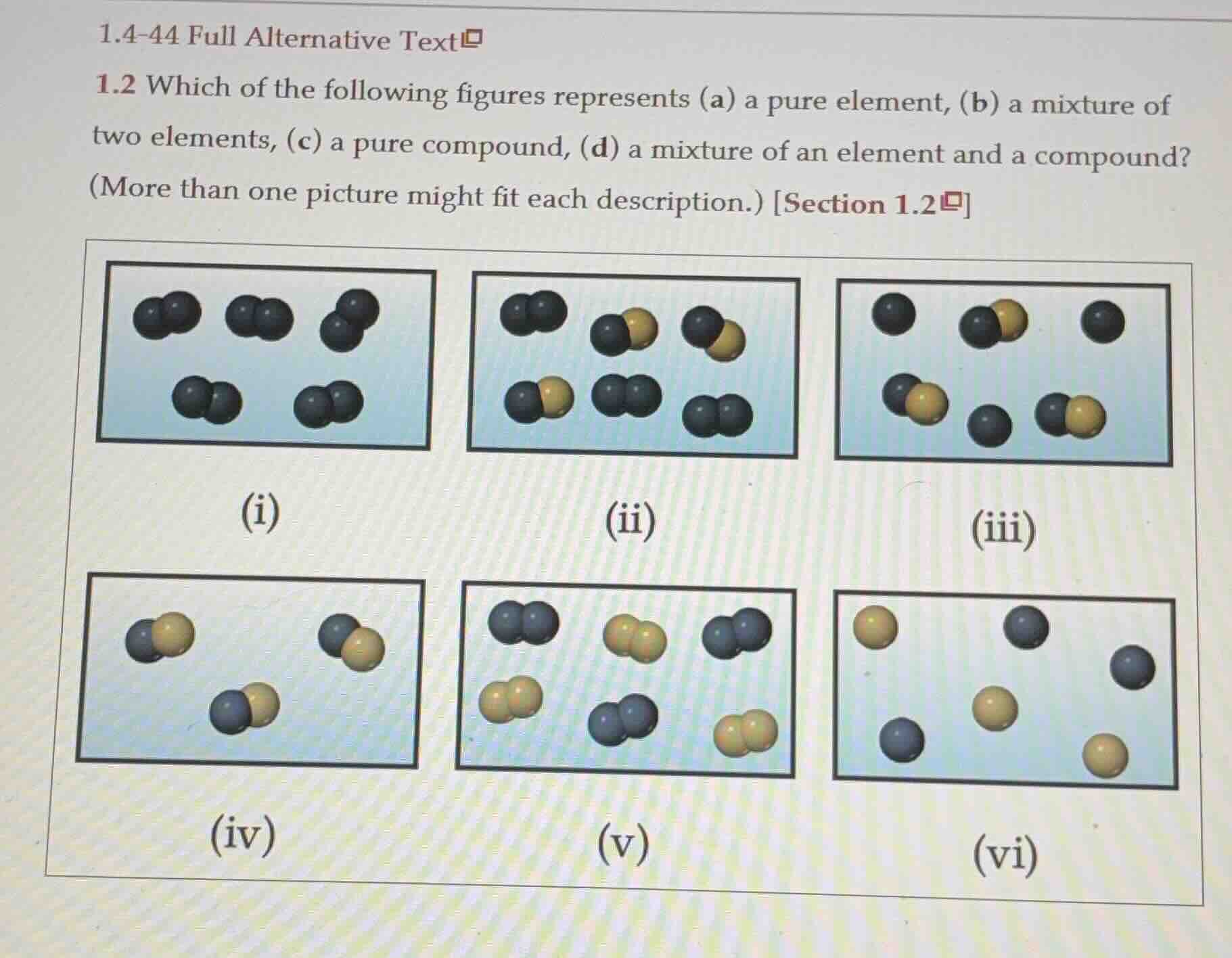
1.2 which of the following figures represents (a) a pure element, (b) a mixture of two elements, (c) a pure compound, (d) a mixture of an element and a compound? (more than one picture might fit each description.) section 1.2
Brief Explanations
To solve this, we analyze each figure based on the definitions:
- Pure Element: Consists of only one type of atom, bonded or not.
- Mixture of Two Elements: Contains two different types of uncombined atoms (or diatomic molecules of different elements).
- Pure Compound: Consists of only one type of molecule, with two or more different atoms bonded.
- Mixture of Element and Compound: Contains molecules of a compound and atoms (or molecules) of an element.
Part (a): Pure Element
- Figure (i): All molecules are diatomic of the same atom (pure element).
- Figure (v): Molecules are diatomic, two types (blue-blue and yellow-yellow), but wait—no, (v) has two types of diatomic molecules (blue₂ and yellow₂), which is a mixture of two elements. Wait, correction: (i) has only one type of diatomic molecule (all black-black), so pure element. (vi) has individual atoms, two types (yellow and blue), but they are uncombined? No, (vi) has separate atoms (not bonded), two types—mixture of two elements. Wait, no: pure element can be diatomic (same atom) or monatomic. So (i): diatomic, same atom → pure element. Any others? (v) has two diatomic elements (blue₂ and yellow₂) → mixture of two elements. So (i) is pure element.
Part (b): Mixture of Two Elements
- Figure (v): Diatomic molecules of two different elements (blue₂ and yellow₂) → mixture of two elements.
- Figure (vi): Individual atoms of two different elements (yellow and blue) → mixture of two elements.
Part (c): Pure Compound
- Figure (iv): All molecules are the same, with two different atoms (blue and yellow bonded) → pure compound.
Part (d): Mixture of Element and Compound
- Figure (ii): Contains diatomic black molecules (element) and black-yellow molecules (compound) → mixture of element and compound.
- Figure (iii): Contains individual black atoms (element) and black-yellow molecules (compound) → mixture of element and compound.

Snap & solve any problem in the app
Get step-by-step solutions on Sovi AI
Photo-based solutions with guided steps
Explore more problems and detailed explanations
(a) Pure Element: (i)
(b) Mixture of Two Elements: (v), (vi)
(c) Pure Compound: (iv)
(d) Mixture of Element and Compound: (ii), (iii)
(Note: For each part, identify the figures as per the analysis above.)