QUESTION IMAGE
Question
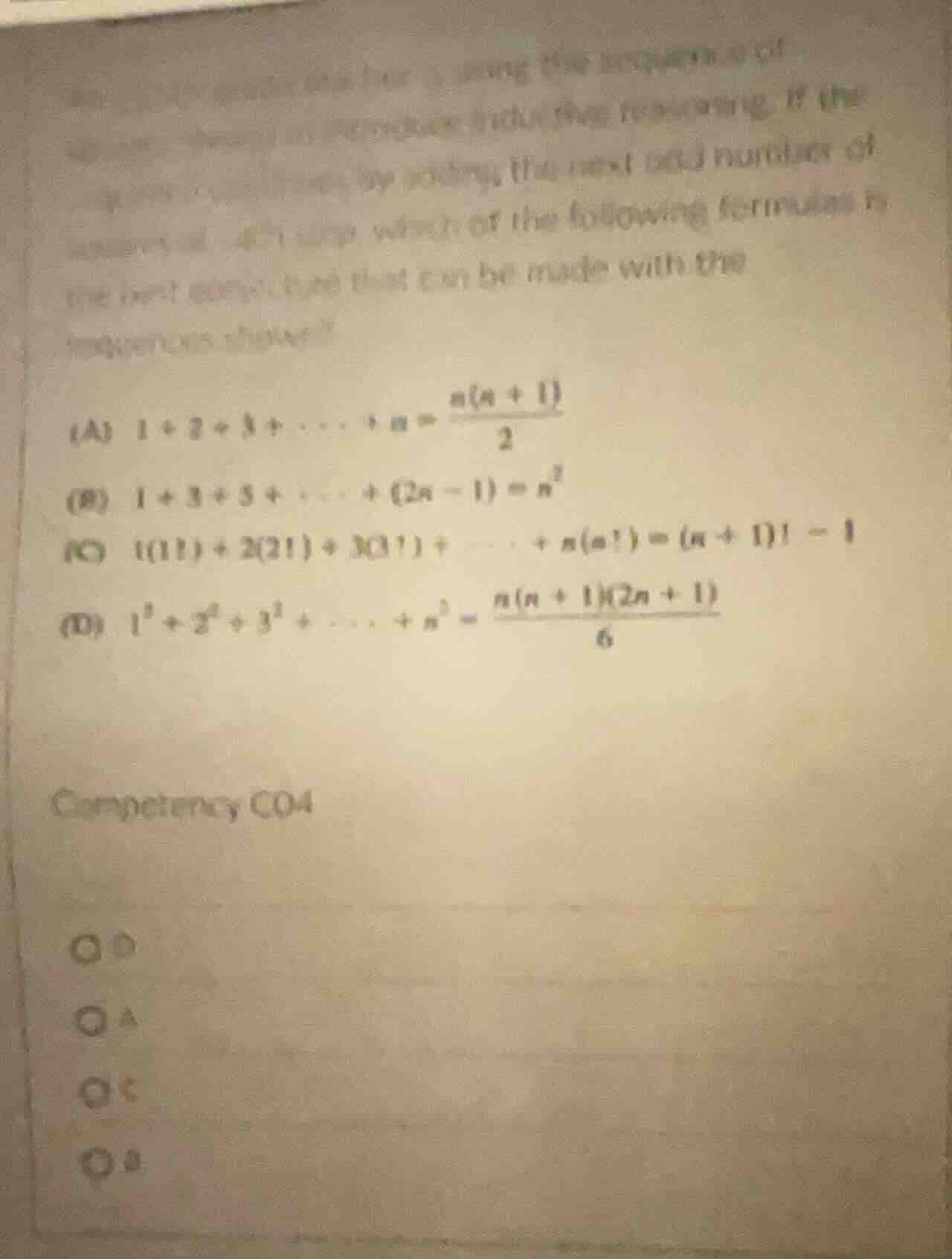
which of the following formulas is the best estimate that can be made with the sequences shown? (a) $1 + 2 + 3 + dots + n = \frac{n(n + 1)}{2}$ (b) $1 + 3 + 5 + dots + (2n - 1) = n^2$ (c) $1(1!) + 2(2!) + 3(3!) + dots + n(n!) = (n + 1)! - 1$ (d) $1^2 + 2^2 + 3^2 + dots + n^2 = \frac{n(n + 1)(2n + 1)}{6}$
To determine which formula is the least obvious (hardest to derive/identify) from the given options, we analyze each:
- Option A: The sum of the first \( n \) natural numbers is a well - known arithmetic series. The formula \( 1 + 2 + 3+\cdots + n=\frac{n(n + 1)}{2} \) is relatively intuitive. We can derive it by pairing terms (\( (1 + n)+(2+(n - 1))+\cdots \)) or using the arithmetic series sum formula \( S_n=\frac{n(a_1 + a_n)}{2} \) where \( a_1 = 1 \) and \( a_n=n \).
- Option B: The sum of the first \( n \) odd numbers \( 1+3 + 5+\cdots+(2n - 1) \). We can verify it with small values of \( n \) (e.g., \( n = 1 \): \( 1=1^2 \); \( n = 2 \): \( 1 + 3=4 = 2^2 \); \( n = 3 \): \( 1+3 + 5 = 9=3^2 \)) and also derive it using the arithmetic series sum formula with \( a_1 = 1 \), \( d = 2 \), and \( a_n=2n - 1 \). So it is relatively easy to recognize.
- Option C: The formula \( 1(1!)+2(2!)+3(3!)+\cdots + n(n!)=(n + 1)!-1 \). Let's prove it by induction or by manipulating factorials. We know that \( k(k!)=(k + 1)!-k! \). So when we sum \( \sum_{k = 1}^{n}k(k!)=\sum_{k = 1}^{n}[(k + 1)!-k!] \). This is a telescoping series. The first term when \( k = 1 \) is \( 2!-1! \), when \( k = 2 \) is \( 3!-2! \), \(\cdots\), when \( k=n \) is \( (n + 1)!-n! \). When we add these up, all the intermediate terms cancel out, and we are left with \( (n + 1)!-1!=(n + 1)!-1 \). However, the pattern of relating \( k(k!) \) to \( (k + 1)!-k! \) is not as immediately obvious as the patterns in the other options, especially for someone not familiar with factorial manipulations.
- Option D: The sum of the squares of the first \( n \) natural numbers \( 1^2+2^2+3^2+\cdots + n^2=\frac{n(n + 1)(2n + 1)}{6} \). While the derivation is a bit more involved than Option A or B (e.g., using algebraic manipulation, induction, or geometric - algebraic methods), the pattern of squaring numbers and the resulting formula is still more recognizable than the factorial - based telescoping series in Option C for many learners.
Among the four options, the formula in Option C is the least obvious as the relationship between the sum of \( k(k!) \) terms and \( (n + 1)!-1 \) is not as straightforward to spot initially compared to the other three formulas.

Snap & solve any problem in the app
Get step-by-step solutions on Sovi AI
Photo-based solutions with guided steps
Explore more problems and detailed explanations
C. \( 1(1!)+2(2!)+3(3!)+\cdots + n(n!)=(n + 1)!-1 \)