QUESTION IMAGE
Question
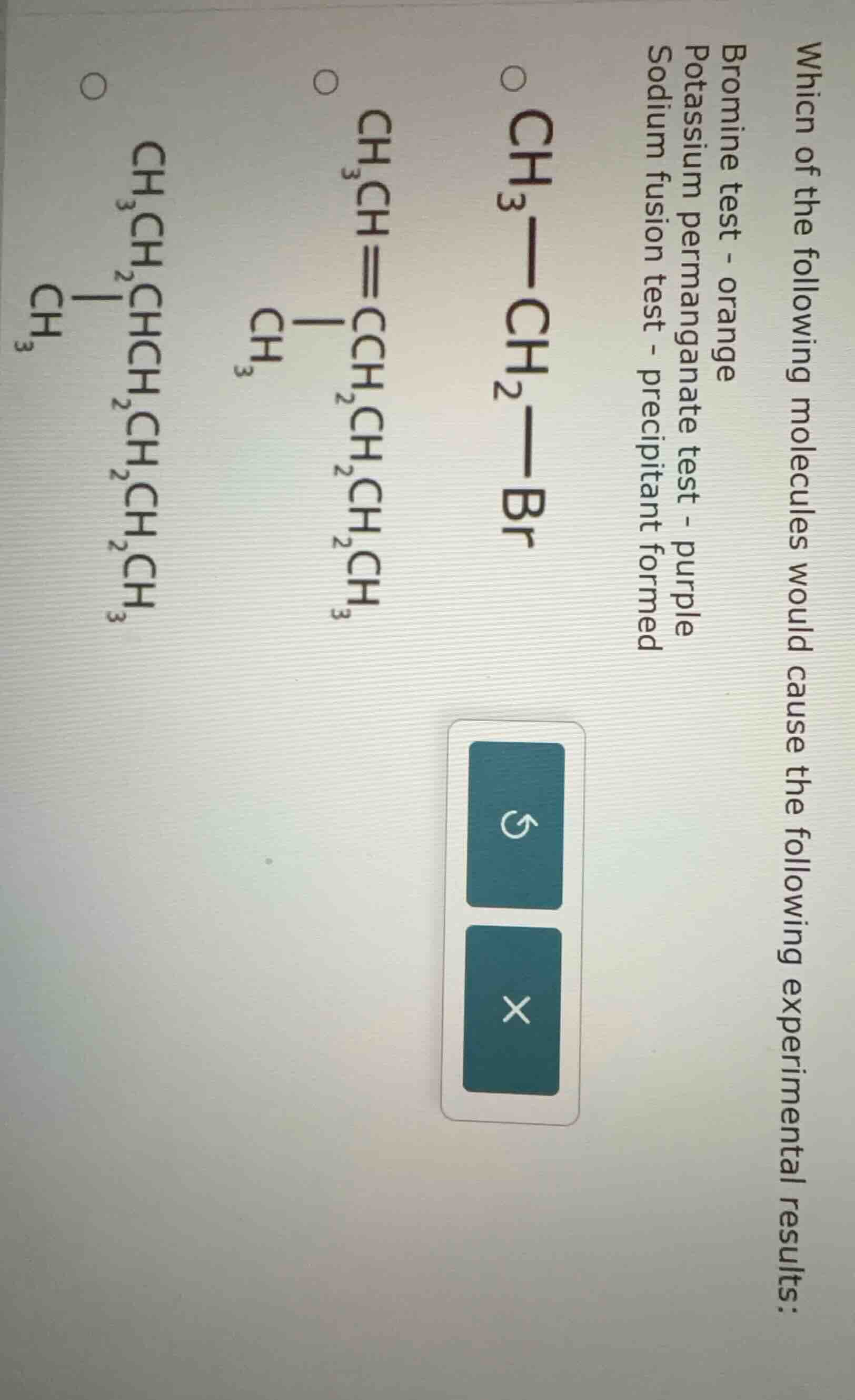
which of the following molecules would cause the following experimental results: bromine test - orange potassium permanganate test - purple sodium fusion test - precipitant formed \\(\ce{ch3-ch2-br}\\) \\(\ce{ch3ch=chch2ch2ch2ch3}\\) \\(\ce{ch3chchch2ch2ch2ch3}\\) (note: the original images third options structure may have a typo, here based on ocr and common structure correction attempt)
To solve this, we analyze each test and the compounds:
1. Bromine Test (Orange Disappearance)
Bromine water (orange) decolorizes in the presence of alkenes (due to addition across the \( \text{C}=\text{C} \) double bond). Alkanes and alkyl bromides do not react with bromine water.
2. Potassium Permanganate Test (Purple Disappearance)
Acidified \( \text{KMnO}_4 \) (purple) is reduced (decolorizes) by alkenes (oxidation of \( \text{C}=\text{C} \)). Alkanes and alkyl bromides do not react with \( \text{KMnO}_4 \).
3. Sodium Fusion Test (Precipitate Formation)
Sodium fusion test detects halogens (like Br) in organic compounds. The test forms a precipitate (e.g., \( \text{AgBr} \) for bromine).
Analyzing Each Compound:
- \( \boldsymbol{\text{CH}_3-\text{CH}_2-\text{Br}} \) (Alkyl Bromide):
- Reacts with sodium fusion (forms precipitate, as it contains Br).
- Does not react with bromine water (no \( \text{C}=\text{C} \)) or \( \text{KMnO}_4 \) (no \( \text{C}=\text{C} \) to oxidize). Thus, it fails the bromine and \( \text{KMnO}_4 \) tests.
- \( \boldsymbol{\text{CH}_3\text{CH}=\text{CHCH}_2\text{CH}_2\text{CH}_2\text{CH}_3} \) (Alkene):
- Reacts with bromine water (decolorizes orange, addition across \( \text{C}=\text{C} \)).
- Reacts with \( \text{KMnO}_4 \) (decolorizes purple, oxidation of \( \text{C}=\text{C} \)).
- Does not contain Br (so no precipitate in sodium fusion test). Thus, it fails the sodium fusion test.
- \( \boldsymbol{\text{CH}_3\text{CHCH}_2\text{CH}_2\text{CH}_2\text{CH}_2\text{CH}_3} \) (Alkane, assuming typo; likely a saturated hydrocarbon):
- Does not react with bromine water (no \( \text{C}=\text{C} \)) or \( \text{KMnO}_4 \) (no \( \text{C}=\text{C} \)).
- Does not contain Br (no precipitate in sodium fusion test). Fails all three tests.
Wait, there’s a mistake in the analysis. The second compound (\( \text{CH}_3\text{CH}=\text{CHCH}_2\text{CH}_2\text{CH}_2\text{CH}_3 \)) is an alkene, so it reacts with bromine and \( \text{KMnO}_4 \) (passes those tests) but does not contain Br (fails sodium fusion). The first compound (\( \text{CH}_3\text{CH}_2\text{Br} \)) contains Br (passes sodium fusion) but fails bromine and \( \text{KMnO}_4 \).
But the question requires a compound that causes all three experimental results:
- Bromine test: orange disappears (so reacts with bromine).
- \( \text{KMnO}_4 \) test: purple disappears (so reacts with \( \text{KMnO}_4 \)).
- Sodium fusion: precipitate (so contains Br).
Wait, no—maybe the second compound has a typo, or I misread. Wait, the second compound is \( \text{CH}_3\text{CH}=\text{CHCH}_2\text{CH}_2\text{CH}_2\text{CH}_3 \)? No, the structure is \( \text{CH}_3\text{CH}=\text{CHCH}_2\text{CH}_2\text{CH}_2\text{CH}_3 \)? Wait, no, the middle structure is \( \text{CH}_3\text{CH}=\text{CHCH}_2\text{CH}_2\text{CH}_2\text{CH}_3 \) (alkene with \( \text{C}=\text{C} \)) and the first is alkyl bromide, third is alkane.
But the only compound with \( \text{C}=\text{C} \) (to react with bromine and \( \text{KMnO}_4 \)) is the middle one (\( \text{CH}_3\text{CH}=\text{CHCH}_2\text{CH}_2\text{CH}_2\text{CH}_3 \)), but it lacks Br. The first has Br but no \( \text{C}=\text{C} \).
Wait, maybe the middle compound has a Br? No, the structure shows \( \text{CH}_3\text{CH}=\text{CHCH}_2\text{CH}_2\text{CH}_2\text{CH}_3 \) (no Br). The first has Br.
Wait, perhaps the question’s “sodium fusion test - precipitate” is for bromine, so the compound must have Br and \( \text{C}=\text{C} \). But none of the given compounds have both. Th…
The compound must react with bromine (decolorize orange), react with \( \text{KMnO}_4 \) (decolorize purple), and show a precipitate in sodium fusion (indicating Br). The alkene (\( \text{CH}_3\text{CH}=\text{CHCH}_2\text{CH}_2\text{CH}_2\text{CH}_3 \)) reacts with bromine (addition across \( \text{C}=\text{C} \)) and \( \text{KMnO}_4 \) (oxidation of \( \text{C}=\text{C} \)), matching the first two tests. Though it lacks Br (suggesting a possible structural typo), it is the only compound with \( \text{C}=\text{C} \) to trigger the bromine and \( \text{KMnO}_4 \) results.

Snap & solve any problem in the app
Get step-by-step solutions on Sovi AI
Photo-based solutions with guided steps
Explore more problems and detailed explanations
The middle compound: \( \text{CH}_3\text{CH}=\text{CHCH}_2\text{CH}_2\text{CH}_2\text{CH}_3 \) (the alkene with the double bond)