QUESTION IMAGE
Question
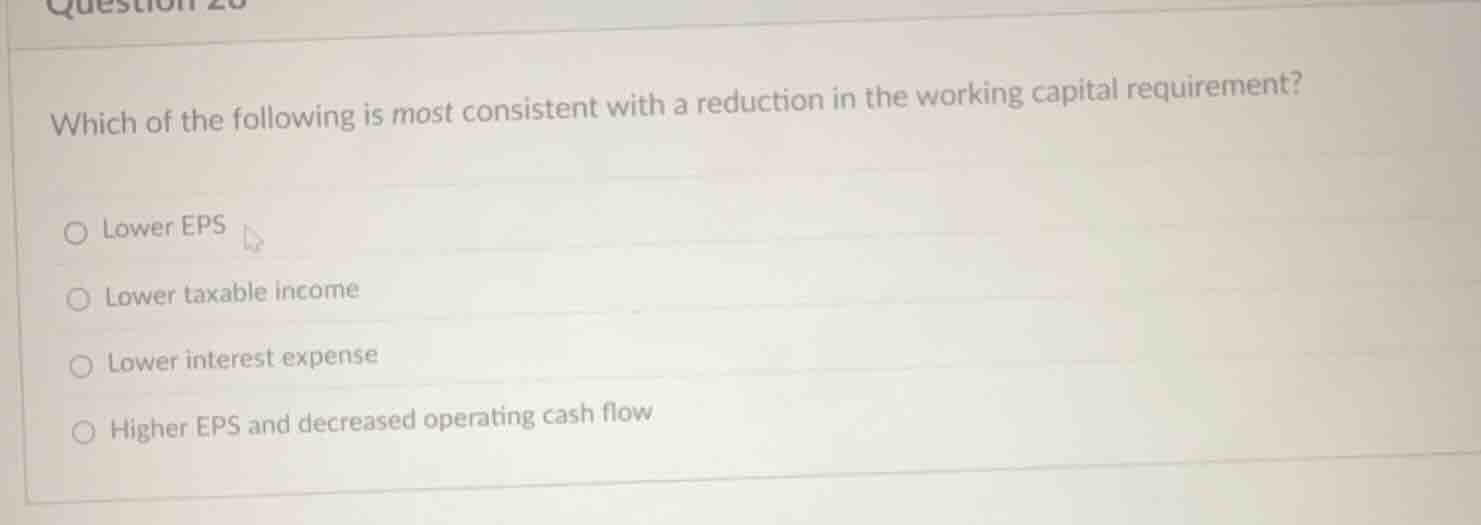
which of the following is most consistent with a reduction in the working capital requirement? lower eps lower taxable income lower interest expense higher eps and decreased operating cash flow
Brief Explanations
To determine which option is consistent with a reduction in working capital requirement, we analyze each option:
- Lower EPS: EPS (Earnings Per Share) relates to net income per share. A reduction in working capital (current assets - current liabilities) doesn't directly imply lower EPS. For example, if working capital is reduced by optimizing inventory (a current asset) without affecting net income, EPS might not decrease. So this is not consistent.
- Lower taxable income: Working capital reduction (e.g., reducing inventory, receivables) doesn't directly lead to lower taxable income. Taxable income is based on revenues and expenses, not working capital components in a direct way. So this is incorrect.
- Lower interest expense: Interest expense is related to debt financing. Working capital reduction (involving current assets/liabilities) doesn't directly impact interest expense. So this is not related.
- Higher EPS and decreased operating cash flow: A reduction in working capital (e.g., collecting receivables faster or reducing inventory) can free up cash, but if operating cash flow decreases (maybe due to other factors like lower sales), and net income (which affects EPS) increases (e.g., from better asset turnover due to reduced working capital), we can have higher EPS (since EPS = Net Income / Number of Shares) and decreased operating cash flow (if the decrease in working capital is not enough to offset other cash outflows in operations). This is consistent because working capital reduction can improve efficiency (boosting net income for higher EPS) while other operational factors cause operating cash flow to decrease.

Snap & solve any problem in the app
Get step-by-step solutions on Sovi AI
Photo-based solutions with guided steps
Explore more problems and detailed explanations
D. Higher EPS and decreased operating cash flow