QUESTION IMAGE
Question
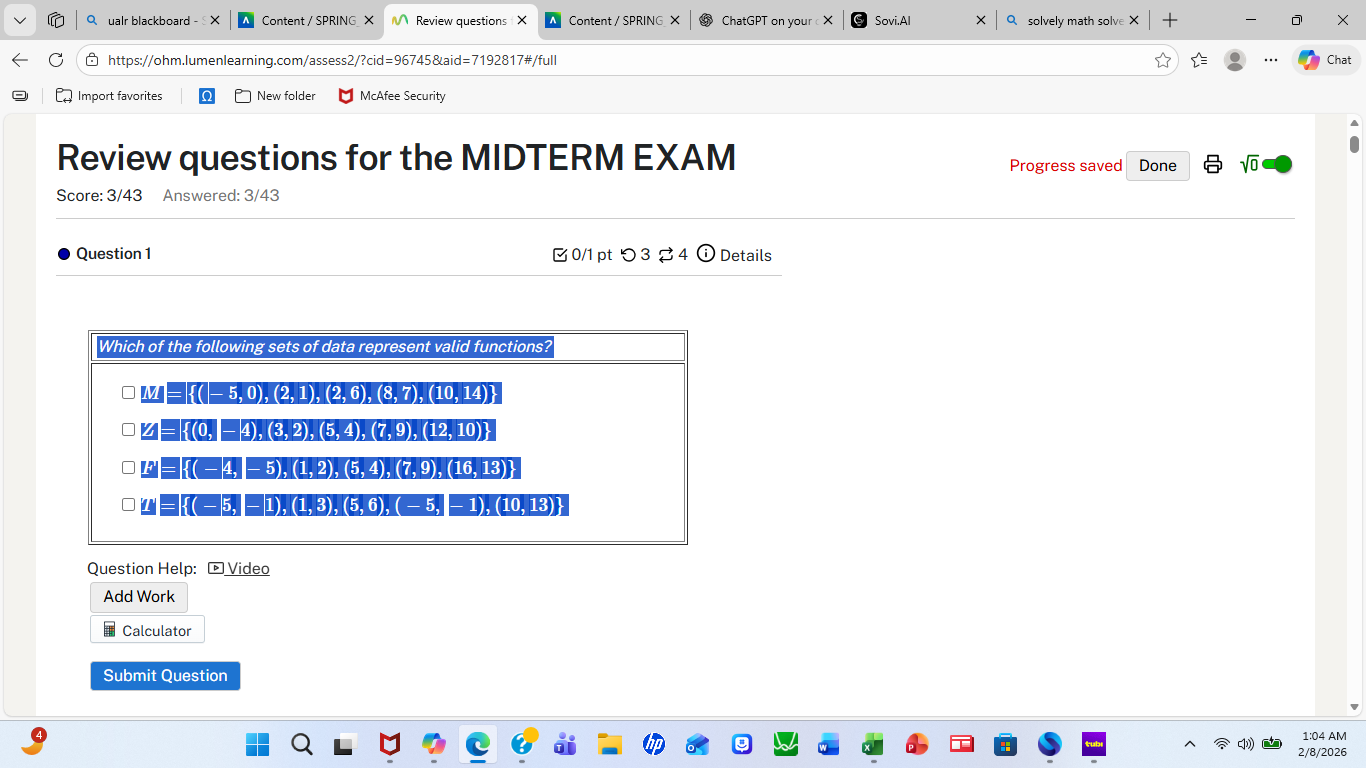
which of the following sets of data represent valid functions?
m = {(-5, 0), (2, 1), (2, 6), (8, 7), (10, 14)}
z = {(0, -4), (3, 2), (5, 4), (7, 9), (12, 10)}
r = {(-4, -5), (1, 2), (5, 4), (7, 9), (16, 13)}
t = {(-5, -1), (1, 3), (5, 6), (-5, -1), (10, 13)}
Step1: Recall function definition
A function is a relation where each input (x - value) has exactly one output (y - value). So we check each set for repeated x - values with different y - values.
Step2: Analyze set M
For \( M=\{(- 5,0),(2,1),(2,6),(8,7),(10,14)\} \), the x - value \( 2 \) is paired with \( 1 \) and \( 6 \). So \( M \) is not a function.
Step3: Analyze set Z
For \( Z =\{(0,-4),(3,2),(5,4),(7,9),(12,10)\} \), each x - value (\( 0,3,5,7,12 \)) has a unique y - value. So \( Z \) is a function.
Step4: Analyze set H
For \( H=\{(-4,-5),(1,2),(5,4),(7,9),(16,13)\} \), each x - value (\( - 4,1,5,7,16 \)) has a unique y - value. So \( H \) is a function.
Step5: Analyze set T
For \( T=\{(-5,-1),(1,3),(5,6),(-5,-1),(10,13)\} \), the x - value \( - 5 \) is paired with \( - 1 \) (repeated, but same y - value) and \( 1 \) is paired with \( 3 \), \( 5 \) with \( 6 \), \( 10 \) with \( 13 \). Wait, actually, in \( T \), the x - value \( - 5 \) has only one unique y - value (\( - 1 \), even though it's repeated), and other x - values are unique. Wait, no, let's re - check. Wait, the definition is each input has exactly one output. So if an x - value is repeated, it must have the same y - value. In \( T \), \( (-5,-1) \) is repeated, but the y - value is the same. But wait, let's check all x - values: \( - 5 \) (output \( - 1 \)), \( 1 \) (output \( 3 \)), \( 5 \) (output \( 6 \)), \( - 5 \) (output \( - 1 \)), \( 10 \) (output \( 13 \)). So \( - 5 \) has only one output (\( - 1 \)), \( 1 \) has one, \( 5 \) has one, \( 10 \) has one. Wait, but earlier for \( M \), the x - value \( 2 \) had two different outputs. But in \( T \), the repeated \( - 5 \) has the same output. Wait, but let's check the original sets again. Wait, the set \( T \) is \( \{(-5,-1),(1,3),(5,6),(-5,-1),(10,13)\} \). So the x - values are \( - 5,1,5,-5,10 \). The x - value \( - 5 \) is mapped to \( - 1 \) both times (same output), \( 1 \) to \( 3 \), \( 5 \) to \( 6 \), \( 10 \) to \( 13 \). So technically, it is a function? Wait, no, wait the definition of a function (in the context of discrete sets) is that for a relation \( f:X
ightarrow Y \), each \( x\in X \) has exactly one \( y\in Y \) such that \( (x,y)\in f \). So if an x - value is repeated, it must have the same y - value. In \( M \), \( x = 2 \) has two different y - values (\( 1 \) and \( 6 \)), so it's not a function. In \( Z \), all x - values are unique, so it's a function. In \( H \), all x - values are unique, so it's a function. In \( T \), the x - value \( - 5 \) is repeated but with the same y - value, and other x - values are unique. Wait, but maybe the problem considers the set of ordered pairs where each x - value (even if repeated) has the same y - value. But let's check the options again. Wait, the original question:
Wait, let's re - evaluate:
- For \( M \): \( x = 2 \) has \( y = 1 \) and \( y = 6 \) → not a function.
- For \( Z \): All x - values \( 0,3,5,7,12 \) are unique, so each has one y - value → function.
- For \( H \): All x - values \( - 4,1,5,7,16 \) are unique, so each has one y - value → function.
- For \( T \): \( x=-5 \) is repeated, but \( y = - 1 \) both times. But in the set of ordered pairs, when we define a function, the domain is the set of all x - values (with no repetition in terms of the mapping). Wait, actually, in a function, the domain is the set of input values, and each input has exactly one output. So if we have a relation where an input is repeated, but with the same output, it's still a function (because the input still has only one…

Snap & solve any problem in the app
Get step-by-step solutions on Sovi AI
Photo-based solutions with guided steps
Explore more problems and detailed explanations
The sets that represent valid functions are \( \boldsymbol{Z=\{(0, - 4),(3,2),(5,4),(7,9),(12,10)\}} \), \( \boldsymbol{H=\{(-4,-5),(1,2),(5,4),(7,9),(16,13)\}} \), and \( \boldsymbol{T=\{(-5,-1),(1,3),(5,6),(-5,-1),(10,13)\}} \) (the check - boxes next to \( Z \), \( H \), and \( T \) should be selected, and the check - box next to \( M \) should be unselected).