QUESTION IMAGE
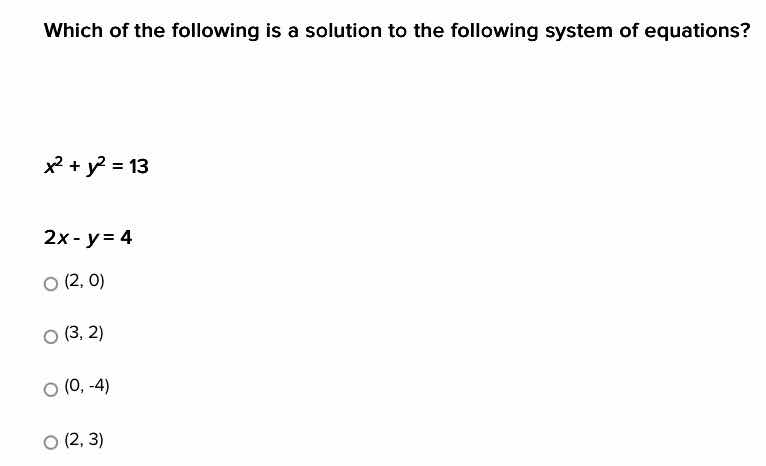
Question
which of the following is a solution to the following system of equations?
$x^2 + y^2 = 13$
$2x - y = 4$
(2, 0)
(3, 2)
(0, -4)
(2, 3)
Step1: Isolate y from linear equation
From $2x - y = 4$, rearrange to get $y = 2x - 4$.
Step2: Substitute y into circle equation
Substitute $y = 2x - 4$ into $x^2 + y^2 = 13$:
$$x^2 + (2x - 4)^2 = 13$$
Expand and simplify:
$$x^2 + 4x^2 - 16x + 16 = 13$$
$$5x^2 - 16x + 3 = 0$$
Step3: Solve quadratic equation
Factor the quadratic:
$$(5x - 1)(x - 3) = 0$$
Solutions: $x = 3$ or $x = \frac{1}{5}$
Step4: Find corresponding y values
For $x=3$: $y = 2(3) - 4 = 2$
For $x=\frac{1}{5}$: $y = 2(\frac{1}{5}) - 4 = -\frac{18}{5}$
Step5: Match with options
The pair $(3, 2)$ is among the given options. We can also verify by plugging into both equations:
- For $x=3, y=2$: $3^2 + 2^2 = 9 + 4 = 13$ (satisfies first equation)
- $2(3) - 2 = 6 - 2 = 4$ (satisfies second equation)

Snap & solve any problem in the app
Get step-by-step solutions on Sovi AI
Photo-based solutions with guided steps
Explore more problems and detailed explanations
B. (3, 2)