QUESTION IMAGE
Question
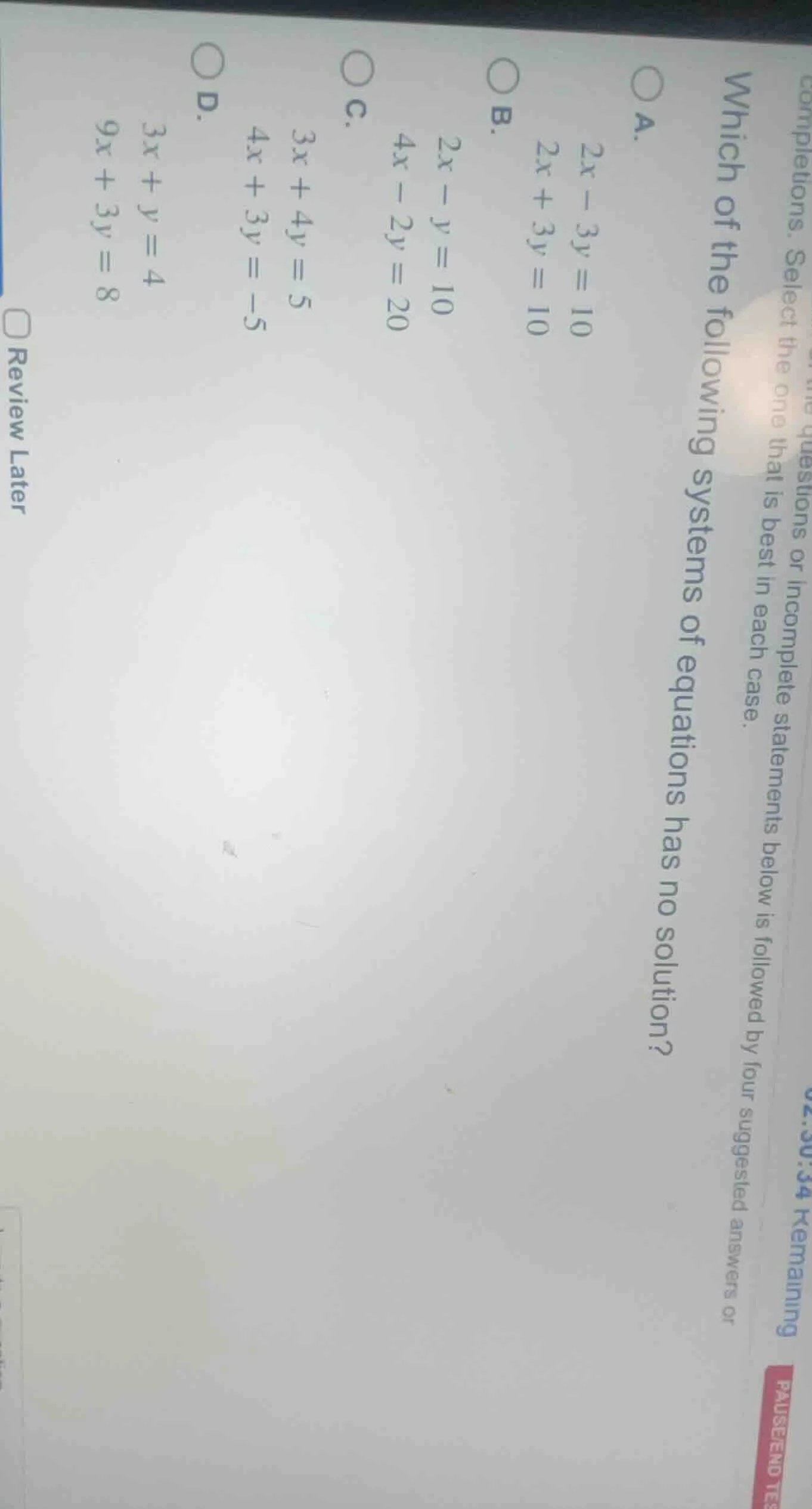
which of the following systems of equations has no solution?
a.
$2x - 3y = 10$
$2x + 3y = 10$
b.
$2x - y = 10$
$4x - 2y = 20$
c.
$3x + 4y = 5$
$4x + 3y = -5$
d.
$3x + y = 4$
$9x + 3y = 8$
To determine which system of equations has no solution, we analyze the slopes and intercepts of the lines represented by each system. A system of linear equations \(a_1x + b_1y = c_1\) and \(a_2x + b_2y = c_2\) has no solution if the lines are parallel, i.e., \(\frac{a_1}{a_2}=\frac{b_1}{b_2}
eq\frac{c_1}{c_2}\).
Step 1: Analyze Option A
The system is:
\[
\]
For the first equation, \(a_1 = 2\), \(b_1=-3\), \(c_1 = 10\). For the second equation, \(a_2 = 2\), \(b_2 = 3\), \(c_2 = 10\).
Check the ratios: \(\frac{a_1}{a_2}=\frac{2}{2}=1\), \(\frac{b_1}{b_2}=\frac{-3}{3}=-1\). Since \(1
eq - 1\), the lines are not parallel. They will intersect, so this system has a solution.
Step 2: Analyze Option B
The system is:
\[
\]
For the first equation, \(a_1 = 2\), \(b_1=-1\), \(c_1 = 10\). For the second equation, \(a_2 = 4\), \(b_2=-2\), \(c_2 = 20\).
Check the ratios: \(\frac{a_1}{a_2}=\frac{2}{4}=\frac{1}{2}\), \(\frac{b_1}{b_2}=\frac{-1}{-2}=\frac{1}{2}\), \(\frac{c_1}{c_2}=\frac{10}{20}=\frac{1}{2}\). Since \(\frac{a_1}{a_2}=\frac{b_1}{b_2}=\frac{c_1}{c_2}\), the two equations represent the same line. So, the system has infinitely many solutions.
Step 3: Analyze Option C
The system is:
\[
\]
For the first equation, \(a_1 = 3\), \(b_1 = 4\), \(c_1 = 5\). For the second equation, \(a_2 = 4\), \(b_2 = 3\), \(c_2=-5\).
Check the ratios: \(\frac{a_1}{a_2}=\frac{3}{4}\), \(\frac{b_1}{b_2}=\frac{4}{3}\). Since \(\frac{3}{4}
eq\frac{4}{3}\), the lines are not parallel. They will intersect, so this system has a solution.
Step 4: Analyze Option D
The system is:
\[
\]
For the first equation, \(a_1 = 3\), \(b_1 = 1\), \(c_1 = 4\). For the second equation, \(a_2 = 9\), \(b_2 = 3\), \(c_2 = 8\).
Check the ratios: \(\frac{a_1}{a_2}=\frac{3}{9}=\frac{1}{3}\), \(\frac{b_1}{b_2}=\frac{1}{3}\), \(\frac{c_1}{c_2}=\frac{4}{8}=\frac{1}{2}\).
Since \(\frac{a_1}{a_2}=\frac{b_1}{b_2}=\frac{1}{3}\) and \(\frac{1}{3}
eq\frac{1}{2}\), the lines are parallel and distinct. So, this system has no solution.

Snap & solve any problem in the app
Get step-by-step solutions on Sovi AI
Photo-based solutions with guided steps
Explore more problems and detailed explanations
D. \(
\)