QUESTION IMAGE
Question
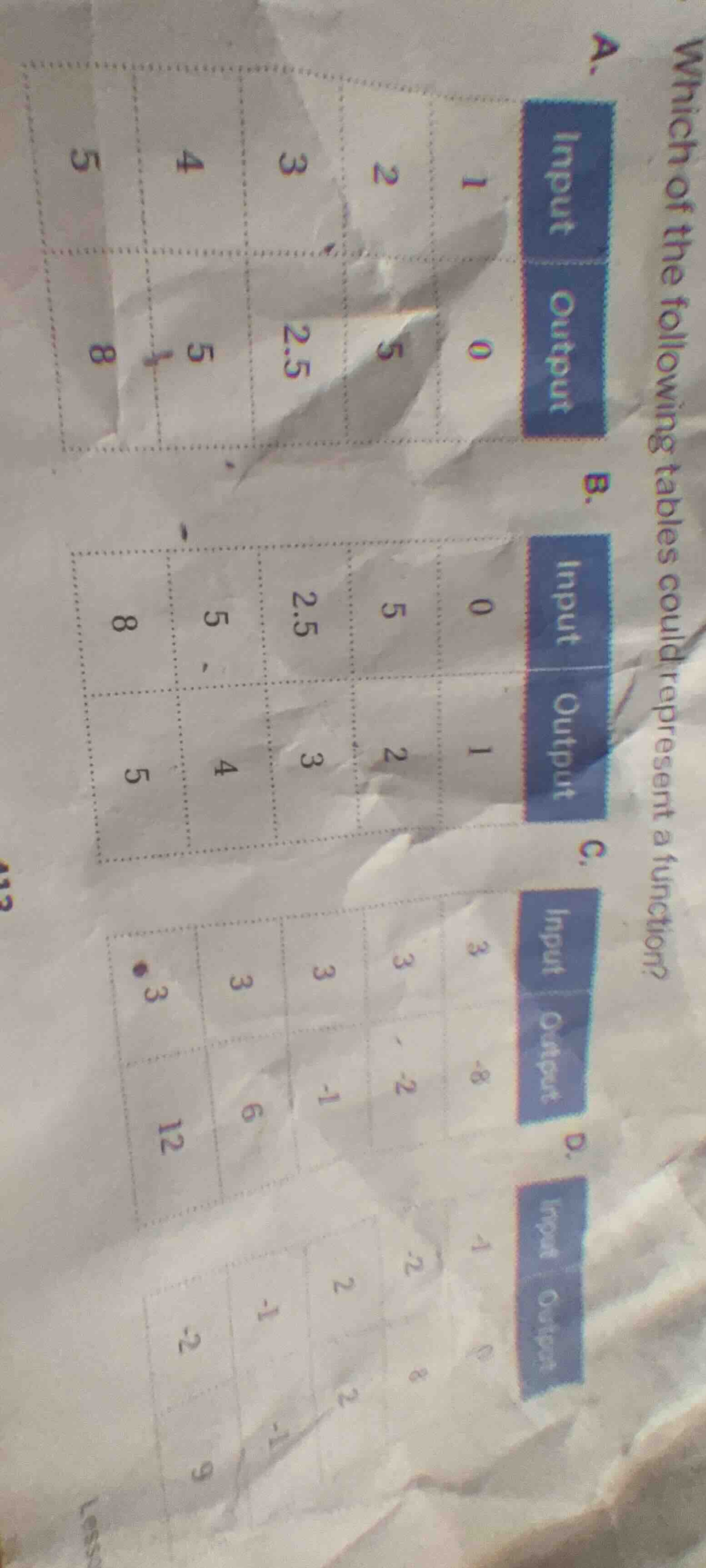
which of the following tables could represent a function? a. input 1 2 3 4 5 output 0 5 2.5 5 8 b. input 0 5 2.5 5 8 output 1 2 3 4 5 c. input 3 3 3 3 3 output -8 -2 -1 6 12 d. input 1 2 2 1 2 output 6 8 2 -1 9
To determine which table represents a function, we use the definition of a function: each input (x - value) must correspond to exactly one output (y - value).
Step 1: Analyze Table A
- Inputs: 1, 2, 3, 4, 5
- Outputs: 0, 5, 2.5, 5, 8
- Check for repeated inputs: All inputs are unique (1, 2, 3, 4, 5 each appear once). So each input has exactly one output. This could be a function. But let's check other tables to be sure.
Step 2: Analyze Table B
- Inputs: 0, 5, 2.5, 5, 8
- Outputs: 1, 2, 3, 4, 5
- The input 5 appears twice (in the input column, 5 is present more than once) and has different outputs (2 and 4). So this does not represent a function (one input has multiple outputs).
Step 3: Analyze Table C
- Inputs: 3, 3, 3, 3, 3
- Outputs: -8, -2, -1, 6, 12
- The input 3 appears multiple times and has different outputs. So this does not represent a function (one input has multiple outputs).
Step 4: Analyze Table D (assuming the table has repeated inputs with different outputs, from the partial view, if there are repeated inputs with different outputs)
- From the visible part, if there are repeated inputs with different outputs, it won't be a function. But since Table A has unique inputs (or repeated inputs? Wait, in Table A, input 2 and 4 both have output 5? Wait, no, wait the input column in Table A: Inputs are 1, 2, 3, 4, 5. Outputs are 0, 5, 2.5, 5, 8. Wait, input 2 has output 5, input 4 has output 5. But in a function, an input can have the same output as another input, but each input must have only one output. Wait, I made a mistake earlier. The key is: for a function, each input (x) must have exactly one output (y). It is okay for different inputs to have the same output.
Wait, let's re - examine:
For a relation to be a function, every input value (x) must map to exactly one output value (y).
Table A:
- Input 1 → 0 (only one output)
- Input 2 → 5 (only one output)
- Input 3 → 2.5 (only one output)
- Input 4 → 5 (only one output)
- Input 5 → 8 (only one output)
Even though input 2 and input 4 both map to 5, that is allowed in a function (multiple inputs can map to the same output, but a single input cannot map to multiple outputs).
Table B:
- Input 5 → output 2 and output 4 (same input, different outputs) → not a function.
Table C:
- Input 3 → multiple outputs → not a function.
Table D: Let's assume the input column has repeated values (from the partial view, if there are repeated inputs with different outputs) → not a function.
So Table A is the one that represents a function. Wait, but wait the original Table A:
Wait the user's Table A:
Input: 1, 2, 3, 4, 5
Output: 0, 5, 2.5, 5, 8
So input 2: output 5; input 4: output 5. But each input (2 and 4) has only one output (5 for input 2, 5 for input 4). So it is a function because each input has exactly one output (even if different inputs have the same output).
Table B: input 5 appears twice (in the input row) with outputs 2 and 4 → same input, different outputs → not a function.
Table C: input 3 appears multiple times with different outputs → not a function.
So the correct table is Table A.

Snap & solve any problem in the app
Get step-by-step solutions on Sovi AI
Photo-based solutions with guided steps
Explore more problems and detailed explanations
A. (The table where Input is 1, 2, 3, 4, 5 and Output is 0, 5, 2.5, 5, 8)