QUESTION IMAGE
Question
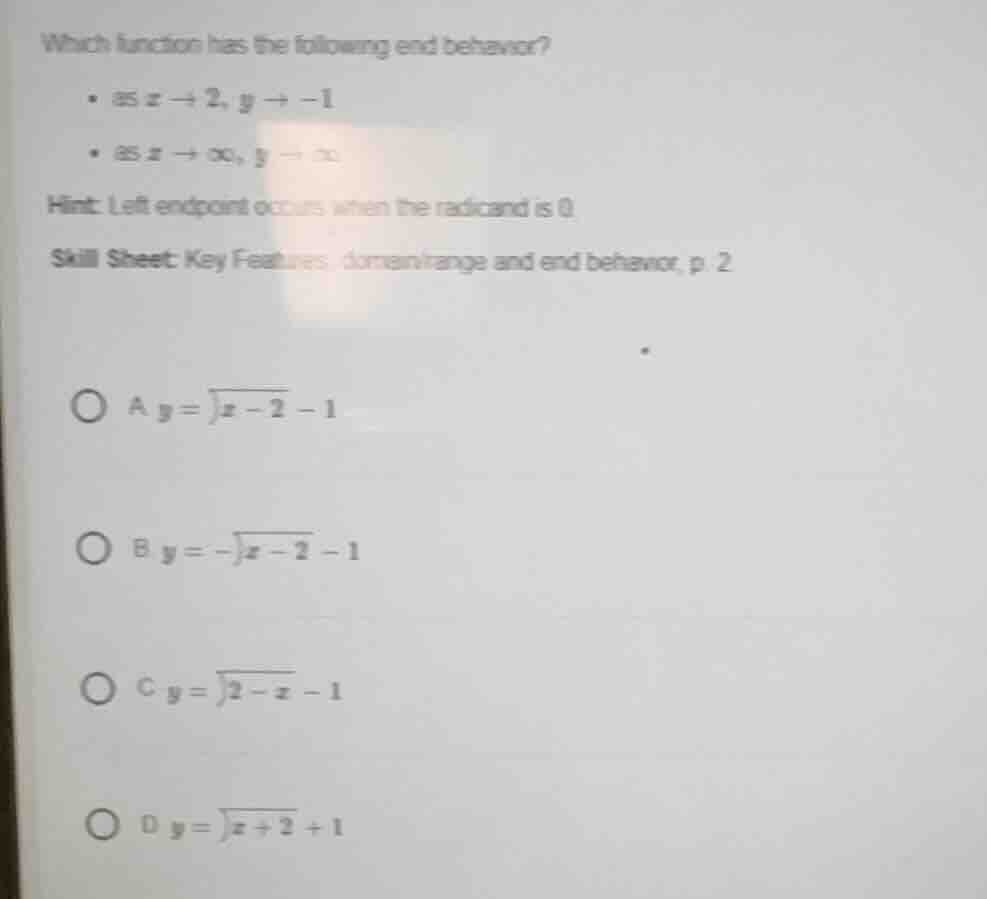
which function has the following end behavior?
- as ( x \to 2 ), ( y \to -1 )
- as ( x \to infty ), ( y \to infty )
hint: left endpoint occurs when the radicand is 0.
skill sheet: key features: domain/range and end behavior, p. 2
a ( y = sqrt{x - 2} - 1 )
b ( y = -sqrt{x - 2} - 1 )
c ( y = sqrt{2 - x} - 1 )
d ( y = sqrt{x + 2} + 1 )
- Analyze the end - behavior as \(x
ightarrow2\):
- For option A: \(y = \sqrt{x - 2}-1\). When \(x
ightarrow2\), \(\sqrt{x - 2}
ightarrow0\), so \(y
ightarrow0 - 1=-1\). When \(x
ightarrow\infty\), \(\sqrt{x - 2}
ightarrow\infty\), so \(y=\sqrt{x - 2}-1
ightarrow\infty\).
- For option B: \(y=-\sqrt{x - 2}-1\). When \(x
ightarrow\infty\), \(\sqrt{x - 2}
ightarrow\infty\), then \(y =-\sqrt{x - 2}-1
ightarrow-\infty\), which does not match the given end - behavior (\(y
ightarrow\infty\) as \(x
ightarrow\infty\)).
- For option C: \(y=\sqrt{2 - x}-1\). The domain of this function is \(2 - x\geq0\) or \(x\leq2\). As \(x
ightarrow\infty\), the function is not defined (since \(x>2\) is not in the domain), so it does not match the end - behavior (\(x
ightarrow\infty\) is part of the end - behavior we need to consider).
- For option D: \(y=\sqrt{x + 2}+1\). When \(x
ightarrow2\), \(y=\sqrt{2 + 2}+1=\sqrt{4}+1 = 2 + 1=3
eq - 1\), so it does not match the end - behavior as \(x
ightarrow2\).

Snap & solve any problem in the app
Get step-by-step solutions on Sovi AI
Photo-based solutions with guided steps
Explore more problems and detailed explanations
A. \(y=\sqrt{x - 2}-1\)