QUESTION IMAGE
Question
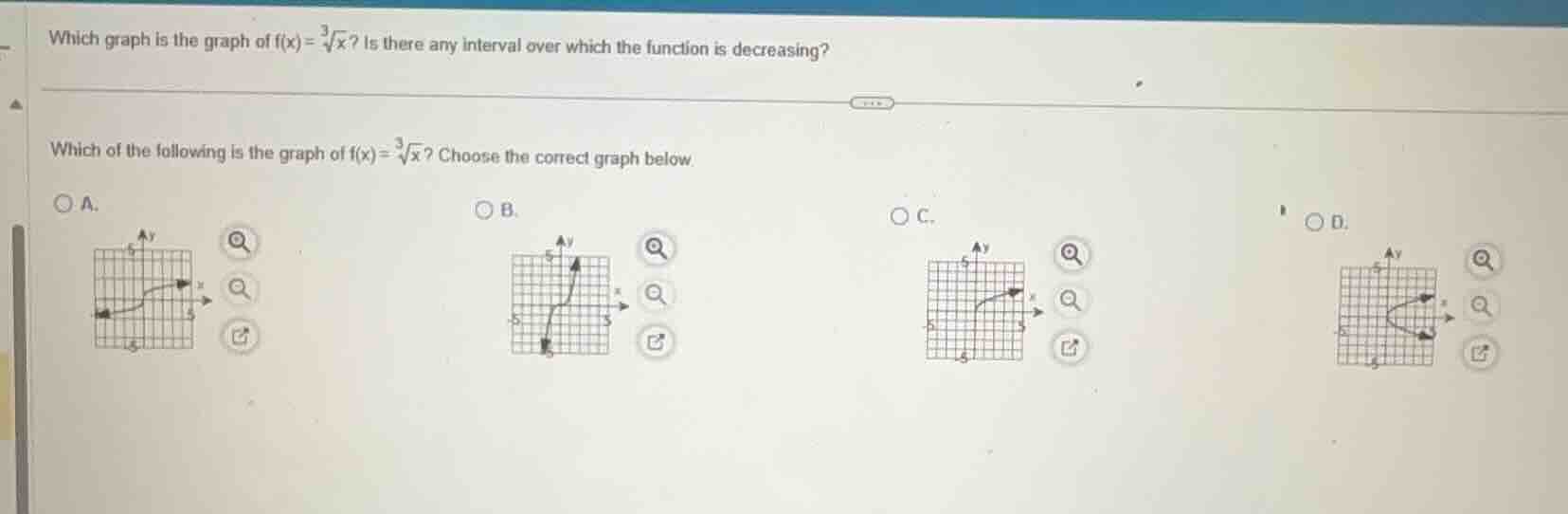
which graph is the graph of ( f(x)=sqrt3{x} )? is there any interval over which the function is decreasing?
which of the following is the graph of ( f(x)=sqrt3{x} )? choose the correct graph below.
a.
b.
c.
d.
Step1: Recall the properties of \( f(x)=\sqrt[3]{x} \)
The cube - root function \( y = \sqrt[3]{x} \) has the following properties:
- The domain of \( y=\sqrt[3]{x} \) is all real numbers (\( (-\infty,\infty) \)) because we can take the cube - root of any real number.
- The range of \( y = \sqrt[3]{x} \) is also all real numbers (\( (-\infty,\infty) \)) because for any real number \( y \), we can find an \( x=y^{3} \) such that \( \sqrt[3]{x}=y \).
- The function \( y = \sqrt[3]{x} \) is an odd function, which means \( f(-x)=-f(x) \). The graph of an odd function is symmetric about the origin.
- The derivative of \( f(x)=\sqrt[3]{x}=x^{\frac{1}{3}} \) is \( f^\prime(x)=\frac{1}{3}x^{-\frac{2}{3}}=\frac{1}{3\sqrt[3]{x^{2}}} \). The derivative is non - negative for all \( x
eq0 \) (since the denominator \( 3\sqrt[3]{x^{2}}>0 \) for \( x
eq0 \)) and \( f^\prime(0) \) is undefined (but the function is continuous at \( x = 0 \)). So the function is increasing on \( (-\infty,0) \) and \( (0,\infty) \), and since it is continuous at \( x = 0 \), it is increasing on \( (-\infty,\infty) \).
Step2: Analyze the options
- Option A: The graph does not show the symmetry about the origin and also does not match the shape of the cube - root function.
- Option B: The graph has a "corner" or a non - smooth point and does not show the symmetry about the origin. It looks more like a piece - wise function with a vertical shift or a different type of function (maybe a square - root related function for \( x\geq0 \) and something else for \( x < 0 \)), not the cube - root function.
- Option C: The graph of the cube - root function \( y=\sqrt[3]{x} \) has a smooth curve, passes through the origin, is symmetric about the origin, and is increasing everywhere. The shape of option C (assuming the graph is the standard cube - root graph) matches the properties of \( y = \sqrt[3]{x} \).
- Option D: The graph is not a function (it fails the vertical line test) since for some \( x \)-values, there are multiple \( y \)-values. The cube - root function is a function, so it must pass the vertical line test.

Snap & solve any problem in the app
Get step-by-step solutions on Sovi AI
Photo-based solutions with guided steps
Explore more problems and detailed explanations
To determine if the function is decreasing:
The derivative of \( f(x)=\sqrt[3]{x} \) is \( f^\prime(x)=\frac{1}{3\sqrt[3]{x^{2}}} \). For all \( x\in(-\infty,0)\cup(0,\infty) \), \( f^\prime(x)>0 \) (because the denominator \( 3\sqrt[3]{x^{2}}>0 \) for \( x
eq0 \)) and at \( x = 0 \), the function is continuous. So the function \( f(x)=\sqrt[3]{x} \) is increasing on \( (-\infty,\infty) \), and there is no interval over which the function is decreasing.
For the graph of \( f(x)=\sqrt[3]{x} \), the correct option is the one that has a smooth curve passing through the origin, symmetric about the origin, and increasing everywhere. If we assume the standard options, the correct graph is the one that matches the properties of the cube - root function (usually, among the given options, the graph with the shape that is symmetric about the origin and increasing). If we consider the visual cues (even though we can't see the exact graphs clearly, based on the properties), the graph of \( y = \sqrt[3]{x} \) is symmetric about the origin, increasing, and passes through \( (0,0) \), \( (1,1) \), and \( (- 1,-1) \).
For the first part (graph of \( f(x)=\sqrt[3]{x} \)): The correct graph is the one that has the shape of the cube - root function (symmetric about the origin, increasing, passes through \( (0,0) \), \( (1,1) \), \( (-1,-1) \)). For the second part (interval of decreasing): There is no interval over which the function \( f(x)=\sqrt[3]{x} \) is decreasing.
If we assume the options are as follows (from the general form of such questions):
The graph of \( f(x)=\sqrt[3]{x} \) is the one that is symmetric about the origin and increasing. And the function \( f(x)=\sqrt[3]{x} \) is not decreasing on any interval.
For the graph selection, if we consider the standard graphs:
The graph of \( y = \sqrt[3]{x} \) has a smooth curve, passes through the origin, and is symmetric about the origin. So if we have to choose from the given options (assuming the correct graph is the one with the shape of the cube - root function, say option C if it has the correct shape), and for the decreasing interval, the answer is no.