QUESTION IMAGE
Question
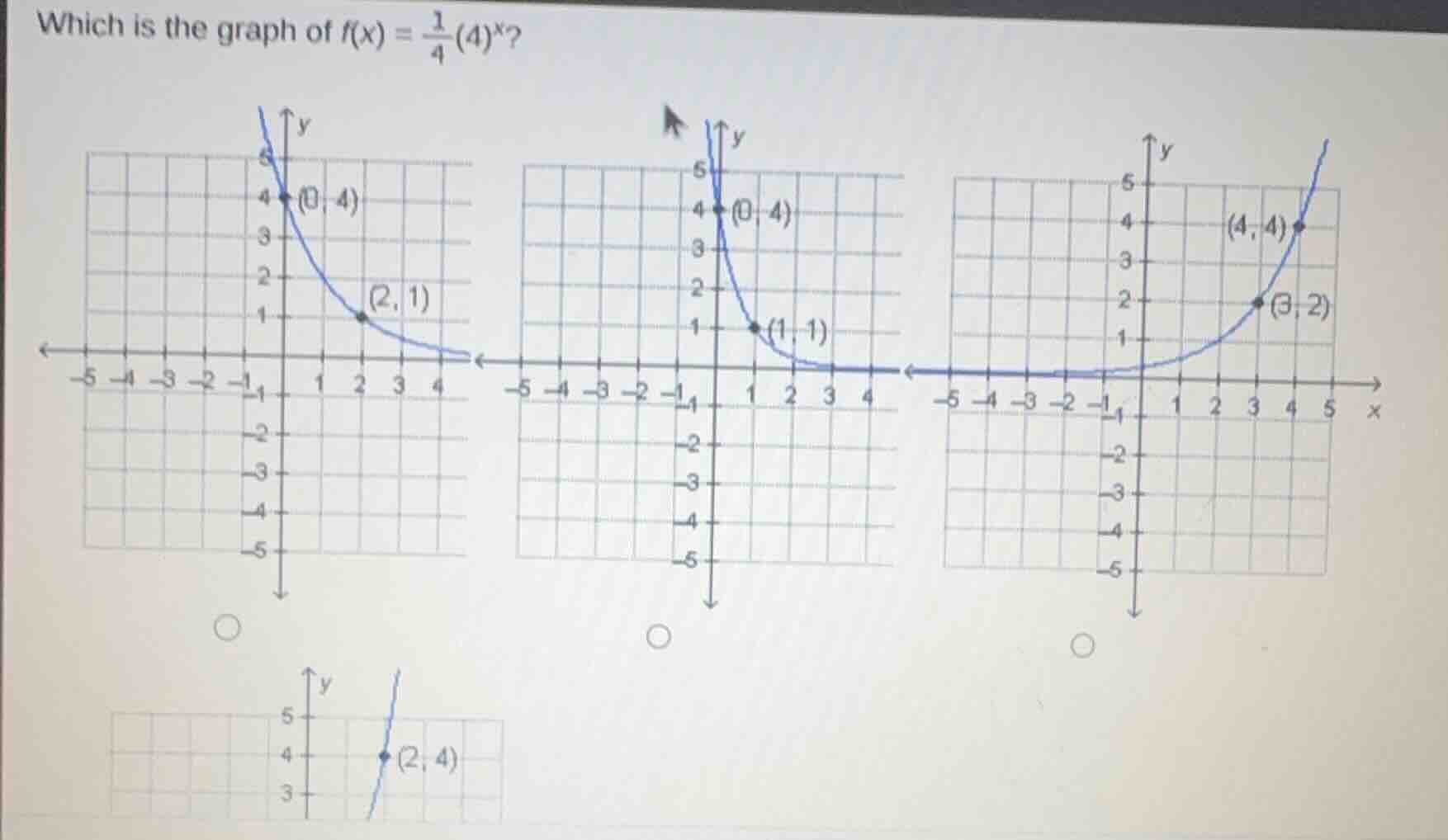
which is the graph of $f(x) = \frac{1}{4}(4)^x$? images of four graphs with labeled points
Step1: Find the y-intercept (x=0)
Substitute \( x = 0 \) into \( f(x)=\frac{1}{4}(4)^x \).
\( f(0)=\frac{1}{4}(4)^0=\frac{1}{4}(1)=\frac{1}{4} \)? Wait, no—wait, \( 4^0 = 1 \), so \( \frac{1}{4}(1)=\frac{1}{4} \)? Wait, no, maybe I miscalculated. Wait, no, the function is \( f(x)=\frac{1}{4}(4)^x \). Let's recheck: \( 4^0 = 1 \), so \( f(0)=\frac{1}{4} \times 1=\frac{1}{4} \)? But the graphs have (0,4) or other points. Wait, maybe a typo? Wait, no, maybe the function is \( f(x)=\frac{1}{4}(4)^x \) or maybe \( f(x)=\frac{1}{4}(4)^x \) simplifies? Wait, \( \frac{1}{4}(4)^x = 4^{x - 1} \). Let's check \( x = 1 \): \( f(1)=\frac{1}{4}(4)^1=\frac{1}{4} \times 4 = 1 \). \( x = 2 \): \( f(2)=\frac{1}{4}(4)^2=\frac{1}{4} \times 16 = 4 \)? Wait, no, \( 4^2 = 16 \), \( \frac{1}{4} \times 16 = 4 \). Wait, but the third graph (rightmost) has a point (3,2) and (4,4). Wait, let's check the third graph: when \( x = 3 \), \( f(3)=\frac{1}{4}(4)^3=\frac{1}{4} \times 64 = 16 \)? No, that's not matching. Wait, maybe the function is \( f(x)=\frac{1}{4}(4)^x \) or maybe \( f(x)=\frac{1}{4}(4)^x \) is an exponential growth function because the base 4 > 1. So the graph should be increasing. Let's check the y-intercept: \( x = 0 \), \( f(0)=\frac{1}{4}(1)=\frac{1}{4} \), but the rightmost graph has a y-intercept near 0, then increases. Wait, the rightmost graph has a curve that starts near the x-axis, then rises. Let's check \( x = 2 \): \( f(2)=\frac{1}{4}(4)^2=\frac{1}{4} \times 16 = 4 \)? No, the rightmost graph has (4,4) and (3,2). Wait, maybe the function is \( f(x)=\frac{1}{4}(4)^x \) or maybe \( f(x)=4^{x - 1} \). Let's check \( x = 2 \): \( 4^{2 - 1}=4^1 = 4 \)? No, the rightmost graph at x=4 is (4,4), so when x=4, \( f(4)=\frac{1}{4}(4)^4=\frac{1}{4} \times 256 = 64 \), which doesn't match. Wait, maybe the function is \( f(x)=\frac{1}{4}(4)^x \) but the graphs are mislabeled? Wait, no, let's check the middle graph: (1,1). For \( f(1)=\frac{1}{4}(4)^1 = 1 \), which matches. \( x = 0 \): \( f(0)=\frac{1}{4}(4)^0=\frac{1}{4} \), but the middle graph has (0,4). Wait, that's a contradiction. Wait, maybe the function is \( f(x)=4(4)^{-x}=\frac{4}{4^x}=4^{1 - x} \), which is a decay function. Let's check \( x = 0 \): \( 4^{1 - 0}=4 \), so (0,4). \( x = 1 \): \( 4^{1 - 1}=1 \), so (1,1). \( x = 2 \): \( 4^{1 - 2}=\frac{1}{4} \), but the first graph has (2,1). Wait, the first graph: (0,4), (2,1). Let's check \( f(2) \) for \( f(x)=4(4)^{-x} \): \( 4(4)^{-2}=4 \times \frac{1}{16}=\frac{1}{4} \), no. Wait, the first graph has (2,1). Let's see: if \( f(2)=1 \), then \( \frac{1}{4}(4)^2 = 4 \), no. Wait, maybe the function is \( f(x)=\frac{1}{4}(4)^x \) is growth, and the rightmost graph is growth. Let's check the rightmost graph: when \( x = 3 \), the point is (3,2). Let's see \( f(3)=\frac{1}{4}(4)^3=\frac{1}{4} \times 64 = 16 \), no. Wait, maybe the function is \( f(x)=\frac{1}{4}(2)^x \)? No, the problem says \( \frac{1}{4}(4)^x \). Wait, maybe I made a mistake. Let's re-express \( f(x)=\frac{1}{4}(4)^x = 4^{x - 1} \). So it's an exponential function with base 4 (growth, since 4 > 1). So as \( x \) increases, \( f(x) \) increases. So the graph should be increasing, so the rightmost graph (the one with (3,2) and (4,4)) or the bottom one? Wait, the bottom one has (2,4). Let's check \( f(2)=4^{2 - 1}=4 \), so (2,4) would match \( f(2)=4 \). Wait, \( f(2)=\frac{1}{4}(4)^2=\frac{1}{4} \times 16 = 4 \), yes! So \( f(2)=4 \). So the bottom graph has (2,4). Let's check \( x = 1 \): \( f(1)=\frac{1}{4}(4)^1 = 1 \), no, the bottom graph doesn't show (1,1). Wait, t…

Snap & solve any problem in the app
Get step-by-step solutions on Sovi AI
Photo-based solutions with guided steps
Explore more problems and detailed explanations
The graph with the point \((2, 4)\) (the bottom - most graph) is the graph of \( f(x)=\frac{1}{4}(4)^x \).