QUESTION IMAGE
Question
which is the graph of the linear inequality $2x - 3y < 12$?
Step1: Rewrite the inequality in slope - intercept form
We start with the inequality \(2x - 3y<12\).
Subtract \(2x\) from both sides: \(- 3y<-2x + 12\).
Divide each term by \(-3\). Remember that when we divide an inequality by a negative number, the direction of the inequality sign changes. So we get \(y>\frac{2}{3}x - 4\).
Step2: Analyze the boundary line
The equation of the boundary line is \(y=\frac{2}{3}x - 4\). Since the inequality is \(y>\frac{2}{3}x - 4\) (not \(y\geq\frac{2}{3}x - 4\)), the boundary line should be a dashed line (to indicate that the points on the line are not included in the solution set).
Step3: Determine the region to shade
We test the point \((0,0)\) in the inequality \(y>\frac{2}{3}x - 4\).
Substitute \(x = 0\) and \(y = 0\) into the inequality: \(0>\frac{2}{3}(0)-4\), which simplifies to \(0>- 4\). This is a true statement. So the region that contains the point \((0,0)\) (the region above the line \(y=\frac{2}{3}x - 4\)) should be shaded.
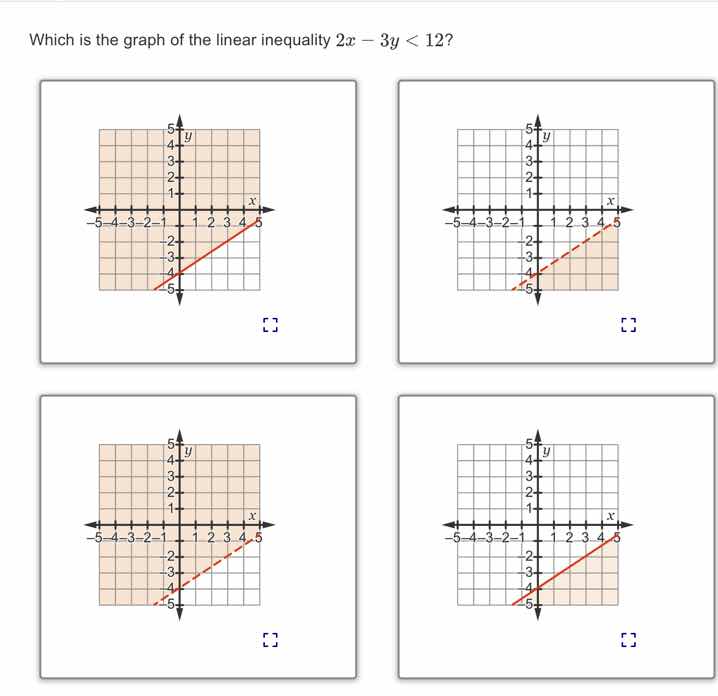
Now let's analyze the graphs:
- The first graph has a solid line, which is incorrect because the inequality is strict (\(<\) or \(>\)), so the boundary line should be dashed.
- The second graph: The boundary line is dashed (good), and we check the shading. Let's see if the region above the line (since \(y>\frac{2}{3}x - 4\)) is shaded. The line \(y=\frac{2}{3}x - 4\) has a y - intercept of \(- 4\) and a slope of \(\frac{2}{3}\). The shading in the second graph is below the line? Wait, no. Wait, when we have \(y>\frac{2}{3}x - 4\), we shade above the line. Wait, let's re - check the test point. For the line \(y=\frac{2}{3}x - 4\), when \(x = 0\), \(y=-4\). The point \((0,0)\) is above the line \(y=\frac{2}{3}x - 4\) (since \(0>-4\)). Now let's look at the third graph: The boundary line is dashed, and the shading is above the line (the region that includes \((0,0)\) since when we look at the grid, the top - left part (where \((0,0)\) is) is shaded? Wait, no, let's look at the four graphs again.
Wait, let's re - express the steps:
- Boundary line: \(y=\frac{2}{3}x - 4\). The slope is \(\frac{2}{3}\) (rise 2, run 3) and y - intercept is \(-4\).
- Since the inequality is \(y>\frac{2}{3}x - 4\), the boundary line is dashed (because the inequality is strict, \(>\) not \(\geq\)).
- We test the point \((0,0)\): \(0>\frac{2}{3}(0)-4\) is \(0 > - 4\), which is true. So we shade the region that contains \((0,0)\), which is above the line \(y=\frac{2}{3}x - 4\).
Now let's analyze each graph:
- First graph: Solid line (incorrect, should be dashed), so eliminate.
- Second graph: Dashed line. Let's see the shading. The line has a y - intercept of \(-4\) and slope \(\frac{2}{3}\). The shaded region is below the line? Wait, no, the second graph's shaded region is the area with the grid (the non - white area) is below the line? Wait, maybe I got the direction wrong. Wait, let's solve for \(y\) again. \(2x-3y < 12\) => \(-3y< - 2x + 12\) => \(y>\frac{2}{3}x - 4\). So \(y\) is greater than the line, so the region above the line.
Third graph: Dashed line, and the shaded region is above the line (the area with the grid is above the line? Wait, the third graph's shaded area is the left - most area (including \((0,0)\) which is above the line \(y=\frac{2}{3}x - 4\) when \(x = 0\), \(y=-4\), so \((0,0)\) is above the line). Wait, the fourth graph: solid line (incorrect). The second graph: dashed line, and the shaded area is below the line? Wait, no, let's take a point in the shaded area of the second graph. Let's say the shaded area is the area with the grid (the non - white…

Snap & solve any problem in the app
Get step-by-step solutions on Sovi AI
Photo-based solutions with guided steps
Explore more problems and detailed explanations
The graph in the bottom - left (third graph) is the correct graph of \(2x - 3y<12\). (Assuming the four graphs are labeled as top - left, top - right, bottom - left, bottom - right in order. If we consider the bottom - left graph as the third one in the 2x2 grid, that is the correct one.)