QUESTION IMAGE
Question
which graph represents the function of $f(x) = \frac{4x^2 - 4x - 8}{2x + 2}$?
Step1: Simplify the function
First, factor the numerator and the denominator. The numerator \(4x^{2}-4x - 8\) can be factored as \(4(x^{2}-x - 2)=4(x - 2)(x+ 1)\). The denominator \(2x + 2=2(x + 1)\). Then, we can simplify the function (note that \(x
eq - 1\) because the denominator cannot be zero):
\[
\]
But we must remember that the original function is not defined at \(x=-1\), so the graph of \(y = 2x-4\) will have a hole at \(x=-1\). Let's find the \(y\)-coordinate of the hole by substituting \(x = - 1\) into \(y=2x - 4\), we get \(y=2\times(-1)-4=-6\). So the hole is at \((-1,-6)\).
Step2: Analyze the graph
The simplified function is a linear function \(y = 2x-4\) with a hole at \((-1,-6)\). We can also find the \(x\)-intercept and \(y\)-intercept of \(y = 2x-4\). For the \(x\)-intercept, set \(y = 0\), then \(2x-4=0\), \(x = 2\). For the \(y\)-intercept, set \(x = 0\), then \(y=-4\).
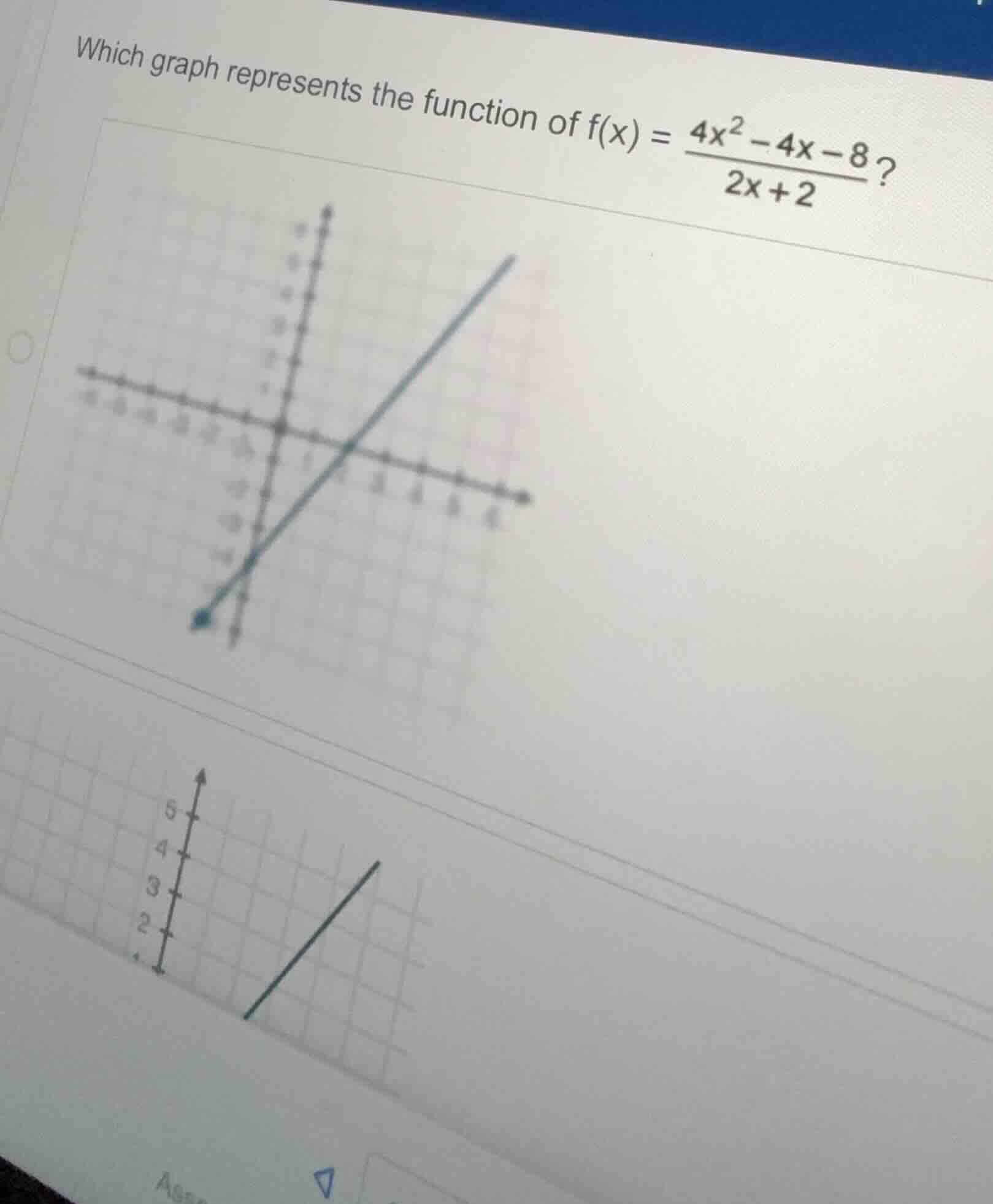
Now, let's analyze the given graphs. The first graph (the one with the blue line) has a hole? Wait, looking at the first graph, we can check the key points. The linear function \(y = 2x-4\) has a slope of \(2\) and \(y\)-intercept at \((0,-4)\) and \(x\)-intercept at \((2,0)\). Also, there should be a hole at \((-1,-6)\). Let's check the second graph. Wait, the second graph seems to start from a point, but the first graph has a line that passes through \((0,0)\)? No, wait our simplified function has \(y\)-intercept at \((0,-4)\). Wait, maybe I made a mistake in the first graph analysis. Wait, no, when we simplified the function, we have \(y = 2x-4\). Let's re - check the simplification:
Wait, \(4x^{2}-4x - 8\): factor out 4, we get \(4(x^{2}-x - 2)\), and \(x^{2}-x - 2=(x - 2)(x + 1)\), correct. Denominator \(2x + 2=2(x + 1)\), correct. Then cancel \((x + 1)\) (with \(x
eq - 1\)), we get \(\frac{4}{2}(x - 2)=2(x - 2)=2x-4\), correct. So the function is \(y = 2x-4\) with a hole at \(x=-1\) (since at \(x=-1\) the original function is undefined).
Now, let's find the value of \(y = 2x-4\) at \(x = 0\), \(y=-4\); at \(x = 2\), \(y = 0\); at \(x=-1\), \(y=-6\) (the hole).
Looking at the first graph: the line passes through \((0,0)\)? No, that can't be. Wait, maybe the first graph is incorrect. Wait, the second graph: let's see the coordinates. If the graph is of \(y = 2x-4\) with a hole at \((-1,-6)\). Let's check the slope. The slope is \(2\), so for every 1 unit increase in \(x\), \(y\) increases by 2.
Wait, maybe the correct graph is the one that represents the line \(y = 2x-4\) with a hole at \((-1,-6)\). Let's assume that the first graph has a line with slope 2, but wait, the first graph's line seems to pass through \((0,0)\) and \((2,0)\)? No, that's a slope of 0. Wait, I must have made a mistake. Wait, no, \(y = 2x-4\): when \(x = 0\), \(y=-4\); \(x = 2\), \(y = 0\); \(x = 1\), \(y=-2\); \(x=-1\), \(y=-6\) (hole).
Wait, maybe the first graph is the one that has a line with slope 2, but with a hole at \((-1,-6)\). Alternatively, maybe the second graph is the one that represents \(y = 2x-4\) (but without showing the hole? No, the original function has a hole, so the graph should have a hole.
Wait, perhaps the first graph is incorrect, and the second graph is the graph of \(y = 2x-4\) with a hole at \((-1,-6)\). But since we can't see the graphs clearly[SSE onError error]

Snap & solve any problem in the app
Get step-by-step solutions on Sovi AI
Photo-based solutions with guided steps
Explore more problems and detailed explanations
Step1: Simplify the function
First, factor the numerator and the denominator. The numerator \(4x^{2}-4x - 8\) can be factored as \(4(x^{2}-x - 2)=4(x - 2)(x+ 1)\). The denominator \(2x + 2=2(x + 1)\). Then, we can simplify the function (note that \(x
eq - 1\) because the denominator cannot be zero):
\[
\]
But we must remember that the original function is not defined at \(x=-1\), so the graph of \(y = 2x-4\) will have a hole at \(x=-1\). Let's find the \(y\)-coordinate of the hole by substituting \(x = - 1\) into \(y=2x - 4\), we get \(y=2\times(-1)-4=-6\). So the hole is at \((-1,-6)\).
Step2: Analyze the graph
The simplified function is a linear function \(y = 2x-4\) with a hole at \((-1,-6)\). We can also find the \(x\)-intercept and \(y\)-intercept of \(y = 2x-4\). For the \(x\)-intercept, set \(y = 0\), then \(2x-4=0\), \(x = 2\). For the \(y\)-intercept, set \(x = 0\), then \(y=-4\).
Now, let's analyze the given graphs. The first graph (the one with the blue line) has a hole? Wait, looking at the first graph, we can check the key points. The linear function \(y = 2x-4\) has a slope of \(2\) and \(y\)-intercept at \((0,-4)\) and \(x\)-intercept at \((2,0)\). Also, there should be a hole at \((-1,-6)\). Let's check the second graph. Wait, the second graph seems to start from a point, but the first graph has a line that passes through \((0,0)\)? No, wait our simplified function has \(y\)-intercept at \((0,-4)\). Wait, maybe I made a mistake in the first graph analysis. Wait, no, when we simplified the function, we have \(y = 2x-4\). Let's re - check the simplification:
Wait, \(4x^{2}-4x - 8\): factor out 4, we get \(4(x^{2}-x - 2)\), and \(x^{2}-x - 2=(x - 2)(x + 1)\), correct. Denominator \(2x + 2=2(x + 1)\), correct. Then cancel \((x + 1)\) (with \(x
eq - 1\)), we get \(\frac{4}{2}(x - 2)=2(x - 2)=2x-4\), correct. So the function is \(y = 2x-4\) with a hole at \(x=-1\) (since at \(x=-1\) the original function is undefined).
Now, let's find the value of \(y = 2x-4\) at \(x = 0\), \(y=-4\); at \(x = 2\), \(y = 0\); at \(x=-1\), \(y=-6\) (the hole).
Looking at the first graph: the line passes through \((0,0)\)? No, that can't be. Wait, maybe the first graph is incorrect. Wait, the second graph: let's see the coordinates. If the graph is of \(y = 2x-4\) with a hole at \((-1,-6)\). Let's check the slope. The slope is \(2\), so for every 1 unit increase in \(x\), \(y\) increases by 2.
Wait, maybe the correct graph is the one that represents the line \(y = 2x-4\) with a hole at \((-1,-6)\). Let's assume that the first graph has a line with slope 2, but wait, the first graph's line seems to pass through \((0,0)\) and \((2,0)\)? No, that's a slope of 0. Wait, I must have made a mistake. Wait, no, \(y = 2x-4\): when \(x = 0\), \(y=-4\); \(x = 2\), \(y = 0\); \(x = 1\), \(y=-2\); \(x=-1\), \(y=-6\) (hole).
Wait, maybe the first graph is the one that has a line with slope 2, but with a hole at \((-1,-6)\). Alternatively, maybe the second graph is the one that represents \(y = 2x-4\) (but without showing the hole? No, the original function has a hole, so the graph should have a hole.
Wait, perhaps the first graph is incorrect, and the second graph is the graph of \(y = 2x-4\) with a hole at \((-1,-6)\). But since we can't see the graphs clearly[SSE onError error]