QUESTION IMAGE
Question
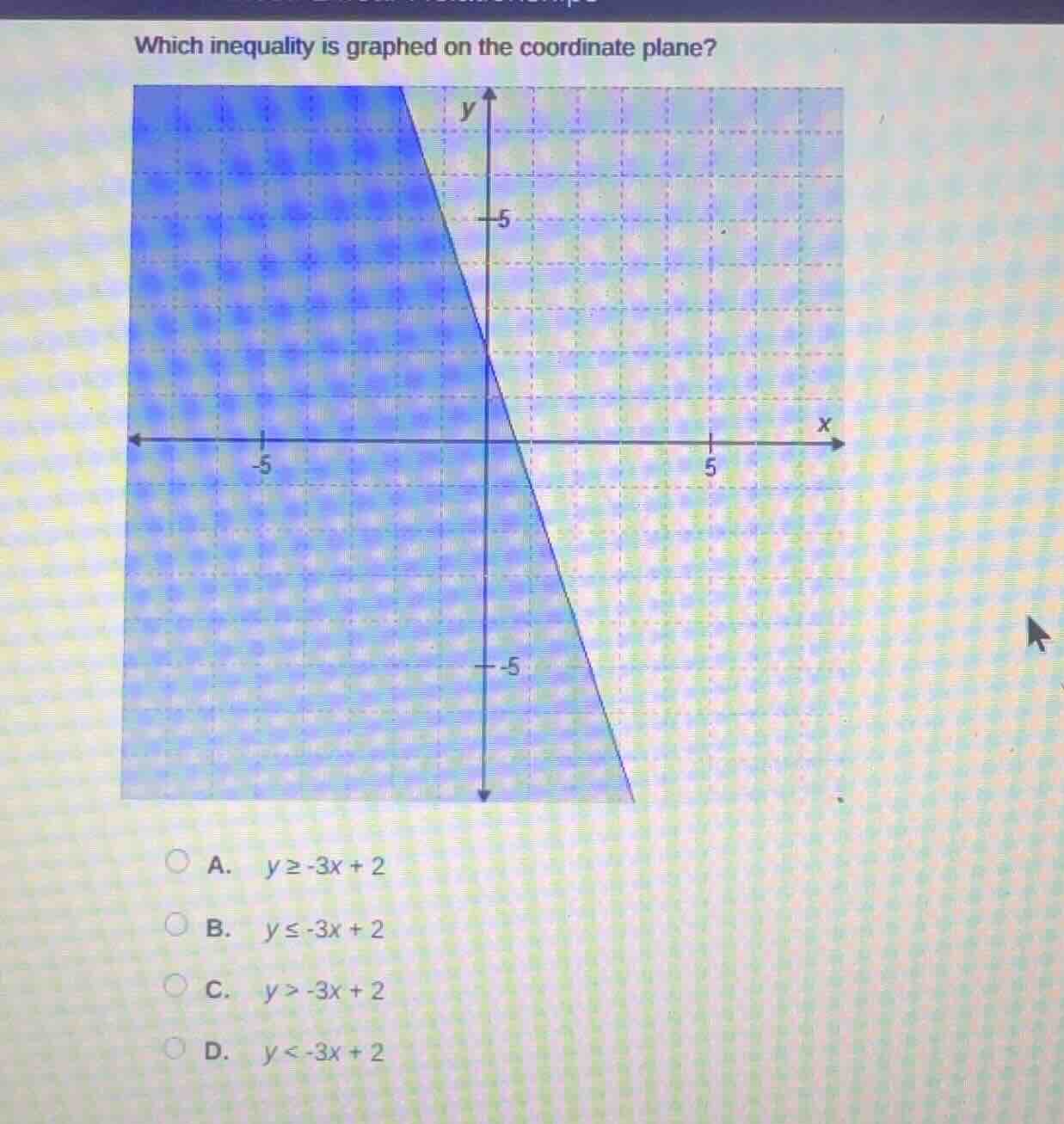
which inequality is graphed on the coordinate plane? a. $y\geq -3x + 2$ b. $y\leq -3x + 2$ c. $y > -3x + 2$ d. $y < -3x + 2$
Step1: Determine the equation of the boundary line
The boundary line intersects the y - axis at (0, 2) and has a slope. Let's calculate the slope. We can also see from the options that the equation of the line is in the form \(y = mx + b\), where \(b = 2\). To find the slope, we can use two points. Let's take the y - intercept (0, 2) and another point. From the graph, when \(x = 1\), \(y=-1\) (since the line goes down 3 units for 1 unit to the right, slope \(m=- 3\)). So the equation of the boundary line is \(y=-3x + 2\).
Step2: Determine if the line is solid or dashed
The boundary line in the graph is solid (since the shaded region includes the line), so the inequality will be either \(\geq\) or \(\leq\), not \(>\) or \(<\). So we can eliminate options C and D.
Step3: Determine the direction of the inequality
To find which side is shaded, we can test a point. Let's take the origin (0,0). Plugging into the inequality \(y\) compared to \(-3x + 2\). For the origin, \(y = 0\) and \(-3x+2=2\). Now, we check the shaded region. The shaded region includes the origin? Wait, no, looking at the graph, the shaded region is to the left of the line. Wait, let's take a point in the shaded region, say (-5, 0). Plug into \(y\) and \(-3x + 2\). \(y = 0\), \(-3(-5)+2=15 + 2=17\). Now, check the inequality. If we consider option A: \(y\geq-3x + 2\), for (-5,0), \(0\geq17\) is false. Wait, maybe I made a mistake. Wait, let's re - examine the graph. The line has a slope of - 3 (since for \(x\) increasing by 1, \(y\) decreases by 3). The y - intercept is (0,2). Now, the shaded region: let's take a point in the shaded area, say (0,0). Wait, no, (0,0) is in the shaded region? Wait, the graph shows that the shaded region is on the side where, when we plug in (0,0) into \(y\) and \(-3x + 2\), \(y = 0\), \(-3x+2 = 2\). If the line is solid and the shaded region is where \(y\) is greater than or equal to \(-3x + 2\)? Wait, no, let's think again. Wait, the slope is - 3, so the line goes from (0,2) down to (1, - 1), (2, - 4), etc. The shaded region: let's take a point like (-1, 5). Plug into \(y=-3x + 2\), when \(x=-1\), \(y=-3(-1)+2=5\). So the point (-1,5) is on the line? Wait, no, (-1,5): \(y = 5\), \(-3(-1)+2=5\), so it's on the line. Wait, maybe the shaded region is above the line? Wait, no, the graph's shaded area: looking at the y - axis, the line crosses the y - axis at (0,2). The shaded region is to the left of the line. Wait, let's use the correct method. The general form for a linear inequality: if the line is \(y=mx + b\), and the line is solid, then we test a point. Let's take (0,0). For the line \(y=-3x + 2\), at (0,0), \(0\) vs \(-3(0)+2 = 2\). Now, the shaded region: if the shaded region includes (0,0), then we check if \(0\leq - 3(0)+2\) (which is \(0\leq2\), true) or \(0\geq - 3(0)+2\) (which is \(0\geq2\), false). Wait, but the line is solid. Wait, maybe I misread the graph. Wait, the options: A is \(y\geq-3x + 2\), B is \(y\leq-3x + 2\). Let's check the slope and the y - intercept again. The line is \(y=-3x + 2\), solid line. Now, the shaded region: let's take a point in the shaded area, say (0,0). For option B: \(y\leq-3x + 2\), \(0\leq2\), which is true. Wait, but earlier I thought the shaded region was not including (0,0), but maybe I was wrong. Wait, the graph: the line goes from (0,2) down to (1, - 1), (2, - 4), etc. The shaded region: looking at the x - axis, when \(x = 0\), the shaded region is below the line? No, the y - axis: at \(x = 0\), the line is at \(y = 2\), and the shaded region is above or below? Wait, the graph's…

Snap & solve any problem in the app
Get step-by-step solutions on Sovi AI
Photo-based solutions with guided steps
Explore more problems and detailed explanations
A. \(y\geq-3x + 2\)