QUESTION IMAGE
Question
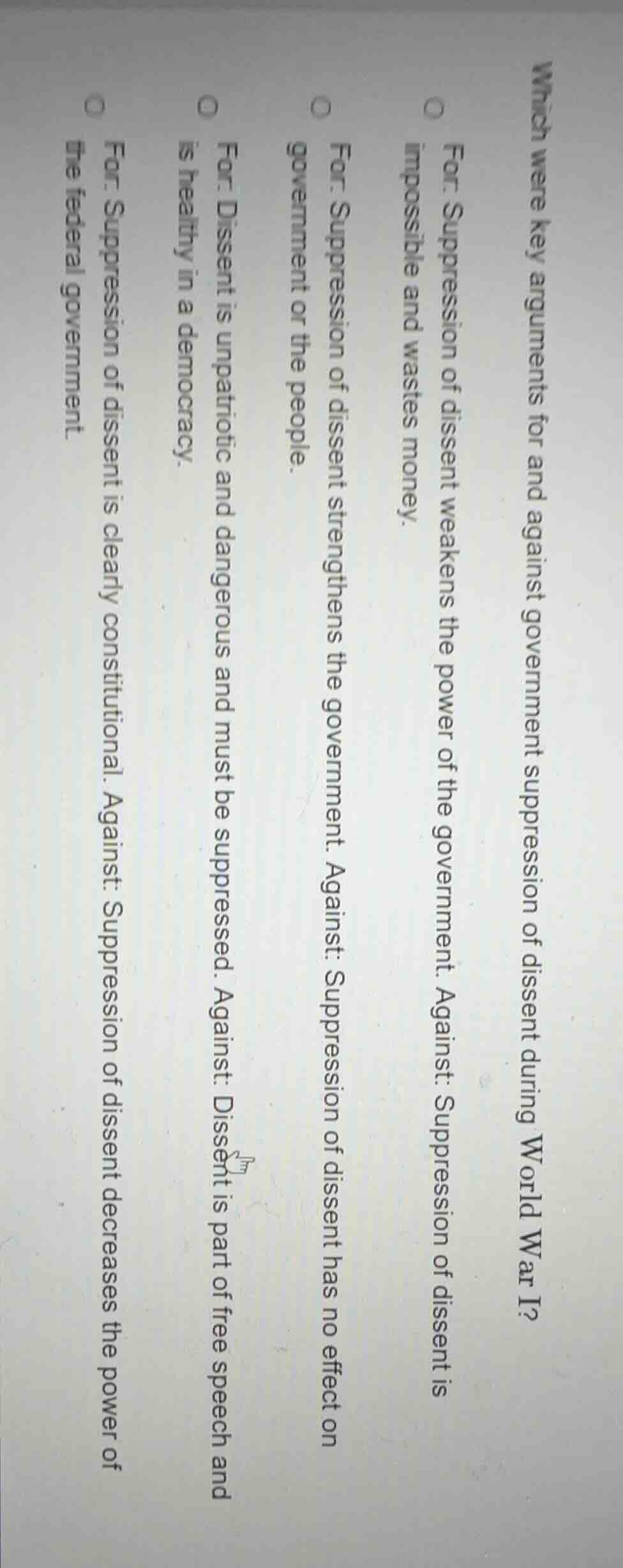
which were key arguments for and against government suppression of dissent during world war i?
- for: suppression of dissent weakens the power of the government. against: suppression of dissent is impossible and wastes money.
- for: suppression of dissent strengthens the government. against: suppression of dissent has no effect on government or the people.
- for: dissent is unpatriotic and dangerous and must be suppressed. against: dissent is part of free speech and is healthy in a democracy.
- for: suppression of dissent is clearly constitutional. against: suppression of dissent decreases the power of the federal government.
This question focuses on the key arguments for and against the U.S. government suppressing dissent during World War I. The correct option reflects the dominant pro-suppression framing (painting dissent as unpatriotic/dangerous) and the core counter-argument (dissent as protected free speech vital to democracy). Other options contain inaccurate claims: suppression was not framed as weakening government power, it was argued to strengthen control; there was no claim suppression had no effect; and suppression was challenged as unconstitutional, not framed as strengthening federal power.

Snap & solve any problem in the app
Get step-by-step solutions on Sovi AI
Photo-based solutions with guided steps
Explore more problems and detailed explanations
For: Dissent is unpatriotic and dangerous and must be suppressed. Against: Dissent is part of free speech and is healthy in a democracy.