QUESTION IMAGE
Question
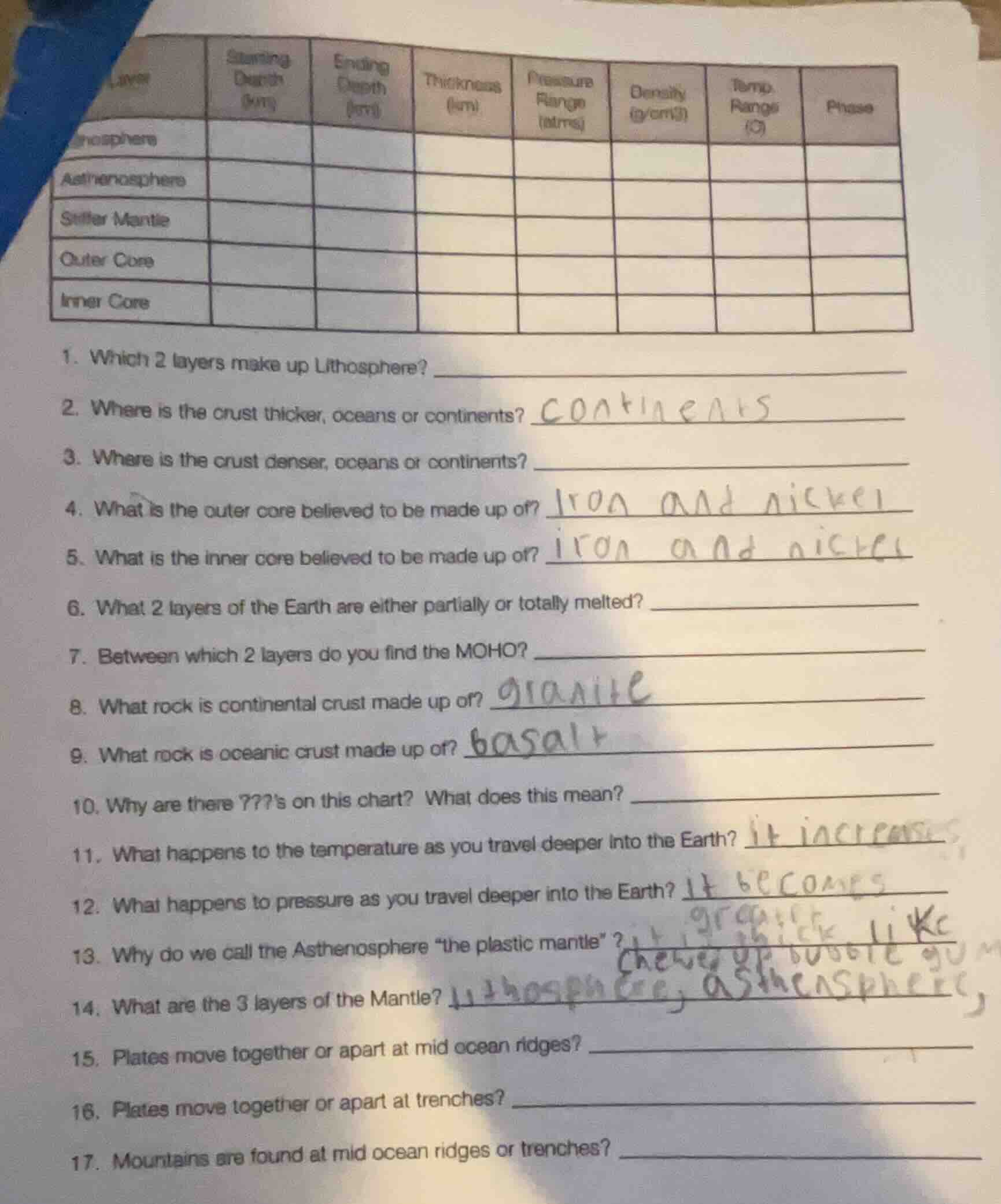
- which 2 layers make up lithosphere?
- where is the crust thicker, oceans or continents?
- where is the crust denser, oceans or continents?
- what is the outer core believed to be made up of?
- what is the inner core believed to be made up of?
- what 2 layers of the earth are either partially or totally melted?
- between which 2 layers do you find the moho?
- what rock is continental crust made up of?
- what rock is oceanic crust made up of?
- why are there???s on this chart? what does this mean?
- what happens to the temperature as you travel deeper into the earth?
- what happens to pressure as you travel deeper into the earth?
- why do we call the asthenosphere \the plastic mantle\?
- what are the 3 layers of the mantle?
- plates move together or apart at mid ocean ridges?
- plates move together or apart at trenches?
- mountains are found at mid ocean ridges or trenches?
Brief Explanations
- The lithosphere combines the rigid outer layers.
- Confirmed correct: continental crust is thicker.
- Oceanic crust is denser due to composition.
- Confirmed correct: outer core is iron-nickel.
- Confirmed correct: inner core is iron-nickel.
- These layers have molten/partially molten material.
- The Moho is the boundary between crust and mantle.
- Confirmed correct: continental crust is granite.
- Confirmed correct: oceanic crust is basalt.
- The "???" indicate missing data to research/fill.
- Confirmed correct: temperature increases with depth.
- Pressure increases due to overlying rock weight.
- The asthenosphere has a plastic, deformable texture.
- Corrected: mantle layers are top asthenosphere, middle/lower stiff mantle.
- Mid-ocean ridges are divergent plate boundaries.
- Trenches are convergent plate boundaries.
- Trenches are linked to mountain formation via subduction.

Snap & solve any problem in the app
Get step-by-step solutions on Sovi AI
Photo-based solutions with guided steps
Explore more problems and detailed explanations
- Crust and Stiffer Mantle
- CONTINENTS
- Oceans
- IRON AND NICKEL
- IRON AND NICKEL
- Asthenosphere and Outer Core
- Crust and Stiffer Mantle (Mantle)
- GRANITE
- BASALT
- They mean the data is missing and needs to be researched or filled in.
- IT INCREASES
- It increases (becomes greater)
- It has a plastic, partially molten texture that can slowly deform.
- Asthenosphere, Stiffer Mantle (Upper Mantle, Lower Mantle)
- Apart
- Together
- Trenches
---
Filled Earth Layers Table:
| Layer | Starting Depth (km) | Ending Depth (km) | Thickness (km) | Pressure Range (atm) | Density (g/cm³) | Temp. Range (°C) | Phase |
|---|---|---|---|---|---|---|---|
| Asthenosphere | 70 | 250 | 180 | ~2100 - ~7500 | 3.3-3.5 | 870 - 1600 | Plastic/Partially Molten |
| Stiffer Mantle | 250 | 2900 | 2650 | ~7500 - ~87000 | 3.5-5.5 | 1600 - 3700 | Solid |
| Outer Core | 2900 | 5150 | 2250 | ~87000 - ~3.3×10⁵ | 9.9-12.2 | 3700 - 5500 | Liquid |
| Inner Core | 5150 | 6371 | 1221 | ~3.3×10⁵ - ~3.6×10⁵ | 12.8-13.1 | 5500 - 6000 | Solid |