QUESTION IMAGE
Question
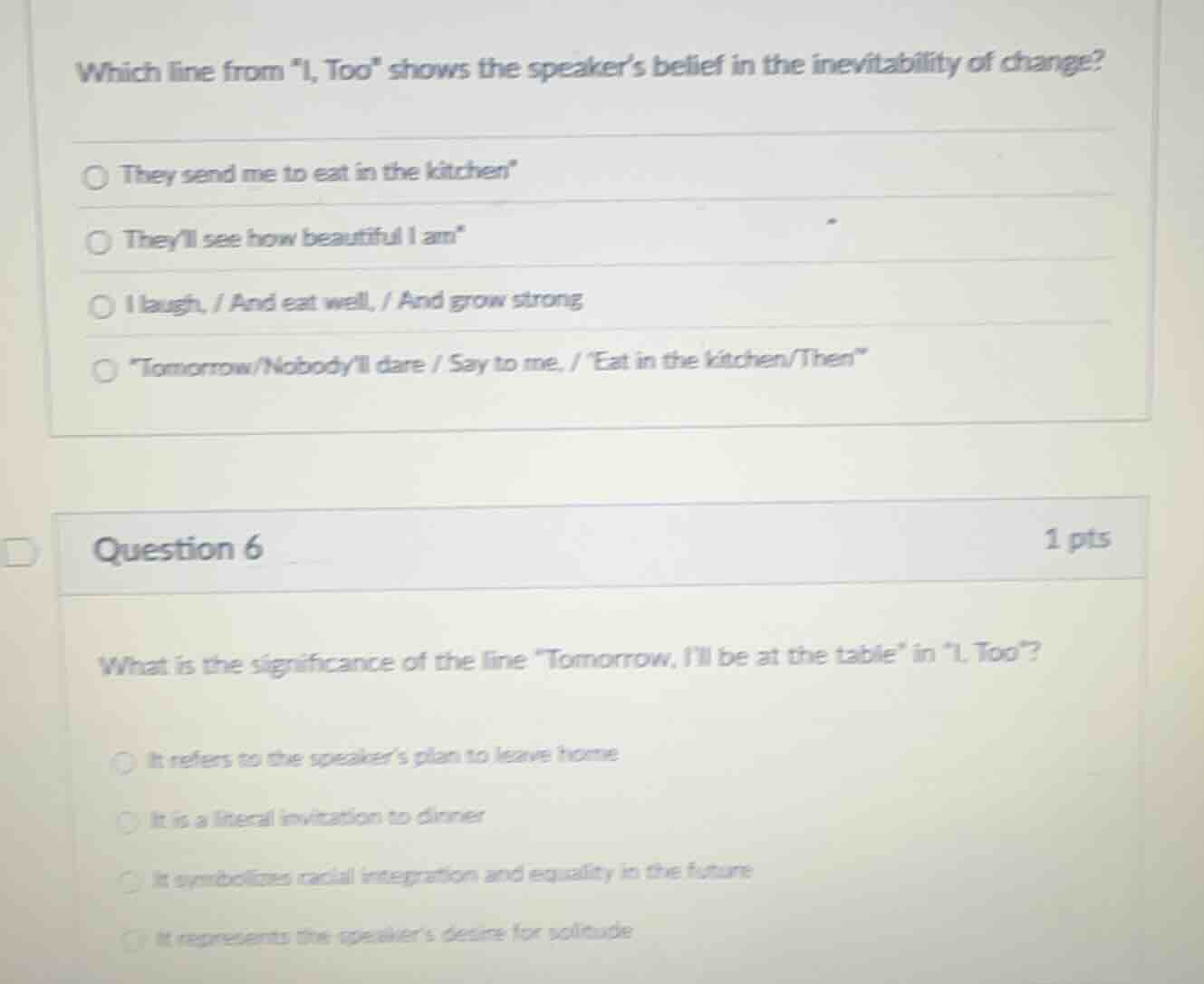
which line from \i, too\ shows the speaker’s belief in the inevitability of change?
○ they send me to eat in the kitchen
○ they’ll see how beautiful i am
○ i laugh, / and eat well, / and grow strong
○ \tomorrow/nobody’ll dare / say to me, / ‘eat in the kitchen/then’\
question 6 1 pts
what is the significance of the line \tomorrow, i’ll be at the table\ in \i, too\?
○ it refers to the speaker’s plan to leave home
○ it is a literal invitation to dinner
○ it symbolizes racial integration and equality in the future
○ it represents the speaker’s desire for solitude
For the first question:
- The line "Tomorrow/Nobody'll dare / Say to me, / 'Eat in the kitchen/Then'" directly references a future where the unfair treatment ends, showing the speaker is certain change will come. The other lines either describe current mistreatment, personal growth, or a future realization of their worth, but not the inevitability of the change in their treatment.
For the second question:
- In Langston Hughes' I, Too, the "table" symbolizes a space of acceptance, equality, and belonging. The line "Tomorrow, I'll be at the table" uses this symbol to represent the speaker's belief in a future where racial integration and equal standing (for Black people in America) are a reality. The other options misinterpret the symbolic meaning of the line.

Snap & solve any problem in the app
Get step-by-step solutions on Sovi AI
Photo-based solutions with guided steps
Explore more problems and detailed explanations
- "Tomorrow/Nobody'll dare / Say to me, / 'Eat in the kitchen/Then'"
- It symbolizes racial integration and equality in the future