QUESTION IMAGE
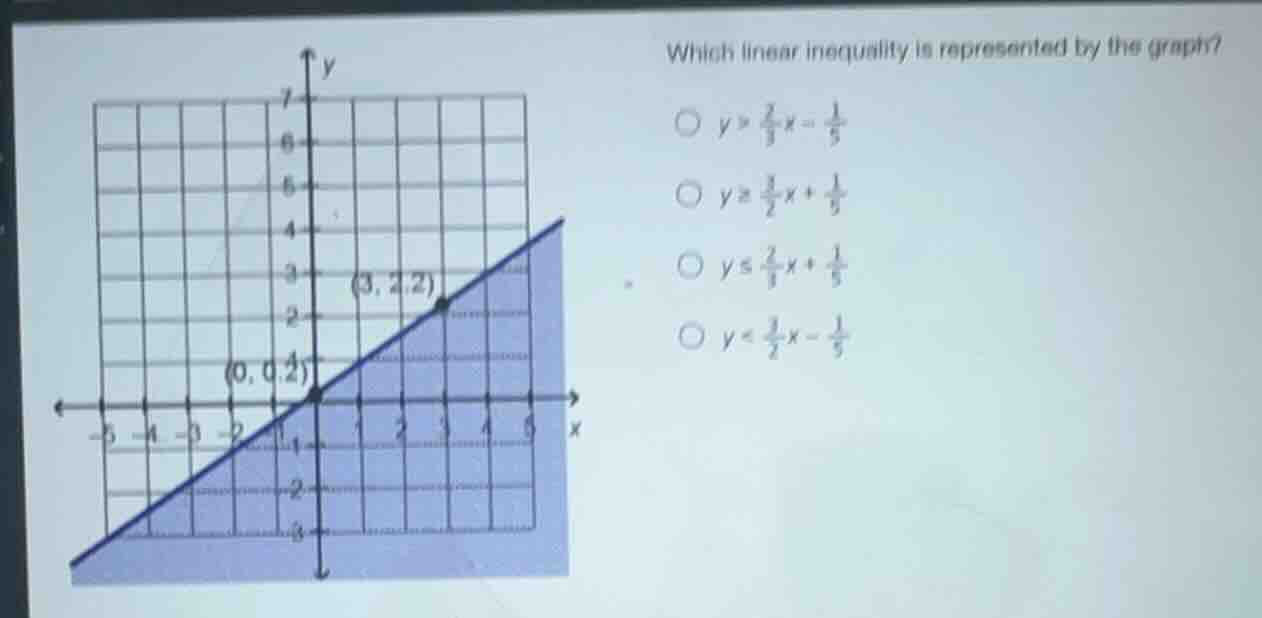
Question
which linear inequality is represented by the graph?
$\bigcirc\\ y > \frac{2}{3}x - \frac{1}{5}$
$\bigcirc\\ y \geq \frac{2}{3}x + \frac{1}{5}$
$\bigcirc\\ y \leq \frac{2}{3}x + \frac{1}{5}$
$\bigcirc\\ y < \frac{2}{3}x - \frac{1}{5}$
Step1: Find the slope
The two points on the line are \((0, 0.2)\) (which is \((0, \frac{1}{5})\)) and \((3, 2.2)\) (which is \((3, \frac{11}{5})\)). The slope \(m\) is calculated as \(m=\frac{y_2 - y_1}{x_2 - x_1}=\frac{\frac{11}{5}-\frac{1}{5}}{3 - 0}=\frac{\frac{10}{5}}{3}=\frac{2}{3}\).
Step2: Determine the y - intercept
The y - intercept \(b\) is the value of \(y\) when \(x = 0\). From the point \((0,\frac{1}{5})\), we know that \(b=\frac{1}{5}\).
Step3: Analyze the line type and inequality sign
The line is solid, so the inequality sign should be either \(\geq\) or \(\leq\). The shaded region is above the line? Wait, no, looking at the graph, the shaded region is below the line? Wait, no, let's check the points. Wait, the line passes through \((0,\frac{1}{5})\) and \((3,\frac{11}{5})\). Let's take a test point, say \((0,0)\). Wait, no, \((0,\frac{1}{5})\) is on the line. Let's take a point in the shaded region, say \((0,0)\) is not in the shaded region? Wait, the shaded region is below the line? Wait, no, the graph shows the shaded region including the area below the line? Wait, no, the line is solid, and let's check the inequality. The equation of the line is \(y=\frac{2}{3}x+\frac{1}{5}\). Now, let's check the inequality sign. If we take a point in the shaded region, say \((0,0)\) is not in the shaded region? Wait, the point \((0,0.2)\) is on the line, and the shaded region is above or below? Wait, the graph's shaded region is below the line? Wait, no, looking at the coordinates, when \(x = 0\), the line is at \(y=\frac{1}{5}=0.2\), and the shaded region is below that? Wait, no, the blue region is below the line? Wait, no, the two points: \((0,0.2)\) and \((3,2.2)\). Let's check the slope again. Wait, \(\frac{2.2 - 0.2}{3-0}=\frac{2}{3}\), correct. The equation of the line is \(y=\frac{2}{3}x+\frac{1}{5}\). Now, the line is solid, so the inequality is either \(y\geq\frac{2}{3}x+\frac{1}{5}\) or \(y\leq\frac{2}{3}x+\frac{1}{5}\). Let's take a test point in the shaded region. Let's take \(x = 0\), \(y=-1\) (which is in the shaded region). Plug into \(y\leq\frac{2}{3}x+\frac{1}{5}\): \(-1\leq\frac{1}{5}\), which is true. If we plug into \(y\geq\frac{2}{3}x+\frac{1}{5}\): \(-1\geq\frac{1}{5}\), which is false. Also, the line is solid, so the inequality is \(y\leq\frac{2}{3}x+\frac{1}{5}\).

Snap & solve any problem in the app
Get step-by-step solutions on Sovi AI
Photo-based solutions with guided steps
Explore more problems and detailed explanations
\(y\leq\frac{2}{3}x+\frac{1}{5}\) (corresponding to the option \(y\leq\frac{2}{3}x+\frac{1}{5}\))