QUESTION IMAGE
Question
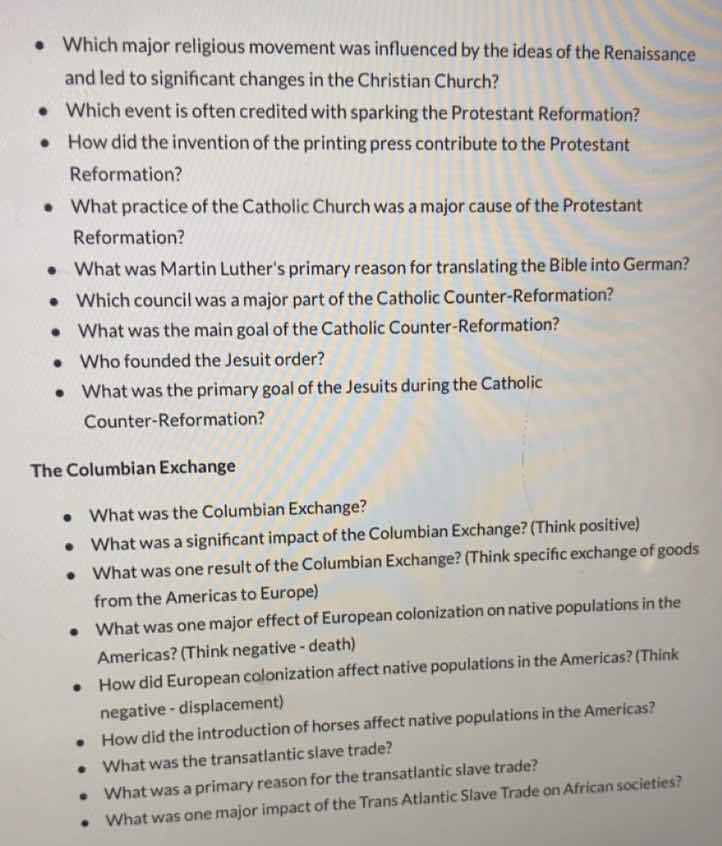
- which major religious movement was influenced by the ideas of the renaissance and led to significant changes in the christian church? - which event is often credited with sparking the protestant reformation? - how did the invention of the printing press contribute to the protestant reformation? - what practice of the catholic church was a major cause of the protestant reformation? - what was martin luthers primary reason for translating the bible into german? - which council was a major part of the catholic counter - reformation? - what was the main goal of the catholic counter - reformation? - who founded the jesuit order? - what was the primary goal of the jesuits during the catholic counter - reformation? the columbian exchange - what was the columbian exchange? - what was a significant impact of the columbian exchange? (think positive) - what was one result of the columbian exchange? (think specific exchange of goods from the americas to europe) - what was one major effect of european colonization on native populations in the americas? (think negative - death) - how did european colonization affect native populations in the americas? (think negative - displacement) - how did the introduction of horses affect native populations in the americas? - what was the transatlantic slave trade? - what was a primary reason for the transatlantic slave trade? - what was one major impact of the trans atlantic slave trade on african societies?
Brief Explanations
Protestant Reformation & Catholic Counter-Reformation Questions
- The Renaissance's focus on individualism, humanism, and critical inquiry laid groundwork for questioning traditional Church authority, directly influencing the Protestant Reformation.
- Martin Luther's public posting of his 95 Theses, which criticized Church practices like indulgences, is the widely accepted spark of the Reformation.
- The printing press enabled rapid, mass distribution of Reformation texts (like Luther's works and vernacular Bibles), spreading reformist ideas across Europe quickly.
- The sale of indulgences (payments claimed to reduce soul's time in purgatory) was a key grievance that drove Reformation protests.
- Luther translated the Bible into German to make sacred text accessible to ordinary people, bypassing the Church's exclusive control over biblical interpretation.
- The Council of Trent was the Catholic Church's formal council to address reform and push back against Protestantism, defining doctrine and correcting abuses.
- The main goal of the Catholic Counter-Reformation was to halt the spread of Protestantism, reform internal Church abuses, and reassert Catholic authority and doctrine.
- Ignatius of Loyola founded the Jesuit order (Society of Jesus) in the 16th century.
- The Jesuits' primary goal was to spread Catholic faith through education, missionary work, and defending Catholic doctrine against Protestantism.
Columbian Exchange & Colonization Questions
- The Columbian Exchange was the widespread transfer of plants, animals, people, culture, and diseases between the Americas and Afro-Eurasia following Columbus' 1492 voyage.
- A positive impact was the introduction of new, high-yield crops (like potatoes, corn) to Europe, which boosted food supplies and supported population growth.
- A specific goods exchange: Maize (corn) was brought from the Americas to Europe, becoming a staple crop in many regions.
- A major negative death-related effect: European-introduced diseases (smallpox, measles) to which Native Americans had no immunity killed an estimated 50-90% of the indigenous population.
- European colonization forced Native American populations off their ancestral lands, displacing them to make way for European settlements, plantations, and resource extraction.
- Horses allowed some Native American groups (like Plains tribes) to revolutionize their hunting (especially of bison), transportation, and warfare, altering their traditional societies.
- The transatlantic slave trade was a forced system of transporting enslaved African people to the Americas to labor on plantations and in other colonial industries.
- A primary reason was the high demand for cheap, forced labor on European-owned sugar, tobacco, and cotton plantations in the Americas.
- A major impact was the depopulation of many African societies, weakening social structures, disrupting communities, and creating long-term economic and cultural harm.

Snap & solve any problem in the app
Get step-by-step solutions on Sovi AI
Photo-based solutions with guided steps
Explore more problems and detailed explanations
Protestant Reformation & Catholic Counter-Reformation Answers
- Protestant Reformation
- Martin Luther's posting of the 95 Theses
- Enabled mass spread of Reformation texts
- The sale of indulgences
- To make the Bible accessible to ordinary Germans
- The Council of Trent
- To stop Protestant spread and reform the Church
- Ignatius of Loyola
- Spread Catholic faith via education/mission work
Columbian Exchange & Colonization Answers
- The widespread transfer of crops, animals, people, diseases, and culture between the Americas and Afro-Eurasia after 1492
- Increased food supplies and population growth in Europe from American crops (e.g., potatoes)
- Maize (corn) was brought from the Americas to Europe
- Mass death of Native Americans from European diseases (e.g., smallpox)
- Forced displacement of Native Americans from ancestral lands
- Transformed hunting, transportation, and warfare for Plains tribes
- A forced system of transporting enslaved Africans to the Americas for labor
- High demand for cheap labor on colonial plantations
- Severe depopulation and disruption of African social structures