QUESTION IMAGE
Question
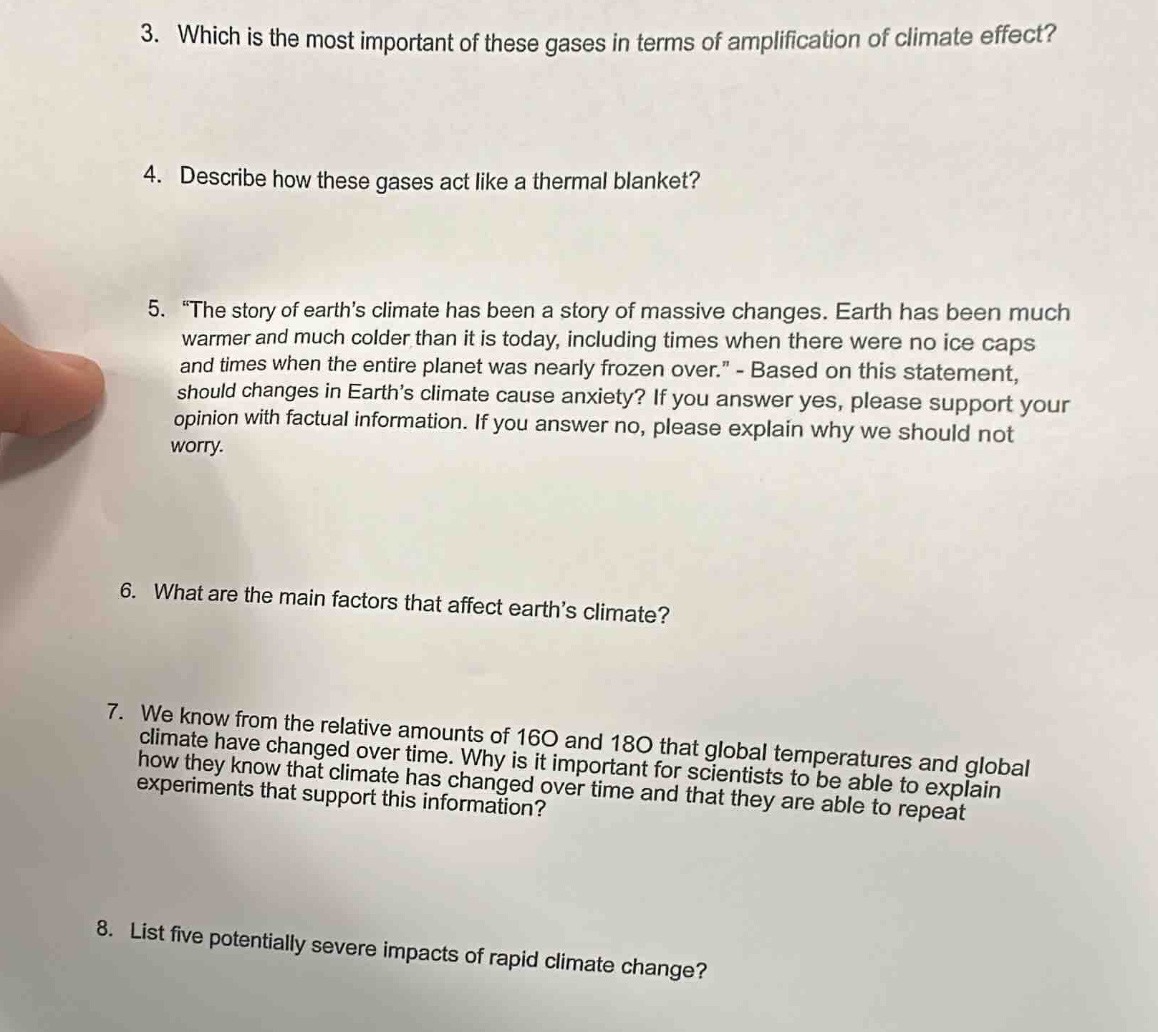
- which is the most important of these gases in terms of amplification of climate effect?
- describe how these gases act like a thermal blanket?
- \the story of earths climate has been a story of massive changes. earth has been much warmer and much colder than it is today, including times when there were no ice caps and times when the entire planet was nearly frozen over.\ - based on this statement, should changes in earth’s climate cause anxiety? if you answer yes, please support your opinion with factual information. if you answer no, please explain why we should not worry.
- what are the main factors that affect earth’s climate?
- we know from the relative amounts of 16o and 18o that global temperatures and global climate have changed over time. why is it important for scientists to be able to explain how they know that climate has changed over time and that they are able to repeat experiments that support this information?
- list five potentially severe impacts of rapid climate change?
For Question 3:
Carbon dioxide ($\text{CO}_2$) is the most impactful because it has a long atmospheric lifespan (centuries to millennia), drives long-term warming trends, and human activities have drastically increased its concentrations, amplifying the greenhouse effect more persistently than other short-lived greenhouse gases.
For Question 4:
Greenhouse gases in the atmosphere allow shortwave solar radiation from the Sun to pass through and reach Earth's surface, where it is absorbed and re-emitted as longwave infrared (heat) radiation. The gases trap this outgoing heat, preventing it from escaping directly to space, which keeps the planet's surface warm—mirroring how a blanket traps body heat close to the skin.
For Question 5:
Yes, current climate changes should cause anxiety. Unlike natural historic shifts (which occurred over thousands to millions of years), modern warming is happening at an unprecedented rate (~1.1°C since 1880, per IPCC data). This rapid change outpaces the adaptive capacity of most ecosystems and human societies: it drives extreme weather events, sea-level rise threatening coastal communities, crop failures from shifting growing seasons, and biodiversity loss. Human civilization is built on stable Holocene climate conditions, so rapid disruption risks widespread food and water insecurity, displacement, and conflict.
For Question 6:
The main factors include: 1. Greenhouse gas concentrations (e.g., $\text{CO}_2$, methane) that trap heat; 2. Solar radiation intensity (variations in the Sun's output); 3. Orbital changes (Milankovitch cycles: eccentricity, tilt, precession) that alter sunlight distribution; 4. Albedo (reflectivity of Earth's surface, e.g., ice cover vs. open ocean); 5. Volcanic activity (releases aerosols that reflect sunlight and cool the planet); 6. Ocean currents (redistribute heat around the globe).
For Question 7:
Understanding and verifying past climate change is critical because: 1. It provides a baseline to distinguish natural variability from human-caused changes; 2. It allows scientists to test and refine climate models, which are used to predict future climate scenarios; 3. Reproducible experiments build credibility in climate science, helping policymakers and the public trust evidence-based climate action; 4. It reveals how Earth's system responds to different forcing factors, informing strategies to mitigate and adapt to current warming.
For Question 8:
Five severe impacts are: 1. Accelerated sea-level rise, leading to permanent flooding of coastal cities and displacement of millions; 2. More frequent and intense extreme weather (e.g., Category 5 hurricanes, prolonged droughts, heatwaves that threaten human health); 3. Collapse of coral reef ecosystems (from ocean acidification and warming), eliminating critical marine habitats and fisheries; 4. Disruption of global food systems, including crop failures and livestock die-offs from extreme temperatures and water scarcity; 5. Spread of infectious diseases, as warmer temperatures expand the range of disease-carrying vectors like mosquitoes.

Snap & solve any problem in the app
Get step-by-step solutions on Sovi AI
Photo-based solutions with guided steps
Explore more problems and detailed explanations
- Carbon dioxide ($\text{CO}_2$)
- Greenhouse gases trap outgoing infrared heat from Earth's surface, preventing it from escaping to space, just as a blanket traps body heat.
- Yes. Modern climate change is occurring at an unprecedented rate (~1.1°C since 1880, per IPCC), outpacing natural historic shifts. This rapid warming threatens food/water security, causes extreme weather, raises sea levels, and disrupts ecosystems, all of which risk widespread human displacement and societal instability.
- 1. Greenhouse gas concentrations
- Solar radiation intensity
- Earth's orbital variations (Milankovitch cycles)
- Surface albedo (reflectivity)
- Volcanic activity
- Ocean heat redistribution currents
- It establishes a baseline for natural vs. human-caused change, validates climate models for future predictions, builds scientific credibility for policy, and informs mitigation/adaptation strategies.
- 1. Permanent coastal flooding and human displacement from sea-level rise
- More frequent and deadly extreme heatwaves and droughts
- Collapse of coral reefs and marine food webs
- Global crop failures and food insecurity
- Expanded range of infectious disease vectors (e.g., mosquitoes)