QUESTION IMAGE
Question
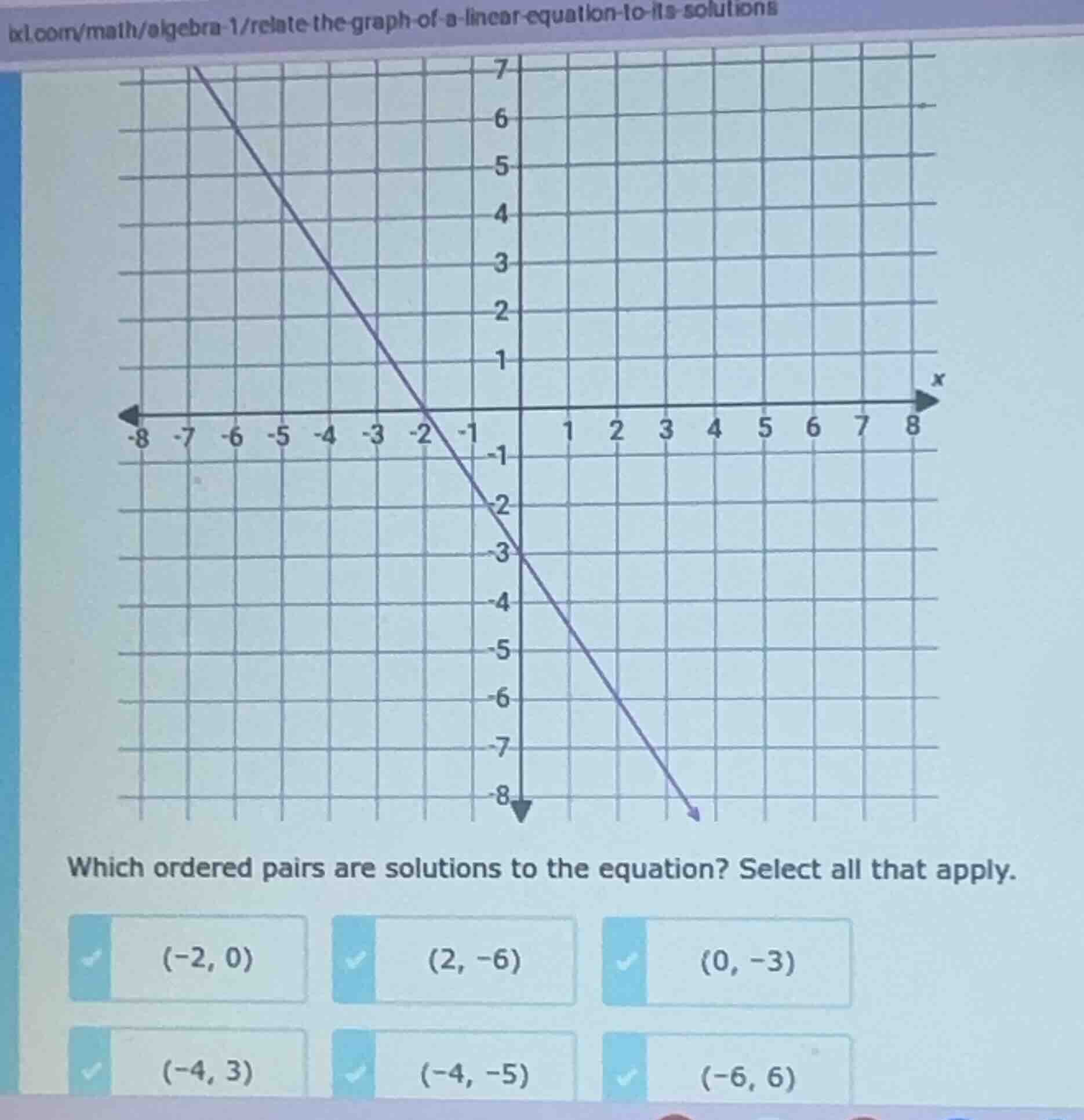
which ordered pairs are solutions to the equation? select all that apply.
(-2, 0) (2, -6) (0, -3)
(-4, 3) (-4, -5) (-6, 6)
Step1: Recall the definition of a solution to a linear equation's graph
A solution to the equation of a line is an ordered pair \((x, y)\) that lies on the line. So we need to check which of the given ordered pairs lie on the graphed line.
Step2: Check each ordered pair
- For \((-2, 0)\): Looking at the graph, when \(x = - 2\), the \(y\)-value on the line is \(0\), so this point is on the line.
- For \((2, -6)\): When \(x = 2\), the \(y\)-value on the line is \(-6\), so this point is on the line.
- For \((0, -3)\): When \(x = 0\), the \(y\)-intercept of the line is \(-3\), so this point is on the line.
- For \((-4, 3)\): When \(x=-4\), the \(y\)-value on the line is \(3\), so this point is on the line.
- For \((-4, -5)\): When \(x = - 4\), the \(y\)-value on the line is not \(-5\) (since at \(x=-4\), the line has \(y = 3\)), so this point is not on the line.
- For \((-6, 6)\): When \(x=-6\), the \(y\)-value on the line is \(6\), so this point is on the line.

Snap & solve any problem in the app
Get step-by-step solutions on Sovi AI
Photo-based solutions with guided steps
Explore more problems and detailed explanations
The correct ordered pairs (solutions) are \((-2, 0)\), \((2, -6)\), \((0, -3)\), \((-4, 3)\), \((-6, 6)\) (note that \((-4, -5)\) is not a solution as it does not lie on the line).