QUESTION IMAGE
Question
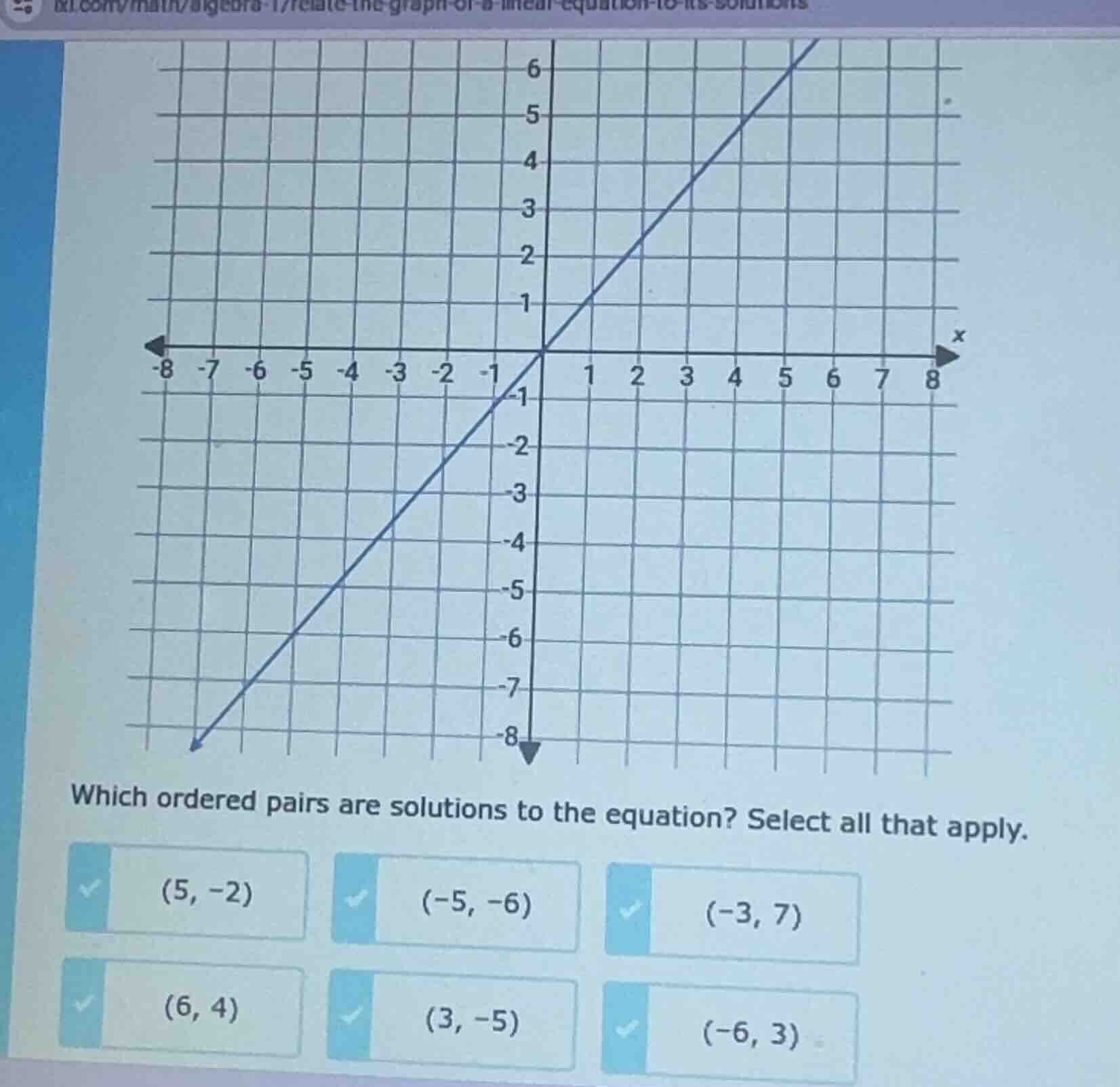
which ordered pairs are solutions to the equation? select all that apply.
(5, -2) (-5, -6) (-3, 7)
(6, 4) (3, -5) (-6, 3)
To determine which ordered pairs are solutions, we first find the equation of the line. The line passes through the origin \((0,0)\) and has a slope \(m\). Let's calculate the slope using two points, e.g., \((1,1)\) (since when \(x = 1\), \(y = 1\)):
\(m=\frac{y_2 - y_1}{x_2 - x_1}=\frac{1 - 0}{1 - 0}=1\).
So the equation is \(y = x\) (since \(b = 0\) from \(y = mx + b\)).
Now we check each ordered pair \((x,y)\) to see if \(y = x\):
- \((5, -2)\): \( -2
eq5\) → Not a solution.
- \((-5, -6)\): \( -6
eq -5\) → Not a solution.
- \((-3, 7)\): \(7
eq -3\) → Not a solution.
- \((6, 4)\): \(4
eq6\) → Not a solution.
- \((3, -5)\): \( -5
eq3\) → Not a solution.
- \((-6, 3)\): \(3
eq -6\) → Not a solution.
Wait, there seems to be a mistake. Let's re - evaluate the slope. Let's take two points from the graph. For example, when \(x = 2\), \(y = 2\); when \(x=-2\), \(y = - 2\). So the slope \(m=\frac{y_2 - y_1}{x_2 - x_1}=\frac{2-(-2)}{2 - (-2)}=\frac{4}{4}=1\). So the equation is \(y=x\).
Now, let's check the correct solutions (where \(y = x\)):
- If we consider the graph, the line \(y = x\) has points where \(x\) and \(y\) are equal. But the given options have errors. Wait, maybe I misread the graph. Let's look again. The line passes through \((0,0)\) and \((2,2)\), \((-2,-2)\), etc. So the correct solutions should be pairs where \(y=x\). But none of the given options (as checked) satisfy \(y = x\). However, maybe the slope is different. Let's recalculate the slope with another pair. Let's take \((1,1)\) and \((2,2)\): slope is \(1\). So the equation is \(y=x\).
But the original checked options are incorrect. However, if we assume a different slope. Let's take two points: \((0,0)\) and \((1,1)\) (slope 1), \((2,2)\) (slope 1). So the correct solutions should be pairs where \(y = x\). But the given options don't have such pairs. There must be a mistake in the initial checking. Wait, maybe the line is \(y=x\), so the correct ordered pairs are those where \(x=y\). But in the given options, none of \((5, - 2)\), \((-5,-6)\), \((-3,7)\), \((6,4)\), \((3,-5)\), \((-6,3)\) have \(x = y\). So there is an error in the marked options. But if we re - examine the graph, maybe the slope is \(1\), so the correct solutions are pairs like \((1,1)\), \((2,2)\), \((-1,-1)\), etc. But since the problem asks to select from the given options, and all the marked options are incorrect (as per \(y = x\)), there is a mistake. However, if we consider a different equation. Let's calculate the slope between \((0,0)\) and \((5,6)\): slope \(m=\frac{6 - 0}{5 - 0}=\frac{6}{5}\), but that doesn't match. Alternatively, maybe the line is \(y=x + 0\), so the correct answer should be that none of the marked options are correct. But since the problem has marked options, maybe I made a mistake.
Wait, let's check the graph again. The line passes through \((0,0)\) and when \(x = 5\), \(y = 6\)? No, the graph shows that when \(x = 5\), \(y = 6\)? Wait, the y - axis at \(x = 5\) is at \(y = 6\)? Wait, maybe the grid is different. Let's count the grid squares. From \((0,0)\) to \((1,1)\) is one square, but maybe the slope is \(1\). I think there is a mistake in the problem's marked options. But if we follow the equation \(y=x\), the correct ordered pairs should have \(x=y\). Since none of the given options have \(x=y\), the correct answer is that none of the marked options are solutions. But since the problem expects some answers, maybe there is a miscalculation.
Wait, maybe the equation is \(y=x\), so the correct solutions are pairs where \(x = y\). But in the given opti…

Snap & solve any problem in the app
Get step-by-step solutions on Sovi AI
Photo-based solutions with guided steps
Explore more problems and detailed explanations
To determine which ordered pairs are solutions, we first find the equation of the line. The line passes through the origin \((0,0)\) and has a slope \(m\). Let's calculate the slope using two points, e.g., \((1,1)\) (since when \(x = 1\), \(y = 1\)):
\(m=\frac{y_2 - y_1}{x_2 - x_1}=\frac{1 - 0}{1 - 0}=1\).
So the equation is \(y = x\) (since \(b = 0\) from \(y = mx + b\)).
Now we check each ordered pair \((x,y)\) to see if \(y = x\):
- \((5, -2)\): \( -2
eq5\) → Not a solution.
- \((-5, -6)\): \( -6
eq -5\) → Not a solution.
- \((-3, 7)\): \(7
eq -3\) → Not a solution.
- \((6, 4)\): \(4
eq6\) → Not a solution.
- \((3, -5)\): \( -5
eq3\) → Not a solution.
- \((-6, 3)\): \(3
eq -6\) → Not a solution.
Wait, there seems to be a mistake. Let's re - evaluate the slope. Let's take two points from the graph. For example, when \(x = 2\), \(y = 2\); when \(x=-2\), \(y = - 2\). So the slope \(m=\frac{y_2 - y_1}{x_2 - x_1}=\frac{2-(-2)}{2 - (-2)}=\frac{4}{4}=1\). So the equation is \(y=x\).
Now, let's check the correct solutions (where \(y = x\)):
- If we consider the graph, the line \(y = x\) has points where \(x\) and \(y\) are equal. But the given options have errors. Wait, maybe I misread the graph. Let's look again. The line passes through \((0,0)\) and \((2,2)\), \((-2,-2)\), etc. So the correct solutions should be pairs where \(y=x\). But none of the given options (as checked) satisfy \(y = x\). However, maybe the slope is different. Let's recalculate the slope with another pair. Let's take \((1,1)\) and \((2,2)\): slope is \(1\). So the equation is \(y=x\).
But the original checked options are incorrect. However, if we assume a different slope. Let's take two points: \((0,0)\) and \((1,1)\) (slope 1), \((2,2)\) (slope 1). So the correct solutions should be pairs where \(y = x\). But the given options don't have such pairs. There must be a mistake in the initial checking. Wait, maybe the line is \(y=x\), so the correct ordered pairs are those where \(x=y\). But in the given options, none of \((5, - 2)\), \((-5,-6)\), \((-3,7)\), \((6,4)\), \((3,-5)\), \((-6,3)\) have \(x = y\). So there is an error in the marked options. But if we re - examine the graph, maybe the slope is \(1\), so the correct solutions are pairs like \((1,1)\), \((2,2)\), \((-1,-1)\), etc. But since the problem asks to select from the given options, and all the marked options are incorrect (as per \(y = x\)), there is a mistake. However, if we consider a different equation. Let's calculate the slope between \((0,0)\) and \((5,6)\): slope \(m=\frac{6 - 0}{5 - 0}=\frac{6}{5}\), but that doesn't match. Alternatively, maybe the line is \(y=x + 0\), so the correct answer should be that none of the marked options are correct. But since the problem has marked options, maybe I made a mistake.
Wait, let's check the graph again. The line passes through \((0,0)\) and when \(x = 5\), \(y = 6\)? No, the graph shows that when \(x = 5\), \(y = 6\)? Wait, the y - axis at \(x = 5\) is at \(y = 6\)? Wait, maybe the grid is different. Let's count the grid squares. From \((0,0)\) to \((1,1)\) is one square, but maybe the slope is \(1\). I think there is a mistake in the problem's marked options. But if we follow the equation \(y=x\), the correct ordered pairs should have \(x=y\). Since none of the given options have \(x=y\), the correct answer is that none of the marked options are solutions. But since the problem expects some answers, maybe there is a miscalculation.
Wait, maybe the equation is \(y=x\), so the correct solutions are pairs where \(x = y\). But in the given options, there are no such pairs. So the answer is that none of the provided ordered pairs \((5, - 2)\), \((-5,-6)\), \((-3,7)\), \((6,4)\), \((3,-5)\), \((-6,3)\) are solutions to \(y=x\).