QUESTION IMAGE
Question
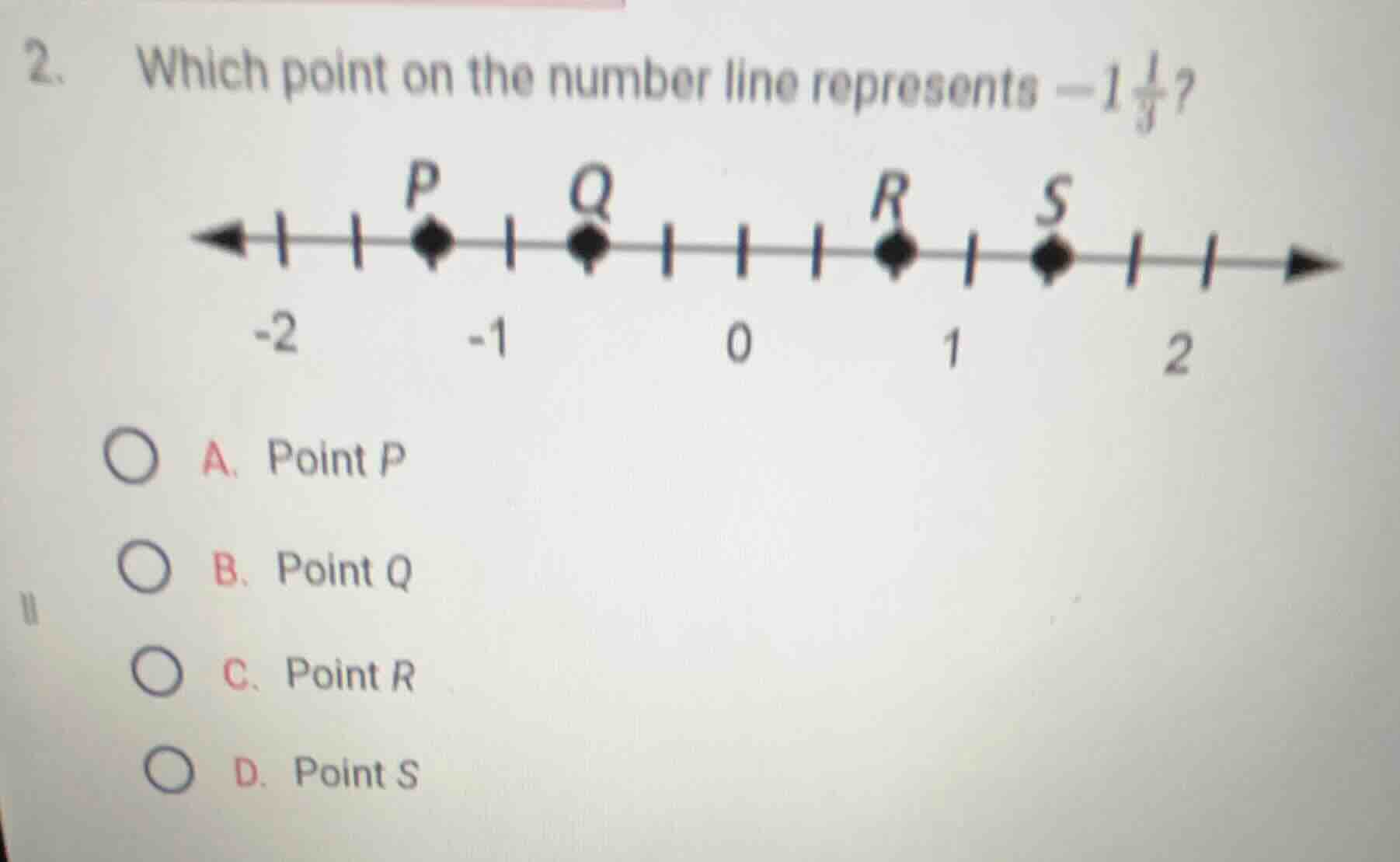
- which point on the number line represents $-1\frac{1}{3}$? number line with points p, q, r, s; options a: point p, b: point q, c: point r, d: point s
Step1: Analyze the number line intervals
The number line has marks between -2, -1, 0, 1, 2. The interval between -2 and -1 is divided into 3 equal parts (since from -2 to -1, there are two intervals, meaning each sub - interval is $\frac{1}{3}$? Wait, no. Wait, from -2 to -1, let's see the points. The distance between -2 and -1 is 1 unit. Let's count the number of segments between -2 and -1. From -2, the first mark is at -2 + 1/3? Wait, no, let's look at the points. Point P is between -2 and -1, closer? Wait, $-1\frac{1}{3}=-\frac{4}{3}\approx - 1.333$. Let's see the positions:
- Point P: Let's see the number line. The interval from -2 to -1: let's assume each small segment is $\frac{1}{3}$ unit. So starting from -2, the first segment: -2 to -2 + 1/3=-5/3≈-1.666, second segment: -5/3 to -4/3=-1.333 (which is $-1\frac{1}{3}$), third segment: -4/3 to -1. Wait, no, maybe the interval between -2 and -1 is divided into 3 equal parts. So each part is $\frac{1}{3}$ unit. So the position of $-1\frac{1}{3}$: we know that -1 is at the right end of the interval from -2 to -1? Wait, no. Wait, -2, then a mark, then P, then a mark, then -1? Wait, the number line has: -2, then a mark, then P, then a mark, then Q, then a mark, then 0? Wait, no, the given number line: the marks are at -2, then a mark, then P, then a mark, then Q, then a mark, then 0? Wait, no, the original number line: the arrows, with marks at -2, then a mark, then P, then a mark, then Q, then a mark, then 0? Wait, no, looking at the number line: the points are P between -2 and -1 (closer to -1? Wait, $-1\frac{1}{3}$ is between -2 and -1? No, $-1\frac{1}{3}$ is greater than -2 and less than -1. Wait, $-1\frac{1}{3}=-\frac{4}{3}\approx - 1.333$. Let's see the positions:
- Point P: Let's calculate the value. If the interval from -2 to -1 is divided into 3 equal parts, then each part is $\frac{1}{3}$ unit. So the first part from -2: -2 + $\frac{1}{3}$=-$\frac{5}{3}\approx - 1.666$, the second part: -2 + $\frac{2}{3}$=-$\frac{4}{3}=-1\frac{1}{3}$, the third part: -2+1 = -1. So the point at -$\frac{4}{3}$ (which is $-1\frac{1}{3}$) is the second mark between -2 and -1? Wait, no, looking at the number line: the marks between -2 and -1: the first mark after -2 is, say, at -2 + 1/3, then -2 + 2/3, then -1. Wait, $-1\frac{1}{3}=-\frac{4}{3}=-2+\frac{2}{3}$. So that's the second mark between -2 and -1, which is point P? Wait, no, let's check the options.
Wait, let's list the values:
- Point P: Let's assume the number line has each small tick as 1/3. So from -2, the ticks are at -2, -2 + 1/3=-5/3, -2 + 2/3=-4/3 ($-1\frac{1}{3}$), -1. So point P is at -4/3? Wait, no, the diagram: the points are P, Q, R, S. P is between -2 and -1 (two ticks from -2: -2, then a tick, then P, then a tick, then -1? Wait, no, the number line as drawn: the leftmost is -2, then a tick, then P, then a tick, then Q, then a tick, then 0? Wait, no, the labels: -2, then a tick, then P, then a tick, then Q, then a tick, then 0? Wait, no, the numbers below: -2, -1, 0, 1, 2. So between -2 and -1: two intervals (so three ticks: -2, tick1, P, tick2, -1). Wait, no, the number of segments between -2 and -1: from -2 to -1, there are two gaps (so three points: -2, middle point, -1). Wait, the distance between -2 and -1 is 1. So each gap is 1/3. So the middle points: -2 + 1/3=-5/3, -2 + 2/3=-4/3 ($-1\frac{1}{3}$). So point P: if P is at -4/3, which is $-1\frac{1}{3}$, then that's the point.
- Point Q: between -1 and 0? No, Q is between -1 and 0? Wait, no, Q is between -1 and 0? Wait, no, the diagram: Q is between -1 and 0? W…

Snap & solve any problem in the app
Get step-by-step solutions on Sovi AI
Photo-based solutions with guided steps
Explore more problems and detailed explanations
A. Point P